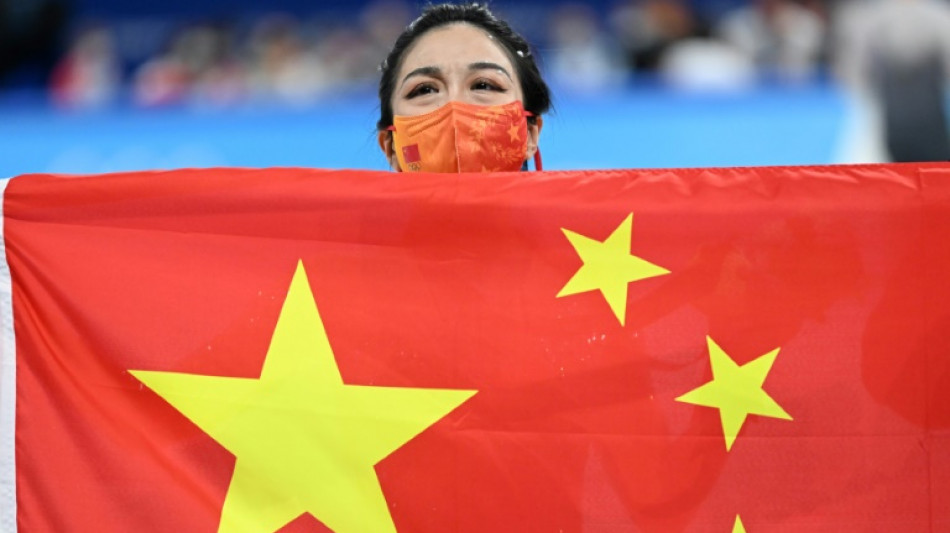
'Not a blockbuster' but Olympics give China plenty to tout

 UK court orders Prince Harry, others to pay Daily Mail £9.5mn
 Aligned Launches $ALIGN, the Native Token of Its Full Ethereum Stack
 Bitcoin jumps, stocks bounce as traders weigh US Treasury action
 Man City boss Maresca hit with Doku injury blow

 Iraola wants to sign wingers to boost Liverpool's attacking options
 Maresca needs time to succeed after 'big changes' at Man City

 Meghan faces difficult return to the UK
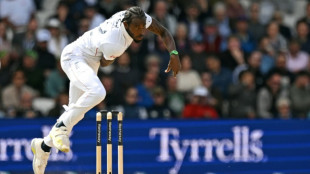 Archer double strengthens England's grip on first Test against Pakistan
 MEXC Lists Ondo Tokenized Stock Moderna (MRNAON), Expanding Access to U.S. Biotech Exposure
 Japan axes Netflix collaboration after outcry over dating show
 Stocks tread cautiously as traders weigh US Treasury action
 STARTRADER Launches XAUUSD247, Extending Gold CFD Access Across the Full Week
 Spurs agree deal to sign Man City's Savinho: reports
 US-sanctioned ICC head warns against 'demise of international rule of law'
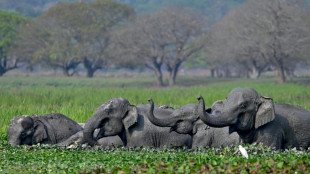 Top India court orders new steps to protect threatened elephants
 Djibouti football federation accused of misusing funds

 Australia charges man with trying to pass Ukraine military intel to Russia
 Ex-Pakistan PM Khan taken back to jail after hospital checks: govt

 China, Indonesia hold talks on security, defence
 Train to nowhere? South Korea's lonely push for peace with the North
 Australia's Hussey mulls role with England for Ashes series
 Indian captain 'scapegoat' in Britain's Russia shadow fleet case, wife says
 Rosenior seeks to match Paris FC's capital ambition as Ligue 1 returns

 Inter set for Serie A title defence as Milan get Amorim reboot
 'Greatest' Springboks face All Blacks in clash of juggernauts
The Beijing Winter Olympics had loomed as one of the most politically contentious in memory and with fears about Covid, but most of that receded once the skis and skates were put on.
The Chinese capital on Sunday wraps up its second Olympics, pulled off with a cold precision and authoritarian muscle that puts it tentatively on the map of winter sports nations and gives its ruling Communist Party plenty to celebrate.
"These were the most politically charged Games coming into them with so many controversies," said Richard Baka, co-director of the Olympic Research Network at Victoria University in Melbourne.
"But we come out of them without much fanfare, partly because China controlled everything quite well."
The United States led a diplomatic boycott over China's rights record, especially allegations of widespread abuses in Xinjiang, and there were fears about the more contagious Omicron variant of Covid.
Chinese authorities had also warned of repercussions if foreign athletes spoke out against Beijing and there were environmental concerns over a Winter Games taking place almost entirely on man-made snow.
But in the end, the episode which tarnished the Games most was a Russian doping scandal that engulfed 15-year-old figure skater Kamila Valieva.
It even snowed so much one day that events were disrupted, while another major talking point before the Games -- the fate of Peng Shuai -- was carefully stage-managed with the tennis player making fleeting appearances.
In November she accused a former vice-premier of sexual assault, but she told the French sports newspaper L'Equipe in Beijing that her allegations had been a "huge misunderstanding". Fears for her safety nevertheless remain.
- Politics enter fray -
International Olympic Committee president Thomas Bach -- who was always unlikely to criticise the hosts -- called it "a very successful Winter Games".
"Here in Beijing it is obvious that the athletes are more than happy," said Bach.
"They're extremely satisfied with the venues, with the (Olympic) villages, with the services being offered and with the safety in the 'closed loop' under these very difficult circumstances under the fast-spreading Omicron variant."
Bach did though reprimand local organisers for bringing politics into the Games when a spokeswoman publicly lashed out at "lies" about Xinjiang.
The Games took place in a Covid-secure "closed-loop" bubble cocooning the nearly 3,000 athletes and about 65,000 others -- the sheer size and its strictness was unprecedented in the pandemic for a sports event and will be a defining memory of the Games.
The restrictions meant no tickets were sold to the public and very limited numbers of spectators were instead hand-picked and sat socially distanced, which led to sometimes flat atmospheres in venues.
In the United States, the IOC's most lucrative television market, ratings were down about 50 percent midway through the Games compared to Pyeongchang in 2018.
- Bread and circuses -
But the Communist Party will overall see it as a job well done that ticks several of its boxes.
With vast resources and manpower, it kept Covid under control thanks to the no-nonsense bubble, playing into China's narrative that its one-party system and "zero Covid" are an example for the world. There were nearly 450 positive cases over four weeks in the bubble, including athletes, but new daily infections were zero towards the end.
Political gestures by athletes over accusations of Chinese genocide against its Uyghur minority in Xinjiang or increasing repression in Hong Kong and Tibet never materialised. Diplomatic boycotts by the US and its closest allies had little impact.
There were no major organisational miscues as Beijing became the only city to host both a Summer and Winter Olympics, and China delivered on at least half of President Xi Jinping's promise of a "safe and splendid" Games.
"It's not been a blockbuster but they're going to get credit for managing this successfully under difficult circumstances," said David Bachman, a China expert at the University of Washington.
The Games allowed China's government to provide a home audience with what Bachman calls the "bread and circuses" of the Roman emperors -– winning over the masses with a spectacle.
- A winter sport country? -
The Communist Party is deeply concerned about maintaining its relevance to a new Chinese generation and its propaganda machine served up a regular diet of fist-pumping patriotism with a dollop of hip, embodied by young stars like US-born freestyle skier Eileen Gu.
"These are compelling dramas and sometimes fantastic performances, and there's nothing like the nature of competition itself to tell its own story," Bachman said.
He added that Gu in particular is gold for China's global soft-power ambitions.
Born to a Chinese mother, she represented the USA but switched to China for the Games and won two of China's nine gold medals.
Olympic hosts routinely enjoy a medal bump and China achieved easily more success than it ever had in the Winter Games.
This is being touted at home as proof that China has stepped onto the podium of "winter sports nations", with the "rich country" connotations which come with that.
Bachman said it also bolsters Xi's push for the "rejuvenation of the Chinese nation" -- the country's Communist Party-led emergence from past war, political chaos and stagnation.
burs-dma/pst
W.Mansour--SF-PST