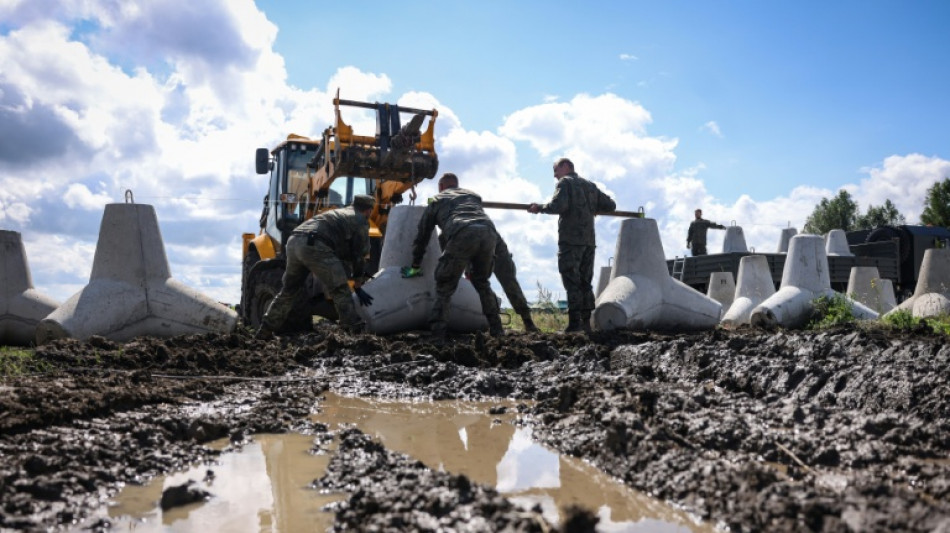
The 'hedgehogs' leading Poland's defences on Russian border / Photo: Anne WEINRICH - BUNDESWEHR/AFP

 Rising Spanish tennis star handed code violation for swearing at ballboy

 Last of the French musketeers Monfils officially retired from tennis

 Ukraine ex-military officer stands trial over Nord Stream sabotage
 British and Irish Lions to play first women's match against France

 Fuel shortage triggers queues on resort island Bali

 Sao Tome's niche vanilla finds far-away fans

 China-North Korea bridge to open Thursday, 12 years late
 Asian stocks mostly down as tech firms struggle to claw back losses

 AI boom drives record sales at Dutch tech giant ASML
 Trump says 'massive' oil, gas, mineral exploration to begin in Greenland

 China heads for record trade surplus as exports surge

 Vietnam mourns 700 war dead in major push to identify missing

 Relentless Swiatek wins all-Polish battle to launch Wuhan campaign

 Seeing pivotal election, Israelis fly from around world to vote

 South Korea's Eom 'racially abused' in England's Championship: club

 Asian markets mixed as tech firms claw back some losses

 India shuts down iconic Delhi protest site after three decades

 Japan urges Russia for 'impartial treatment' of arrested journalist

 Lula, Bolsonaro ordered to call off attempts at online censorship

 EU takes a page from Ireland's AI playbook

 Global deforestation slowed in 2025 but surged in Congo basin: study

 Saudi says Houthi attacks sparked Aramco fire, wounded 4 in Riyadh

 Few buyers for starving cattle in El Nino parched El Salvador

 Bybit Expands Beyond Crypto as CEO Outlines Next Phase of Financial Platform

 Bayern held by Viking after 'super dumb' Olise red in Champions League

Military trucks sped across winding roads through farmland and quiet villages to one of Europe's most strategic borders, separating Poland and the Russian exclave Kaliningrad.
Polish and German soldiers worked for five weeks at the frontier to dig trenches, lay barbed wire and place long lines of concrete barriers known as "hedgehogs" across the landscape.
The work is part of Poland's "Eastern Shield" -- a programme started in 2024 aimed at securing Poland's and NATO's borders with Russia and Belarus.
It includes the construction of fortifications, equipment depots, as well as reconnaissance and anti-drone installations.
Poland, a member of NATO and the European Union, is one of the alliance's highest military spenders -- allocating about five percent of its GDP on defence. Securing the 210-kilometre (130 mile) border with Russia has become a priority.
According to Defence Minister Wladyslaw Kosiniak-Kamysz, around 10 billion euros ($8.5 billion) have been allocated to the project.
A German major at the site, who only gave his first name Martin, told generals visiting the area that it had looked "totally different" before the work started.
"Today, right now, is the time to close these gaps," he added.
"It was a huge logistical challenge," Jakob, another German soldier, told AFP.
- Deterring Russia -
The former swamp, made muddy by recent rains, is a natural deterrent for potential invaders.
By combining nature with military technology, Polish forces and their allies hope to deter any Russian threat, as the war in neighbouring Ukraine heads for a fifth year.
Thousands of concrete tetrapod "hedgehogs", designed to slow or stop armoured vehicles, now line the border. They were placed in rows by tractors and soldiers.
In the village of Budry, cows and horses grazing in the rolling fields give little hint of the heavily militarised Kaliningrad exclave next door.
The Russian territory, which borders Poland, Lithuania and the Baltic Sea, is bristling with weaponry, fighter jets and Iskander missiles capable of striking European targets.
The number of Russian soldiers deployed in Kaliningrad is unknown, but military analysts estimate around 20,000-30,000 before the 2022 invasion of Ukraine.
The Russian Baltic Fleet conducted military exercises in Kaliningrad in June.
"They know what they see, but they don't know what we plan to do with it," Polish Lieutenant General Stanislaw Czosnek told troops.
"We will secure over 200 kilometres of Poland's border at those most sensitive points which are relevant to the conduct of a potential defensive operation," junior defence minister Cezary Tomczyk said of the Eastern Shield project.
Describing it as a "multi-layered system," he added that Poland was purchasing several hundred thousand mines "to be deployed in the event of a defensive operation".
"Polish armed forces can mine the entire eastern and northern border of the Republic of Poland within 48 hours," he added.
- Polish-German cooperation -
For some in Poland, notably the conservative-nationalist opposition, the presence of German forces has been controversial. The northeastern border region was once German territory.
Devastated by Nazi Germany's forces during World War II, Poland has significantly improved relations with its Western neighbour since entering the EU and NATO, but some historical conceptions of Berlin remain.
But the two countries, which in June signed an enhanced cooperation agreement regarding military mobility, logistics, Baltic Sea security, and cybersecurity, emphasise such cooperation is necessary to ensure peace.
In December, Poland and Germany revealed that a number of German troops would be deployed from mid-2026 until the end of 2027 to support Eastern Shield.
From October, French and Polish soldiers, along with elements of the US Army and British groups, will also take part in border-securing activities, the generals said.
"I believe that defending our bilateral ties will be essential in ensuring long-term stability and security in the region," Lieutenant General Czosnek told journalists.
"As Germany and Poland, we are NATO, we are friends, and we are allies," said Major General Tilo Maedler, Chief of the Bundeswehr Joint Force Command.
S.Abdullah--SF-PST