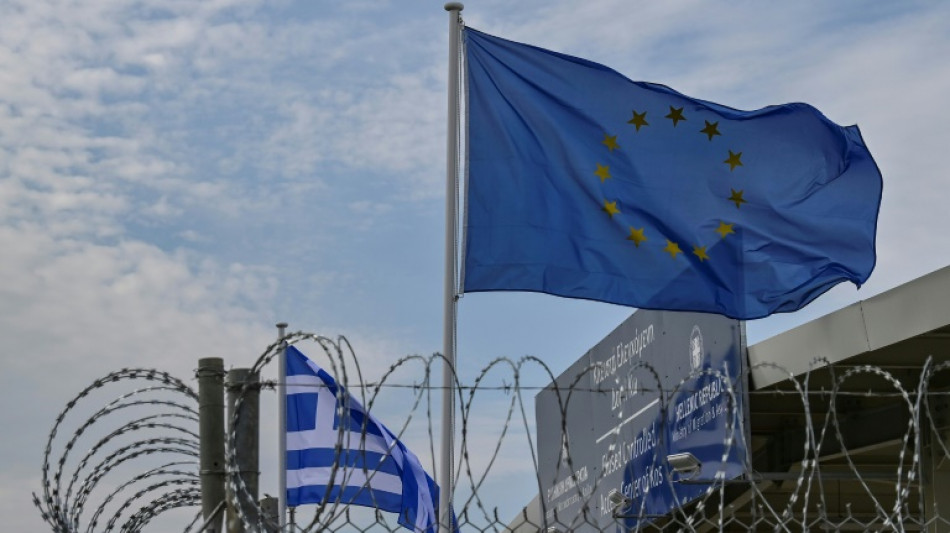
Migrant groups decry 'witch-hunt' as Greece tightens grip
/ Photo: ARIS MESSINIS - AFP/File

 Sweden centre-left leader fails to form government

 EU economy chief doubtful Russian diesel exports will affect prices

 Capital International Highlights Multilingual Access to Its Platform as European Economic Conditions Diverge

 Hazlewood takes six as Australia win first Test

 Pope Leo admitted to hospital for lung operation

 Hungary cuts anti-LGBTQ measures from Orban-era law

 Tech stocks slump on AI jitters; oil falls

 ePlanet Brokers Publishes H1 2026 Transparency Report and Highlights Best Broker 2026 Award

 Van Gogh work unseen in public for 60 years on show in Hong Kong

 Prosecutors drop most impeachment charges against Philippine VP Duterte
 Hypersonic weapons highlight arms race on the Korean peninsula

 Fiji appoint ex-Springboks boss White as coach ahead of World Cup

 Hungary to reverse Orban-era anti-LGBTQ legislation

 Allen rushes Bills to thrilling 37-34 win over Rams

 India youth shift tactics as police clamp down on election protest
 Malaysia's Firefly extends flight cancellations due to haze

 IMF upgrades 2026 growth forecast but warns of 'split' outlook
 Infantino could pull off 'Houdini' act as critics struggle for candidate

 France braces for fresh nationwide student demonstrations

 Ahead of Israel vote, desert town becomes frontline against ultra-Orthodox expansion

 El Nino Watch: the impacts around the world this week

 Man City, PSG clash at contrasting time for state-backed projects
 Digi Power X Announces $200 Million Debt Financing Commitment to Support Completion of Alabama AI Data Center and Provides Expansion Update

 'Breaking Bad' actor RJ Mitte dead: representatives

 Former DR Congo president Kabila forms new force with M23 armed group
When dozens of Syrian asylum seekers were stranded on the Greek-Turkish border in July, lawyer Evgenia Kouniaki never imagined taking on their case would lead to her quitting her NGO in protest at perceived government pressure.
But in a country determined to reduce migration from neighbouring Turkey, rights groups are facing increasing hostility with some campaigners stepping away from the struggle.
Kouniaki told AFP there was once up to ten people in Evros region helping victims of controversial "pushback" tactics allegedly used by Greek border forces to return migrants to Turkey. Athens denies their use.
"Now we are fewer and fewer," she said complaining that she has received less legal work because of her involvement in the sensitive case of the Syrian migrants.
Some 50 humanitarian workers are currently facing prosecution in Greece, following a trend in Italy which has also criminalised the provision of aid to migrants.
"Greek authorities are engaging in a witch-hunt targeting refugees, but also their defenders," sixteen rights groups said last month.
The organisations, which included prominent NGOs Refugee Support Aegean, the Greek Council for Refugees and the Greek League for Human Rights, called on the country's authorities to stop "undermining and demonising" migrant support groups.
Despite in-depth investigations by media and NGOs, alongside abundant testimony from alleged victims, Greek authorities have consistently denied pushbacks.
Greek officials have meanwhile kept up verbal attacks on asylum support groups.
"As a Greek... I will not work with NGOs that undermine the national interest," deputy migration minister Sofia Voultepsi told state TV ERT in September.
Greece's conservative government, elected in 2019, has vowed to make the country "less attractive" to migrants.
- Border wall -
Part of that strategy involves extending an existing 40-kilometre (25-mile) wall on the Turkish border in the Evros region by 80 kilometres.
An additional 250 border guards are to be deployed in the area by the end of the year.
But at the Evros River itself, the natural border between Greece and Turkey, refugees continue to make their way to Europe.
Humanitarians rarely have access to the militarised area, patrolled by police, Greek soldiers and European border control agency Frontex.
In July, two lawyers were accused of facilitating the illegal entry of migrants while trying to file asylum applications for two Iraqis and five Turks.
In August, the Vienna-based rights group Josoor said Athens was making "immense efforts" to link them to illegal smuggling, filing three cases against them that did not result in convictions. The group ceased operations in October.
"There are very few NGOs left in Greece," Migration Minister Notis Mitarachi told Skai TV this week.
"Among those operating (at the height of the migration crisis) in 2015-2019, the great majority have left the country on their own accord," he said.
Kouniaki's then-group, HumanRights360, was embroiled in a row after assisting the 38 Syrian asylum seekers stranded on an Evros River islet for several days.
The asylum seekers claim that a five-year-old girl died from a scorpion sting during this time.
But Athens has sought to disprove the claim, and has since tried to discredit the aid workers who came to help them.
HumanRights360's manager did a U-turn after initially claiming the islet was Greek, which would have made the migrants Athens' responsibility, eventually saying publicly it was Turkish.
Many of the NGO's staff including Kouniaki quit in protest at the about-face, insisting HumanRights360's hand had been forced by the government.
- 'Toxic' rhetoric -
"We have had to deal with dozens of similar situations... but this high-profile case embarrassed the government," said Kouniaki, who was denied access to the northern Greek camp where the Syrians were later taken.
Athens has taken steps to control the work of migrant groups, arguing regulation is necessary because they encounter vulnerable people.
New registration requirements were imposed in February 2020. In September 2021, a new law criminalised charities undertaking sea rescues without the approval of the Greek coastguard.
Critics warned the new regulations would impair services to thousands of vulnerable people.
The Council of Europe Commissioner for Human Rights Dunja Mijatovic last year warned the law "would seriously hinder" the NGOs life-saving work and monitoring.
Anti-NGO rhetoric became "toxic" from February 2020 when Turkish President Recep Tayyip Erdogan said he would allow asylum seekers aiming for the EU to cross Turkey's borders, said Lefteris Papagiannakis, director of the Greek Council for Refugees.
"Athens accuses Ankara of instrumentalising refugees and using them to destabilise Greece. As a result, the NGOs that defend them are described in public discourse as agents of Turkey," said Papagiannakis.
The UN's Special Rapporteur on Human Rights Defenders Mary Lawlor said in June there was "increasing criminalisation of humanitarian assistance" in Greece.
She also criticised "hostile comments" towards human rights defenders who "are described as traitors, enemies of the state, Turkish agents, criminals and smugglers and traffickers" -- sometimes by key government figures.
A.AbuSaada--SF-PST