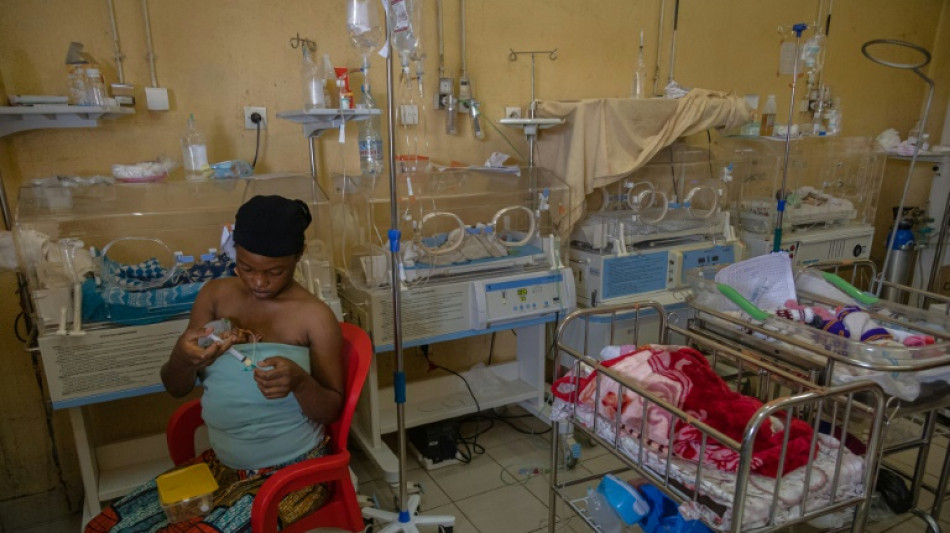
Skin-to-skin contact key for premature baby survival, WHO says in shift / Photo: Daniel Beloumou Olomo - AFP/File

 Demonstrations backing France's protesting students gather strength

 Trump says US Senate as hard to defend as House in midterms

 Suspected Russian drones hit two ships off Bulgaria, 11 missing

 Tech stocks slide on AI jitters

 Trump asks Greece ambassador to resign amid ethics scandal

 New White House spokeswoman heavy on Trump praise, light on questions in debut

 Emery urges Villa to make most of reduced home comfort

 Flavio Bolsonaro visits father under house arrest ahead of Brazil runoff

 France, Eq. Guinea in standoff over luxury Paris mansion

 'Holding our ground': Israel demolishes dozens of Bedouin homes

 Hazlewood takes six as Australia beat South Africa in 1st Test

 Saudi coalition tells Sanaa residents to flee site before operation

 Zverev defies 'physical issues' to reach Shanghai Masters quarter-finals

 'We're not giving up': Activist Thunberg joins France student protests

 Man City captain Dias defends celebrations after Liverpool win

 B2PRIME Expands Tier-1 Access and Liquidity Architecture for Sophisticated Institutional Flow

 STARTRADER Adds 48 US Stock CFDs with 24-Hour Weekday Trading

 'Ink' director Danny Boyle slams Trump's Truth Social 'lies'

 Coach Kovac extends contract at Dortmund until 2029

 Activist Thunberg joins France student rally after violence at protests

 Archer and Bethell in England squad for Australia ODI series

 Formula One to return to Africa in 'early 2030s' in Rwanda

 US actor Selma Blair charged with assault after alleged flight altercation

 Hungary cuts anti-LGBTQ legislation from Orban-era law

 'Our future is being robbed': Greta Thunberg joins France student protests

Skin-to-skin contact is key to improving survival of premature and small babies, the WHO said on Tuesday in a major overhaul of policy that previously called for the use of incubators.
The new guidelines mark a major turnaround in the way the UN health agency recommends neonatal intensive care be provided to tiny babies.
Allowing mothers or other caregivers and preterm babies to remain close from the start, without separation, boosts the chances of survival, Karen Edmond, a World Health Organization medical officer and paediatrician, told reporters in Geneva.
"The first embrace with a parent is not only emotionally important, but also absolutely critical for improving chances of survival and health outcomes for small and premature babies," she said.
The new guidelines for how to treat babies born before 37 weeks of pregnancy or under 2.5 kilogrammes (5.5 pounds) applies in all settings, WHO said.
Immediate skin-to-skin contact should be provided "even for babies who are unwell with breathing difficulties," it said, insisting: "they too need the close contact with their mother from birth."
Previously, the WHO had said that "unstable" newborns weighing less than two kilos at birth should be placed in incubators.
The WHO describes prematurity as an "urgent public health issue," with an estimated 15 million babies born preterm each year -- accounting for one in 10 births.
With its update Tuesday, the UN agency provided 25 recommendations on care of premature babies, including 11 that were new since the last update in 2015.
The guidelines cover things like nurturing care, care during illness, and stressing the importance of breastfeeding premature babies.
And for the first time ever, the guidelines also include recommendations on family involvement, including a call for intensive care units to restructure to allow the mother and baby to stay together.
It is important, Edmond said, to keep "the baby in skin-to-skin contact 24/7 even if the baby needs to be in... intensive care."
The guidelines also propose for the first time that increased emotional and financial support be given to caregivers of preterm babies.
"Parental leave is a must to help families care for the infant," Edmond said, adding that caregivers of preterm babies should be offered sufficient financial and workplace support, as well as home visits after discharge.
F.AbuShamala--SF-PST
