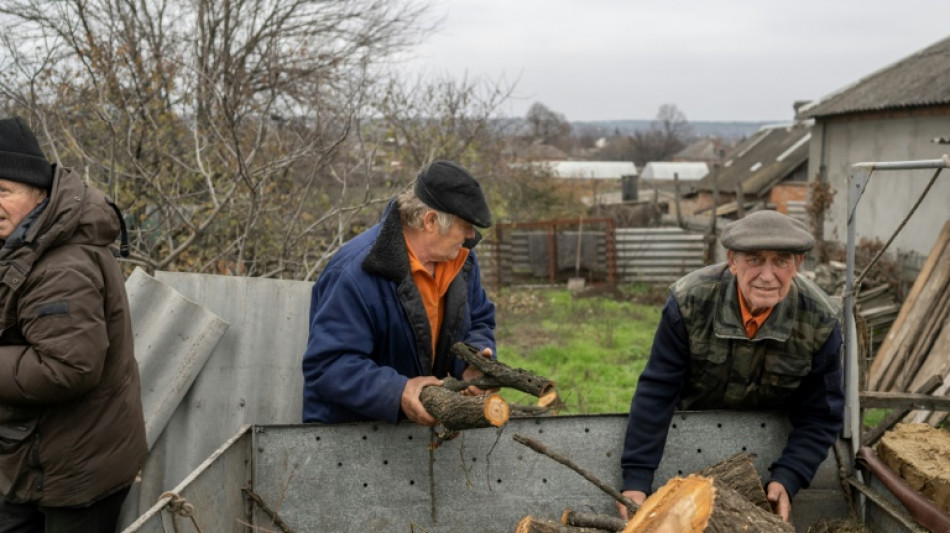
War-weary Ukraine residents chop wood to 'survive' winter / Photo: BULENT KILIC - AFP

 Judge extends halt to Trump's golf course tree-cutting

 Milan's Saelemaekers set for lenghty spell out after ankle surgery

 Nvidia says to invest in French medical website

 Real Madrid's Mourinho has 'trust' in referees despite complaints

 Mendis, Shanaka star in Sri Lanka consolation T20I win

 Demonstrations backing France's protesting students gather strength

 Trump says US Senate as hard to defend as House in midterms

 Suspected Russian drones hit two ships off Bulgaria, 11 missing

 Tech stocks slide on AI jitters

 Trump asks Greece ambassador to resign amid ethics scandal

 New White House spokeswoman heavy on Trump praise, light on questions in debut

 Emery urges Villa to make most of reduced home comfort

 Flavio Bolsonaro visits father under house arrest ahead of Brazil runoff

 France, Eq. Guinea in standoff over luxury Paris mansion

 'Holding our ground': Israel demolishes dozens of Bedouin homes

 Hazlewood takes six as Australia beat South Africa in 1st Test

 Saudi coalition tells Sanaa residents to flee site before operation

 Zverev defies 'physical issues' to reach Shanghai Masters quarter-finals

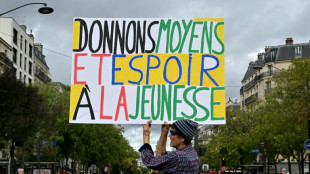 'We're not giving up': Activist Thunberg joins France student protests

 Man City captain Dias defends celebrations after Liverpool win

 B2PRIME Expands Tier-1 Access and Liquidity Architecture for Sophisticated Institutional Flow

 STARTRADER Adds 48 US Stock CFDs with 24-Hour Weekday Trading

 'Ink' director Danny Boyle slams Trump's Truth Social 'lies'

 Coach Kovac extends contract at Dortmund until 2029

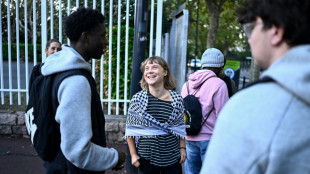 Activist Thunberg joins France student rally after violence at protests

In the eastern Ukrainian town of Siversk, Valery drives a chainsaw through a tree trunk, like many others in the war-ravaged region stocking up for a cold winter.
"We try to survive thanks to wood," says the 39-year-old, who stayed behind to look after his mother after his wife and children fled to the capital.
"A basement (to hide from Russian strikes), a stove and wood -- that's all we have," he says, not giving his surname.
Russian forces who invaded Ukraine in February pounded the district with missiles and rockets this summer, and unsuccessfully tried several times to capture it.
Though the town has so far held out, its heights and eastern flank have been disfigured by the strikes, and deep craters have been etched in the earth.
In one square, buildings including a school has been severely damaged.
Only a handful of the town's pre-war 12,000 residents remain today, battling life without gas or electricity.
"There's nothing else to do, so we chop down the trees as much as possible. There are lots here, so it should be enough" for the winter, Valery says.
- Wine before bed -
The front line lies in a semi-circle, some 10 to 15 kilometres (6 to 9 miles) to the east of the town.
The constant to and fro of artillery fire between Ukrainian and Russian forces resounds throughout near-abandoned town.
"The only way to get through it is to drink wine before sleeping," Valery says.
"I'm stressed, it's difficult to cope."
Alla, a 68-year-old doctor who also stayed behind, says she helps distribute humanitarian aid from the local authorities and church when it arrives.
"There are also volunteers who bring in food for the animals" left behind to roam the town, she says.
The physician says the fighting has destroyed her flat and one of her two houses in Siversk.
She has moved all the firewood from the destroyed house to the surviving one where she lives with her husband.
Suddenly, a blast makes her jump.
"There goes the Vasilek," she says, as Ukrainian soldiers fire their Soviet 2B9 Vasilek mortar gun in the direction of Russian positions.
"It's hard to get used to all this firing," she says.
"But it's our choice. We stayed here, so we're trying to deal with it."
- No phone signal -
The main problem, she says, is the lack of communication with the outside world.
"We don't have a telephone signal. We did before, but not anymore. It's hard to reach someone," she says.
With no power in the area, residents have had to adapt to daylight hours, which end at around 5:00 pm.
"It gets dark early so we go to bed early. And we wake up early. That's how we live," she says.
In the town's heights, Volodymyr, Victoria and Mykola chat at the bottom of the building where they live.
Axe in hand, Volodymyr is dicing up log for an outside oven.
"We chop up wood, put it in the oven and cook the buckwheat," he says, adding it's warmer outside near the stove than inside his unheated flat.
Sitting on a bench in a woolly blue hat and with her hands stuffed into her jacket pockets, Victoria grumbles.
"I live next door and we were put on the list to receive wood. They (the local authorities) took our names three months ago, but still we haven't received anything," she says.
"So we decided to find some ourselves."
At least they receive some humanitarian donations.
"Without them, it would be difficult," she says.
S.AbuJamous--SF-PST