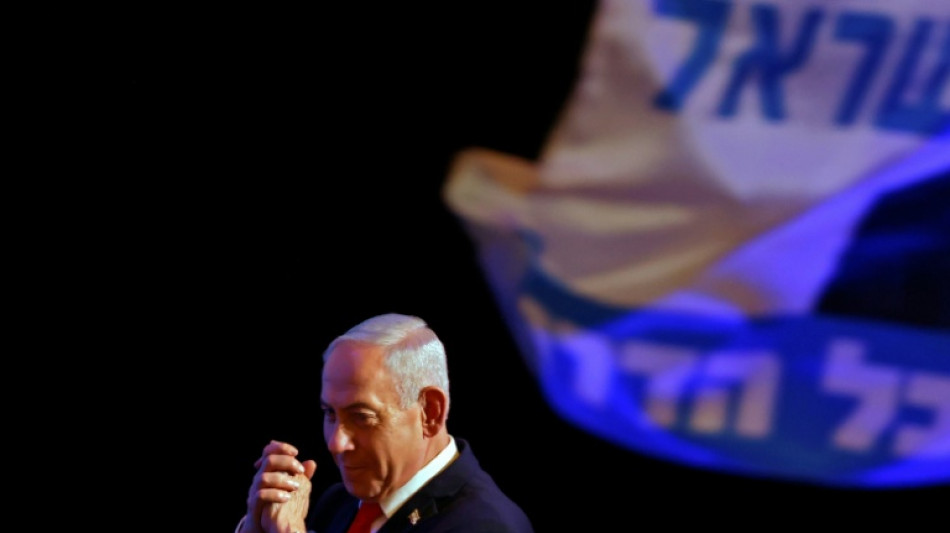
Netanyahu bloc leads after half of Israeli votes counted but no majority / Photo: Jalaa MAREY - AFP

 China says takes Mbappe apology 'seriously' after Mao remark

 Flavio Bolsonaro on way to Ecuador from Argentina after fleeing Brazil

 Netanyahu bloc leads after half of Israeli votes counted but no majority

 India vows action after first cheetah shot dead

 'Now or Never': Ethiopia influencers push for Eritrea invasion

 Mbappe furore rages on in China, but Mao comments censored

 Billionaire Ambani's Jio jumps 21% in market debut after record India IPO
 Rays win thriller to thwart Brewers in World Series

 Reigning champ Knicks earn first win against Pistons

 Runners swap streets for shopping malls as haze chokes Singapore

 Billionaire Ambani's Jio to debut after record India IPO
 UK set for cautious budget as borrowing costs climb

 Anthropic's record IPO faces some big questions

 US Fed expected to hold rates steady ahead of key midterm elections

 Can this Latin Grammy-winner help Democrats win back Congress?

 Tuvalu has 'limited' power to halt its fossil fuel investments: NZ govt papers seen by AFP

 Palestinian activist Khalil returns to Columbia after US detention

 Trump drastically loosens oil and gas methane rules

 French Senate weighs bill to make protesters pay for unrest damage
 الأردن يعلن القبض على ثلاثة متهمين بهجوم كنيسة الكرك

 استقالة رئيس ونائب رئيس وعضوين من مجلس إدارة يونيكاي للأغذية
 Charles tackles thorny legacy of slavery on Caribbean trip

 Arsenal stunned by fourth-tier Fleetwood in League Cup

 افتتاح وقف المحميد في دبي لدعم الأسر محدودة الدخل والحالات الإنسانية

 Brazil's Flavio Bolsonaro flees to US after election loss
The camp of Prime Minister Benjamin Netanyahu was ahead of his rival's opposition bloc but still short of a majority on Wednesday after 50 percent of votes were counted in Israel's pivotal general election.
Voters turned out in the highest numbers in decades to give their verdict on Netanyahu, Israel's longest-serving prime minister who has pushed the country sharply to the right and unleashed a wave of wars in response to Hamas's October 7, 2023 attack.
Following the vote, both Netanyahu and his rival Gadi Eisenkot vowed to form a government despite neither being projected to win a majority.
After 51.8 percent of ballots were counted, Netanyahu's bloc was shown to have 55 of the 120 seats in the parliament.
Eisenkot's opposition bloc had 49 seats and the Arab parties 16. The partial results are likely to change as more votes are counted.
Exit polls had shown that Eisenkot, a former military chief and political novice, and his opposition bloc were neck-and-neck with Netanyahu's hard-right camp, with both winning about 51 seats, well away from the threshold for a majority in parliament.
The strongest gains came from Arab Israeli parties whose voters turned out in soaring numbers against Netanyahu, who has relentlessly warned that the minority would dilute the Jewish nationalist direction in which he has taken Israel.
The partial results suggest that Eisenkot's bloc would have enough seats for a majority if there was a coalition agreement with the Arab parties.
But Eisenkot said during the campaign he would not govern with Israeli Arab lawmakers, echoing the position of Netanyahu, who has suggested a government relying on Arab votes would lack legitimacy.
Arab lawmakers could also give Eisenkot support in parliamentary votes to maintain a minority government without joining a coalition.
A lack of clear majority for either camp could mean weeks spent trying to cobble together coalitions, with possible new elections on the horizon if negotiations fail.
A stalemate could in the immediate term benefit Netanyahu, who would remain caretaker prime minister until a new government is formed.
Full results are expected by Thursday evening or Friday morning.
Netanyahu, greeting cheering supporters at a Jerusalem convention centre after 3 am (0100 GMT) on Wednesday morning, called for a "strong government of the right" and said the "Jewish and Zionist majority must unite".
The 77-year-old prime minister, who has governed Israel on and off for nearly two decades, was unusually brief and did not directly claim victory.
US President Donald Trump told reporters on Wednesday that his endorsement of Netanyahu had helped the premier "a lot".
- 'Public voted for change' -
Speaking to supporters in Tel Aviv, 66-year-old Eisenkot issued a veiled warning to Netanyahu, who observers say could use a war to push for a unity government.
"Netanyahu, don't you dare use Israel's security for your political needs," Eisenkot said.
He called Netanyahu "a caretaker prime minister, without a mandate or the people's trust".
The vote came as Israel looks increasingly isolated on the world stage, driven by the war in Iran and the military campaign in Gaza, as well as soaring settlement construction and violence against Palestinians in the occupied West Bank.
Eisenkot shares many of Netanyahu's views on security and has backed the Gaza offensive that has reduced the territory to rubble.
After a turnout of nearly 78 percent, the highest since 1999, Eisenkot said it would be a mistake to hold a second election and vowed to work "swiftly" to form a government.
"The public has voted for change," he said. "A worthy leader would accept the people's vote of no confidence and announce his retirement from political life today."
Exit polls had shown Israeli Arab lists projected to win 18 or 19 seats, a sharp gain.
Arab Israelis, also known as Palestinian citizens of Israel, account for about 21 percent of the country's population.
E.Qaddoumi--SF-PST