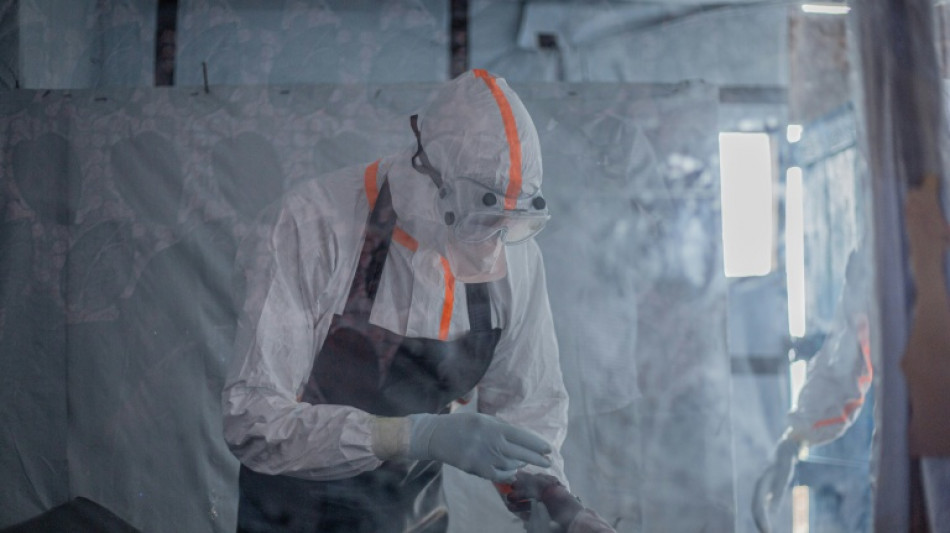
WHO says needs 5,000 more healthworkers to tackle Ebola in DRC / Photo: BENEDICTION MURHABAZI - AFP

 South Africa economy shrinks ahead of local elections

 CapTLX Expands Institutional-Oriented Platform for Access to U.S. Capital Markets
 UK's Prince George starts at Eton College
 French far right keeps guarded silence over AfD Germany triumph
 Russia-Ukraine talks possible this month, Zelensky says, as Moscow pounds Kyiv
 Turkish Airlines will be new Liverpool shirt sponsor in £300 mn deal
 On London's Brick Lane, a data centre sparks local battle
 Nepal flood death toll rises as rescuers scour tunnels
 France's Mistral sees value soar with 3 bn euro cash infusion

 Nepal glacier saw exceptional heat before collapse caused deadly floods: researcher

 Ethiopia boosts drone production to fight rebels
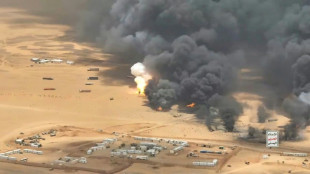 Yemen rebels hit Saudi Arabia with wave of strikes, wounding 73
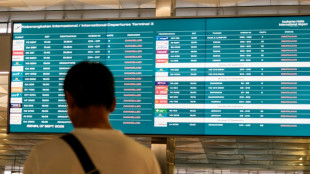
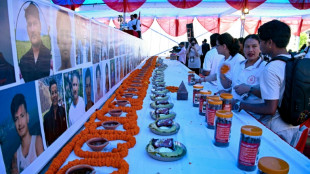 Nepalis mark a year since deadly protests that toppled government

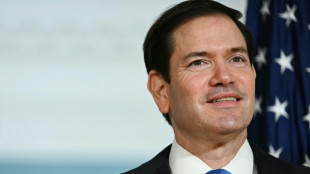 Rubio launches Latin America tour to cement US influence
 France tries 14 over deadliest Channel migrant crossing disaster

 Australia threatens hefty fines if big tech fails 'duty of care'
 Zverev romps into quarter-finals as Darderi downed
 Kauai on tornado watch as Hurricane Lowell nears Hawaiian islands
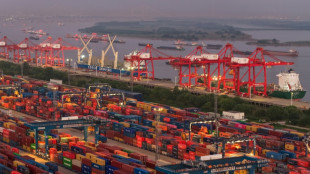
 Pakistan roll the dice in search of consolation win over England

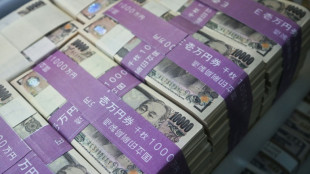 Yen extends gains as traders eye rate hike, tech rallies again
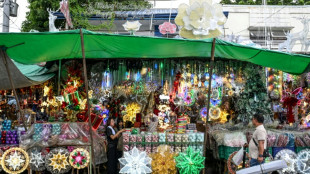 'The ber months': Christmas arrives early in the Philippines
 N. Korea calls Russia bridge a sign of tighter ties

 US sanctions threaten to crush Iranian students' dreams
 Former champ Gauff holds off Jovic to reach US Open quarter-finals

 A New Force in the Surf Park Economy

The World Health Organization (WHO) said on Tuesday it needed 5,000 extra health workers to help tackle the highly contagious Ebola virus in the Democratic Republic of Congo (DRC).
The outbreak, officially detected in mid-May, has spread to six provinces in the country's conflict-plagued east and northeast.
Since May 15, the virus has killed 3,175 people among the more than 6,600 confirmed infected, the WHO said, citing official Congolese figures.
Health services lack sufficient staff and resources and have been overwhelmed by the surge in cases of Ebola, which is transmitted through contact with bodily fluids and can cause severe internal and external bleeding and organ failure.
The WHO said it hoped to create 3,000 beds for patients in Ebola treatment centres in the DRC.
With three medical staff needed for each patient, that means training 9,000 health workers, said Luca Fontana, a senior technical official with the United Nations' health agency.
"More than 900 beds have been built within the first two months of the response and we have now reached close to 1,400 beds across 59 treatment centres," he told a press briefing in Geneva.
"Despite this extraordinary effort, we estimate that another 1,600 beds will be required to meet the rapidly growing needs," he continued.
"Right now we have nearly 4,000 healthcare workers currently working inside the treatment centres. So it means we need 5,000 more."
Fontana said the health ministry in Kinshasa was racing against time to find suitable medical staff in other regions to bring into the Ebola-affected provinces.
"The problem is to identify those fast enough to make sure that we can cover the growing need," he explained.
"Every treatment centre that is fully staffed and functional means more life saved and a stronger chance of bringing this outbreak under control."
The current Ebola epidemic is caused by the Bundibugyo strain, for which there is currently no approved vaccine or treatment. Several treatments and vaccines are being tested.
It has hit regions in the north and east where the presence of the state is weak, health infrastructure is largely lacking and myriad armed groups have roamed for decades.
Fontana said that while in the initial stages, most patients admitted to treatment centres came from Bunia, the capital of Ituri province, sick people were now arriving from villages "far beyond" the epicentre.
This was "a clear sign" that the outbreak is spreading and the WHO response "must adapt", he stressed.
Ebola has killed more than 15,000 people in Africa in the last 50 years.
The worst outbreak previously recorded in DR Congo killed nearly 2,300 people of the 3,500 reported infected between 2018 and 2020.
Q.Najjar--SF-PST