
World Bank chief economist warns of hunger risk from war in Iran / Photo: Kent NISHIMURA - AFP

 St. Louis City's unbeaten MLS run ends at 19, Union's reaches 15

 NFL Eagles bench Hurts at least a month with blood clot

 Across US, 'No Kings' events seek to boost early voting

 Tents spring up in Lisbon as Portugal housing protests spread
 'Best in world' Yamal powers Barca to Betis rout, Atletico strike late

 El Salvador's Bukele puts conditions on early release of gang prisoners
 Fire rages at town hall in France's Limoges after protests: authorities

 Unstoppable Barca thrash Betis to extend perfect start

 Maresca faces anxious wait over Haaland injury scare

 PSG fight back to beat Strasbourg after Dembele penalty miss

 Looting, blazes and clashes in France amid nationwide protests

 Walsh breaks her own 50 free world short course record

 Haaland brace extends Man City's winning start in Premier League

 'Special' Ombudsman storms to victory in Champion Stakes

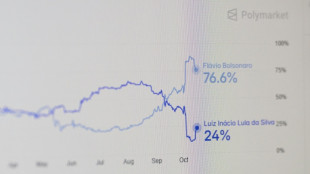 Brazil's right embraces election betting odds amid polls skepticism

 Four more Ebola cases detected in Kenya, bringing total to seven

 Clashes erupt in France as protesters vow to make government 'tremble'

 Chwalinska downs Swiatek to set up Wuhan final with world number 170 Kartal

 Chacarra takes lead as McIlroy falls away in Delhi

 Neto double gives Chelsea win marred by Martinez injury

 'Cockroach' party founder released from Indian police custody

 Nepal floods 'defining moment' for climate action: UN
 Albanian capital sees fifth straight day of violent clashes

 Leaders weigh 'huge benefit', risks of AI for global economy

 Zverev stunned by Davidovich Fokina in Shanghai semi-finals

The conflict in the Middle East could push millions more towards hunger as its economic fallout reverberates further around the globe, the World Bank's chief economist warned in an AFP interview on Wednesday.
"You have about 300 million people who suffer from acute food insecurity already," Indermit Gill said. "That'll go up by about 20 percent very, very quickly," as knock-on effects grow.
Gill spoke on the sidelines of the International Monetary Fund-World Bank Spring Meetings in Washington.
The blocking of the Strait of Hormuz, a key oil supply route, has sent fertilizer prices soaring since they rely on oil-based inputs.
Higher prices for fertilizers, which are used in agriculture, may entice countries to halt food exports and hoard more food for themselves, further driving up food prices.
"Those export bans scare us massively," Gill told AFP.
Most exposed are people in countries that are at war or have fragile governments.
If the situation isn't resolved soon, "hunger will start to stalk these countries massively."
Currently, the shortage of petrochemicals and their economic effects are being most felt in Asia, Gill explained, but "as the crisis gets longer, it's very rapidly going to spread first to Africa."
"The food that's in the market right now has already been grown," Gill said, but the real effects could be felt in a few months.
- Lower growth, higher inflation, more expensive debt –
Low-income people across the world tend to spend a larger share of their earnings on basic needs like food and fuel.
"If you get inflation in, especially in the kind of things that the poor consume relatively more often, that inflation is going to hurt massively," Gill went on.
Gill also warned that inflation – not just in food prices – could rise from about 3 percent globally to as much as 4.7 percent this year, in the most extreme scenario where the conflict stretches to August.
At the same time, global growth could be cut by as much as 40 percent on a yearly basis, if the crisis drags on.
Higher inflation mixed with lower growth would be a "double whammy" for the debt sustainability of poor countries, further hindering their ability to deal with this and future crises.
Gill warned that many headline figures for regional growth may appear too rosy, as the massive US, Chinese, and Indian economies, which are generally more insulated from external shocks, tend to drag up estimates.
When you remove them from the estimates, "you start to see a lot more vulnerabilities," Gill said.
"And by the way, that extreme scenario, with every passing day, is not that extreme of a scenario -- because we're getting closer and closer to August."
K.Hassan--SF-PST