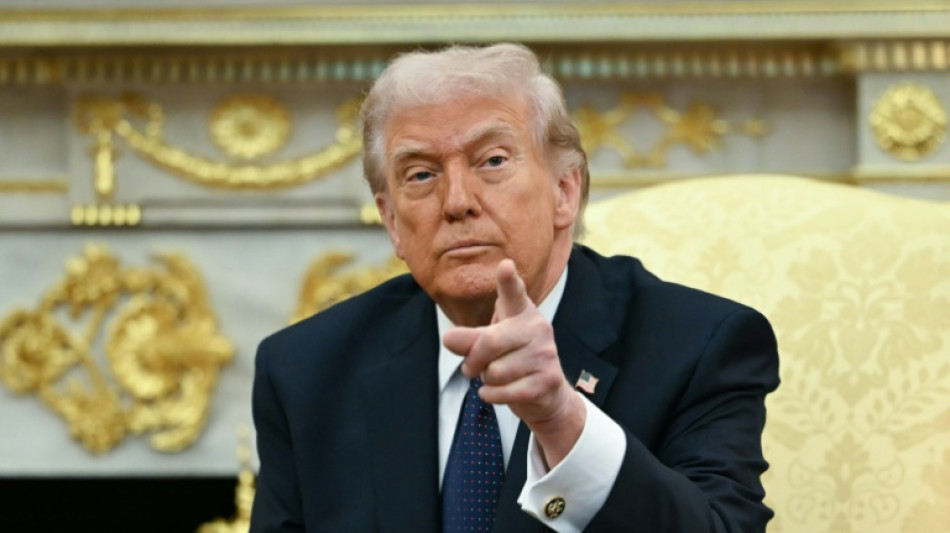
Trump says US Navy could escort tankers, Iran aimed to strike first / Photo: ANDREW CABALLERO-REYNOLDS - AFP

 Australia's new Ghost Shark submarines grow some 'teeth'

 'I call it a bribe': Pennsylvania residents spurn $10,000 data center checks

 In a former US steel city, ordinary people struggle to get by

 'Liar,' 'clown': Lula and Bolsonaro spar in Brazil poll debate
 Record El Nino? Depends who's counting
 On the front line of ocean conservation off Portugal's Madeira

 Wembanyama targets title breakthrough as NBA season tips off

 With LeBron on board it's title or bust for Philly fans
 One year after Louvre heist, where are the missing jewels?

 Knicks face tall task in NBA championship repeat bid
 Warriors' Curry 'fine' after limping out of practice - Kerr

 Zelensky speaks to US envoys as Trump lashes out
 'Surprise package' Lazio crush Juve to keep pace with Serie A leaders Inter
 China growth expected to miss official target in third quarter
 Lazio crush Juventus to move level with Serie A leaders Inter

 Leeds draw feels like 'fresh start' for Man Utd's Carrick
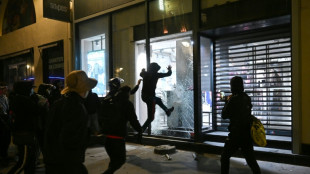
 Macron denounces 'unbridled' violence as France hit by new clashes

 Hurzeler lauds 'hard worker' Gomez after Brighton goal from halfway line
 Toulouse hold off Exeter, Northampton save English Champions Cup blushes
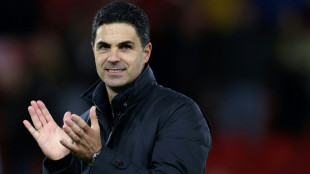
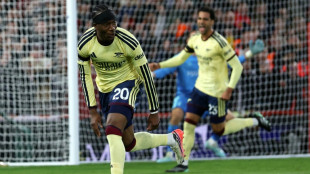 Arsenal snatch late win to keep pressure on Man City as Man Utd held
 Arsenal strike late to keep pressure on Man City as Man Utd held

 Four soldiers dead, dozens injured in fire at Canada military base
 Ton-up Agha helps Pakistan down Sri Lanka in tri-series opener

 Man Utd draw at Leeds keeps pressure on Carrick

 Barca defenders Garcia, Kounde injured before key games
President Donald Trump said Tuesday the US Navy was ready to escort oil tankers through a crucial Gulf shipping route, as he justified his war on Iran by saying he believed Tehran was about to strike first.
Trump has given often conflicting explanations for the joint US-Israeli attack on Iran, while the president who once campaigned to end to America's Middle Eastern wars has set out no firm endgame.
The attacks and Iran's fiery response have engulfed the Middle East -- while also causing global economic turmoil as shipping avoids the Strait of Hormuz near Iran, one of the world's most vital shipping lanes.
Trump, whose own boasts of economic revival are now also under threat ahead of midterm elections later this year, moved to calm the jitters by saying US warships could help.
"If necessary, the United States Navy will begin escorting tankers through the Strait of Hormuz, as soon as possible," Trump said on his Truth Social platform.
The US president also ordered Washington to provide insurance for commercial shipping. US stocks cut their losses after the announcement, although crude prices continued to rise.
- 'Knocked out' -
With questions swirling about Trump's justifications for his country's biggest Middle Eastern entanglement for decades, the US leader earlier denied Israel had forced him into launching the strikes.
Trump's comments appeared to contradict Secretary of State Marco Rubio, who said on Monday that Washington only acted after learning that ally Israel was going to strike.
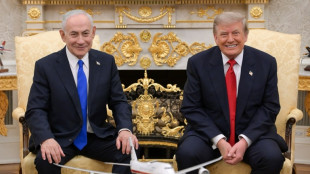
"I think they (Iran) were going to attack first. And I didn't want that to happen," Trump said as he hosted German Chancellor Friedrich Merz at the Oval Office.
"So, if anything, I might have forced Israel's hand."
Fielding questions for the first time in public since launching the operation Saturday, Trump also said the US-Israel strikes had largely destroyed Iran's military.
"Just about everything's been knocked out," Trump said, adding that Iran's navy, air force and radar systems had all been taken out of action.
Trump however offered no firm plan for Iran's future leadership, saying that "most of the people we had in mind are dead."
He said that the "worst case" was that a replacement for Iranian supreme leader Ali Khamenei, who was killed in strikes on Saturday, could be just as bad.
- 'Weeks from a weapon' -
The US leader's stance on "regime change" has been unclear, and toppling the Islamic republic was not among the four key goals for the operation that he gave on Monday.
One of those key objectives was stopping Iran's nuclear program, and US officials sought to back up Trump's case by saying Tuesday that Iran had been stringing Washington along in talks prior to the war.
"They basically could have been days or weeks away from a weapon," one senior administration official told reporters on a call.
Trump meanwhile said it was "too late" for Iran to seek talks.
And the US officials confirmed that negotiator Steve Witkoff and Trump's son-in-law Jared Kushner had had no back-channel contact with the Iranians since Saturday's strikes.
Germany's Merz meanwhile voiced support Tuesday for the US-Israeli war on Iran but said he hoped it would end soon "as soon as possible," saying it was "damaging our economies."
While praising Merz, Trump had harsh words for European allies Britain and Spain.
"This is not Winston Churchill that we're dealing with," Trump said of British Prime Minister Keir Starmer who initially refused to let US forces use UK bases to attack Iran, before relenting.
Trump also threatened to cut off trade with "terrible" Spain, whose left-wing government also refused the use of its bases.
Y.Shaath--SF-PST