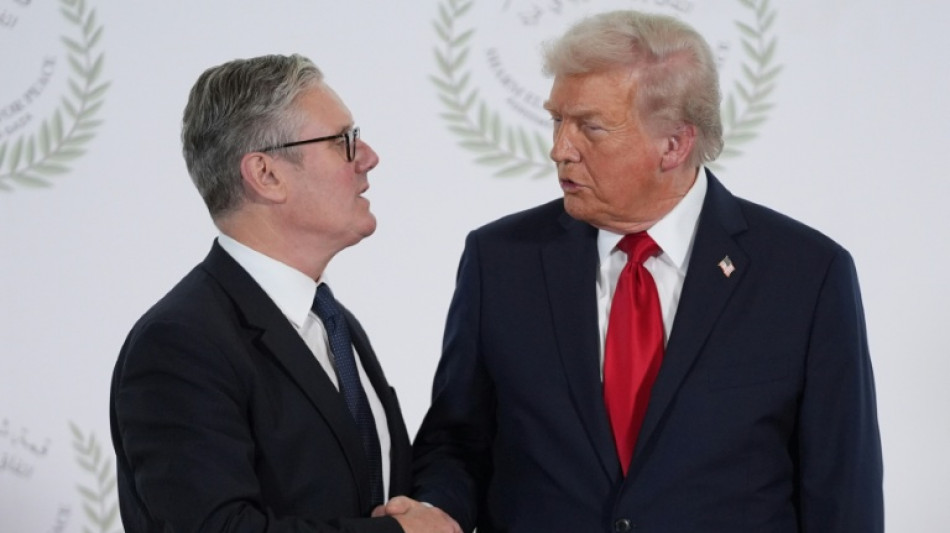
Trump says US-UK relationship 'not like it used to be' / Photo: Evan Vucci - POOL/AFP/File

 Australia's new Ghost Shark submarines grow some 'teeth'

 'I call it a bribe': Pennsylvania residents spurn $10,000 data center checks

 In a former US steel city, ordinary people struggle to get by

 'Liar,' 'clown': Lula and Bolsonaro spar in Brazil poll debate
 Record El Nino? Depends who's counting

 On the front line of ocean conservation off Portugal's Madeira

 Wembanyama targets title breakthrough as NBA season tips off

 With LeBron on board it's title or bust for Philly fans
 One year after Louvre heist, where are the missing jewels?

 Knicks face tall task in NBA championship repeat bid
 Warriors' Curry 'fine' after limping out of practice - Kerr

 Zelensky speaks to US envoys as Trump lashes out
 'Surprise package' Lazio crush Juve to keep pace with Serie A leaders Inter

 China growth expected to miss official target in third quarter

 Lazio crush Juventus to move level with Serie A leaders Inter

 Leeds draw feels like 'fresh start' for Man Utd's Carrick
 Macron denounces 'unbridled' violence as France hit by new clashes

 Hurzeler lauds 'hard worker' Gomez after Brighton goal from halfway line

 Toulouse hold off Exeter, Northampton save English Champions Cup blushes

 Arsenal snatch late win to keep pressure on Man City as Man Utd held
 Arsenal strike late to keep pressure on Man City as Man Utd held

 Four soldiers dead, dozens injured in fire at Canada military base

 Ton-up Agha helps Pakistan down Sri Lanka in tri-series opener

 Man Utd draw at Leeds keeps pressure on Carrick
 Barca defenders Garcia, Kounde injured before key games
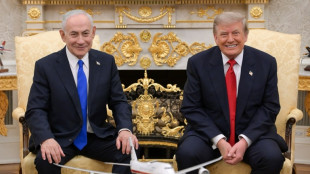
US President Donald Trump said the historical relationship between his country and Britain was "not like it used to be", in an interview to British daily newspaper The Sun, amid a major transatlantic fall out over US-Israeli strikes against Iran.
"This was the most solid relationship of all. And now we have very strong relationships with other countries in Europe," he said, singling out France and Germany, after UK Prime Minister Keir Starmer's initial refusal to allow the United States to use British military bases in its war with Iran.
Trump said Starmer "has not been helpful", adding: "I never thought I'd see that. I never thought I'd see that from the UK. We love the UK."
In a telephone interview from the White House on Monday evening, Trump said: “This was the most solid relationship of all. And now we have very strong relationships with other countries in Europe.”
"It's a different world, actually. It's just a much different kind of relationship that we’ve had with your country before.
"It’s very sad to see that the relationship is obviously not what it was," he added.
The scathing comments come a day after Trump described Starmer's reaction as "very disappointing” in an interview with The Daily Telegraph.
He added that Starmer’s later decision to allow the use of UK bases on specific grounds as "useful" but said it "took far too much time".
Any potential military action in the Middle East is politically sensitive in the UK following former prime minister Tony Blair's disastrous support for the US-led invasion of Iraq.
- 'National interest' -
Starmer defended his position to parliament on Monday.
"President Trump has expressed his disagreement with our decision not to get involved in the initial strikes, but it is my duty to judge what is in Britain's national interest," he told lawmakers.
"That is what I have done and I stand by it," he added.
After initially refusing to have any role in the strikes, Starmer on Sunday announced that he had agreed to a US request to use British military bases for a "specific and limited defensive purpose".
His Downing Street office said Starmer took the decision after Iran fired missiles over the weekend that put British interests and people "at risk".
"We all remember the mistakes of Iraq, and we have learnt those lessons. Any UK actions must always have a lawful basis and a viable thought-through plan," he added in parliament.
The prime minister also said that British military bases in Cyprus "are not being used by US bombers" during the US-Israeli war with Iran.
Britain's Akrotiri air force base on Cyprus came under attack by an unmanned Iranian drone that hit the base's runway early on Monday.
Starmer said the strike "was not in response to any decision that we have taken," adding that the British government believed the drone "was launched prior to our announcement".
Iran's approach is becoming "more reckless and more dangerous", Starmer said.
"They are working ruthlessly and deliberately through a plan to strike, not only military targets, but also economic targets in the region, with no regard for civilian casualties. That is the situation we face today and to which we must respond," he added.
A.AlHaj--SF-PST