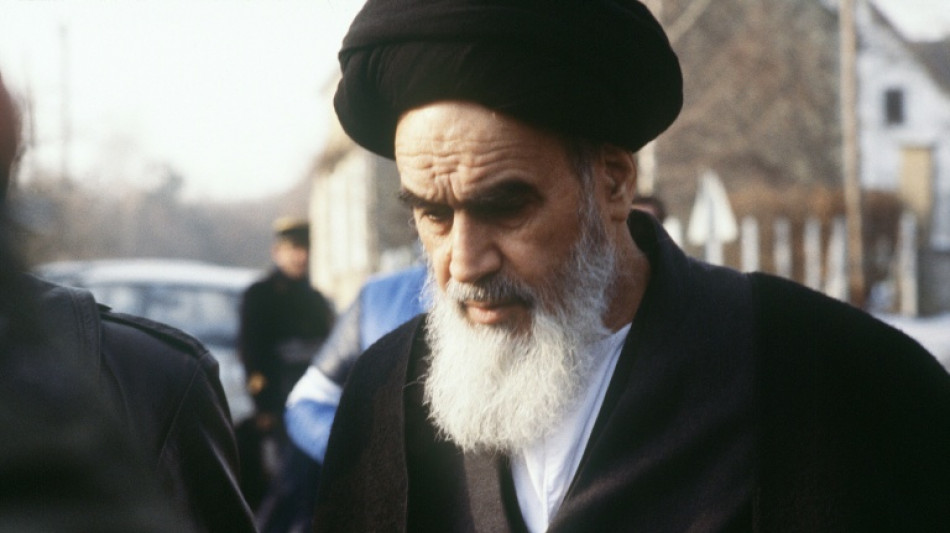
The French village where Ayatollah Khomeini fomented Iran's revolution / Photo: JOEL ROBINE, - - AFP/File

 Australia's new Ghost Shark submarines grow some 'teeth'

 'I call it a bribe': Pennsylvania residents spurn $10,000 data center checks

 In a former US steel city, ordinary people struggle to get by

 'Liar,' 'clown': Lula and Bolsonaro spar in Brazil poll debate

 Record El Nino? Depends who's counting

 On the front line of ocean conservation off Portugal's Madeira

 Wembanyama targets title breakthrough as NBA season tips off

 With LeBron on board it's title or bust for Philly fans

 One year after Louvre heist, where are the missing jewels?

 Knicks face tall task in NBA championship repeat bid

 Warriors' Curry 'fine' after limping out of practice - Kerr

 Zelensky speaks to US envoys as Trump lashes out

 'Surprise package' Lazio crush Juve to keep pace with Serie A leaders Inter

 China growth expected to miss official target in third quarter

 Lazio crush Juventus to move level with Serie A leaders Inter

 Leeds draw feels like 'fresh start' for Man Utd's Carrick

 Macron denounces 'unbridled' violence as France hit by new clashes

 Hurzeler lauds 'hard worker' Gomez after Brighton goal from halfway line
 Toulouse hold off Exeter, Northampton save English Champions Cup blushes

 Arsenal snatch late win to keep pressure on Man City as Man Utd held
 Arsenal strike late to keep pressure on Man City as Man Utd held

 Four soldiers dead, dozens injured in fire at Canada military base
 Ton-up Agha helps Pakistan down Sri Lanka in tri-series opener

 Man Utd draw at Leeds keeps pressure on Carrick

 Barca defenders Garcia, Kounde injured before key games
It has been nearly 50 years since the Ayatollah Ruhollah Khomeini recorded speeches calling for an Islamic revolution from a country home in an affluent village west of Paris.
But the inhabitants of Neauphle-le-Chateau have still not got over their famous guest, as the US-Israeli war against Iran puts the spotlight back on the ayatollah's legacy.
Khomeini, the original spiritual guide of Iran's modern theocracy, spent barely 120 days ensconced in a villa in the village 40 kilometres (25 miles) west of the French capital, before returning in a blaze of publicity to complete the ousting of the Shah, Mohammad Reza Pahlavi, in the Iranian Revolution in early 1979.
Andre, an 86-year-old neighbour of the house that was briefly Khomeini's headquarters, recalled the sudden storm that hit sleepy Neauphle-le-Chateau in the Yvelines department.
"One evening on the television, they announced that an ayatollah had set up home in a comfortable district in the Yvelines," said the retired engineer, who declined to give his family name but has live in the village since 1974.
"From the Saturday morning, there was an invasion of journalists. They were parked everywhere."
Neauphle-le-Chateau, which is just 20 kilometres (12 miles) from Versailles palace, soon became a major draw. "The number of people that the ayatollah would receive, especially the young Iranians who studied in Germany," said Andre.
"It was incredible. He organised the whole Iranian revolution from Neauphle-le-Château."
- Revolutionary exile -
Khomeini, then 76, needed a new bolthole after being expelled from his exiled base in the Iraqi city of Najaf by the country's dictator Saddam Hussein.
"The only place an Iranian could go to without a visa was France," said Bernard Hourcade, a specialist on Iran at the CNRS, France's main research institute.
Abolhassan Banisadr, a future president of the Islamic Republic, at first offered accommodation at Cachan, southeast of Paris. But then a friend offered the house west of the capital and Neauphle-le-Chateau became internationally famous.
The ayatollah arrived on October 6, 1978 and left France again on February 1, 1979. He died in Iran in 1989.
According to Hourcade, one of Khomeini's main activities at the house was to record speeches condemning the shah and calling for revolution, which were recorded on cassettes and secreted into Iran.
Michel, an 87-year-old resident, who also did not want to give his family name, recalled the "police checks" and "blocked roads" during the ayatollah's stay.
"We weren't bothered by his presence, but the neighbours on Chevreuse road (where the ayatollah lived) were quite inconvenienced."
Some, like former resident Alain Simonneau, 80, played down the ayatollah's role in the history of the village. "It was a minor event for Neauphle-le-Chateau, even if it's part of our collective memory, whether we like it or not."
But Lydie Kadiri, who arrived in 1999, said it is a part of history that everyone remembers. "When we say we come from Neauphle-le-Château, everyone immediately remembers the ayatollah!" she said.
The destiny of the house where the ayatollah stayed is another mystery.
The home was destroyed in an explosion in February 1980, a few months after the ayatollah's death. Other buildings have since been erected.
"One evening, I heard an explosion and suddenly, everything burst into flames. The house shook from the blast. Some glass was cracked in my hall," recalled Andre.
For some years, a signboard stood on the land where the house had been, signalling the link between Iran's original spiritual guide and the village. This was vandalised in 2023.
Now pilgrimages are held each year to mark his return to Iran on February 1, 1979.
Khomeini's successor, Ayatollah Ali Khamenei, was killed in the US-Israeli air strikes on Iran.
A Neauphle-le-Chateau resident, speaking on condition of anonymity, said that between 150 and 200 people came each year with Iran's ambassador "to celebrate the anniversary" of Khomeini's return to Iran.
In Tehran, a road is named after Neauphle-le-Chateau. The French embassy is located on the street.
T.Ibrahim--SF-PST