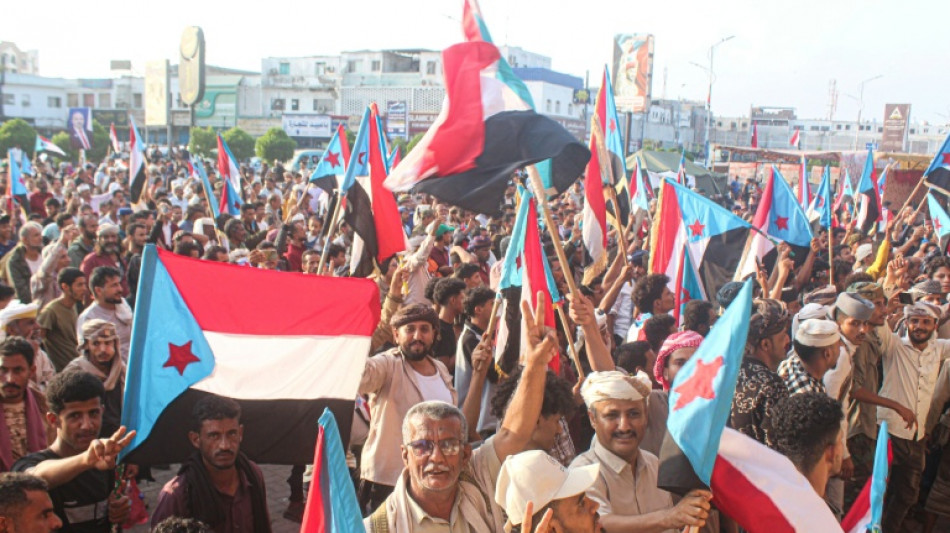
What's at stake as Yemeni separatists gain ground? / Photo: Saleh Al-OBEIDI - AFP

 Websites go dark as AI exposes critical security flaws

 Man Utd humiliated as Arsenal deny Bayern in Champions League

 Low-budget Brewers and Rays seek first World Series title
 Pitiful Man Utd display heaps pressure on Carrick

 Ohtani surgery 'not on the table': Dodgers chief

 eBay to slash 1,000 more jobs, around 9% of workforce

 Villa tame Viking to stay perfect in Champions League

 Tesla profits drop but top analyst estimates

 Angels drop Suzuki as manager after club's worst MLB season

 Washington orders US embassy staff, families to leave Saudi Arabia
 Musk's SpaceX results lift global stock markets

 NFL boss Goodell: Comfort level 'very high' for Paris game
 Fernandes laments 'mood of defeat' as Man Utd crumble in Como
 Maradona doctor was made 'scapegoat' for his death, Argentine court told
 Man Utd thrashed by Como in Champions League horror show

 UN experts urge Meta to safeguard political expression in Brazil election

 Websites go dark worldwide as AI exposes critical security flaws
 Defense in Maradona death trial seeks acquittal of doctor
 Jansen, Rabada put South Africa in sight of win over Australia

 Low Rhine weighed on German growth: central bank
 OpenAI says its AI agents disabled their own safety monitors
 Alldritt returns as France call up seven newcomers for Nations Championship

 UN issues call to arms to combat off-the-charts El Nino
 Nigeria Ebola case matches DR Congo strain
 Musk's SpaceX helps launch stock market gains
UAE-backed south Yemeni separatists have taken control of vast new areas, rattling the anti-Houthi government and threatening to further divide a country fractured by more than a decade of civil war.
Yemen is already split between the Iran-backed Houthis who control much of the north and a fractious patchwork of anti-rebel groups in the internationally recognised government.
The separatists of the Southern Transitional Council are part of that anti-Houthi government, but their advances have raised fears that the group might secede in an effort to revive the once independent South Yemen.
- What is the STC? -
Headed by Aidaros Alzubidi, the STC is a coalition of groups that want to bring back South Yemen, which existed from 1967 until its unification in 1990 with North Yemen.
They now control almost all of South Yemen's former territory.
The STC has gained influence during Yemen's civil war, which has pitted the Houthis against forces backed by a Saudi-led military coalition that includes the United Arab Emirates.
Close to Abu Dhabi, the separatists are part of the Presidential Leadership Council (PLC), the eight-member body that heads the internationally recognised government.
Alzubidi is the PLC's vice-president while Saudi-backed Rashad al-Alimi, who has heavily criticised the separatists' advance, is its president.
The STC already controlled swathes of Yemen's south coast, including al-Mukalla, the capital of the country's largest province Hadramawt.
Last week, its forces swept inland, seizing the key city of Seiyun as well as oil fields in the mostly desert area bordering Saudi Arabia.
In recent days, some local leaders in neighbouring Mahra province, which borders Oman and is a key smuggling route, also joined their alliance, the STC told AFP.
- Will the STC secede? -
The advance and the lack of resistance "suggests a level of coordination with at least some of the government forces," according to Elisabeth Kendall of Cambridge University.
Its speed and success are "symptomatic of PLC failures" she said.
"The PLC has proven weak and divided, riddled by infighting and unable to govern effectively," she said, warning that its future was now unclear, with fears rising that the STC might secede.
A senior government official dismissed the possibility of such a move succeeding.
"The declaration of a new state isn't feasible nor viable nor possible," he told AFP, requesting anonymity to discuss sensitive matters.
"Secession isn't possible as it requires national, regional and international consensus which doesn't exist now," the Yemeni official said, speaking on condition of anonymity.
The STC is likely seeking to renegotiate the current power-sharing agreement within the PLC amid reports of a potential resumption of talks between Saudi Arabia and the Houthis.
The larger civil war has been effectively frozen since a UN-brokered ceasefire in 2022, though talks to bring it to a formal end are yet to succeed.
- What do the UAE and Saudi Arabia want? -
Riyadh has called for STC forces to withdraw from the newly seized territory while an Emirati official said Abu Dhabi's position on Yemen was "in line with Saudi Arabia".
The two Gulf monarchies have one shared objective, to counter the Houthi rebels, but they have diverging long-term interests.
Secession would offer the UAE "control over lucrative energy resources, ports, trade routes and strategic security locations," Kendall said, leaving "Saudi with a bellicose Houthi-dominated state on its border".
Their territorial gains are "undoubtedly unsettling for Oman," she added, which sees the province of Mahra as its "backyard".
strs-saa-sar/aya/dcp
M.AbuKhalil--SF-PST