Kharkiv's lute-playing publisher champions 'cultural resistance' / Photo: OLEKSII FILIPPOV - AFP

 UK singer-songwriter Raye wins Mercury Prize for second album
 Antonelli needs ‘perfect weekend’ to realise title dream

 Reclaiming the walls in a former Salvadoran gang hotspot
 Musk wants to merge SpaceX and Tesla: Here's what to know

 Musk's wants to merge SpaceX and Tesla: Here's what to know

 Hashimoto sweeps to gymnastics world all-around title

 Super Bowl MVP Walker returns to Seattle with unbeaten Chiefs

 Red Bull advisor Marko slams Horner memoir as 'collection of untruths'
 France reports first human Shamonda virus case, says no health risk
 Rekindled Gucci desirability fails to light flame under Kering sales

 Thousands rally as Serbia heads to pivotal poll

 Marathon star Aga banned six years for doping and misleading investigation
 USA to host women's football Club World Cup in 2028 - FIFA
 Finland grants licence for world's first nuclear waste repository
 'Old-fashioned' South Africa thump Australia to level Test series
 No more taking out the trash at your Airbnb
 Swiss supreme court upholds Guatemala ex-police chief sentence

 UN climate disaster fund moves to provide $20 mn aid for Nepal

 Africa faces 'complex' Ebola outbreak after spread to Nigeria: WHO
 American detained in Russia arrives in US: lawyer
 Pentagon, Lockheed announce deal for 850 F-35 jets over 10 years
 French authorities seek to ban or curb fresh protests

 Nearly all coral reefs risk collapse in 50 years: IUCN

 Foden can be one of Premier League's best again, says Maresca
 'Solution from the heavens': Indonesians pray for rain as fires burn
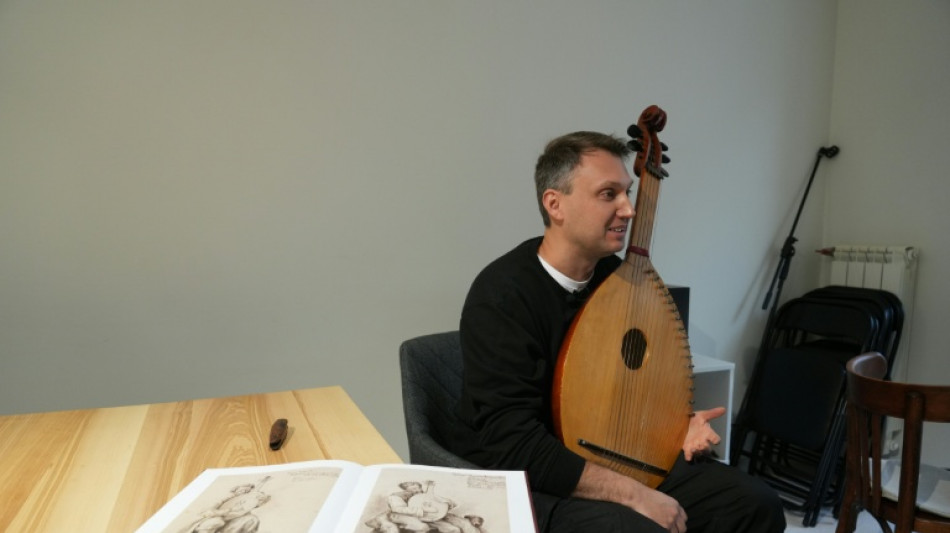
With his eyes closed, Oleksandr Savchuk plucks the strings on his bandura, a lute-like Ukrainian folk instrument, as he delivers a gently melancholic performance in the frontline city of Kharkiv.
Savchuk, the 41-year-old owner of a small publishing house, has spent years promoting Ukrainian language, history and culture in the predominantly Russian-speaking city in Ukraine's northeast, unearthing manuscripts by authors who were forgotten or censored by the Soviet Union.
"My family history prompted me to start this cultural resistance as early as 2005," Savchuk told AFP, adding that his two grandfathers endured repression under the Soviets.
Savchuk's mission took on a new urgency after Russia invaded Ukraine in February 2022 and ignited a cultural renaissance.
In March, Savchuk opened "Book Shelter", a bookshop that has quickly become a popular cultural venue in a city frequently targeted by Russian air assaults.
He has also sought to help preserve the centuries-old tradition of the wandering kobzars, blind bards who performed religious and folk songs -- Savchuk has even crafted his own bandura.
Kobzars used to accompany Cossacks on their military campaigns, glorifying Ukrainian resilience and spirit.
Long seen as symbols of Ukrainian identity and national pride, kobzars were persecuted by the Soviet authorities.
"Kobzars were blind. It was believed that blind people were closer to God," Savchuk said.
Many of them were executed in the 1930s under Soviet dictator Joseph Stalin.
"They left a dozen kobzars alive and taught them to sing a piece about Lenin," Savchuk said with a bitter smile, referring to the Bolshevik leader.
- 'Giving people answers' -
On a recent October morning, Savchuk sang a poem by Hryhoriy Skovoroda, an 18th-century philosopher and poet, accompanying himself on the bandura.
Skovoroda's historic home was located in the village of Skovorodynivka outside Kharkiv.
A Russian missile strike destroyed the museum in May 2022, in what Ukrainians called a deliberate attack on the country's cultural heritage.
According to Savchuk, different worldviews are at the root of the Russian war against Ukraine, as well as Ukraine's centuries-long fight for freedom.
"It is about different types of thinking," he said.
"I do not know a single Ukrainian who wants another hectare of land somewhere in the Belgorod region," he added, referring to Russia's border region.
The Oleksandr Savchuk publishing house was founded in 2010 in a bid to protect Ukraine's national heritage and revive forgotten names.
Over the past 15 years, he has published around 200 titles, amassing a print run of around 60,000 copies.
"Of course, it's just a drop in the ocean," he said.
"We cannot publish many books, but with the demand that has emerged, we realised that we are giving people answers."
Book orders have skyrocketed following the launch of Russia's invasion.
"Everything we had been doing for the past 15 years was as if we were preparing to tell everyone who wanted to know about our culture," Savchuk said.
Despite the war, many residents of Kharkiv, which is located just 30 kilometres (19 miles) from the Russian border, continue to speak Russian.
But Moscow's cultural influence is fading.
"I've been interested in Ukrainian literature for a year now," said 14-year-old Varvara Fomenko, who volunteers at Savchuk's bookshop.
The teenager is increasingly rejecting Russian culture -- especially the Russian music she grew up listening to -- but conceded that her tastes were still in the minority among her classmates.
- Remembrance -
Kharkiv is home to other cultural initiatives breathing new life into Ukrainian culture.
In August, prominent poet and novelist Serhiy Zhadan organised a literary festival that brought together some of the best-known Ukrainian-language authors.
Despite some local resistance, Savchuk campaigned to have a commemorative plaque installed in 2020 on the building where Ukrainian art scholar Stefan Taranushenko was arrested in 1933 over "counter-revolutionary activity".
The scholar had photographed and recorded the plans of five 18th-century wooden churches before their destruction by the Soviet authorities.
Decades later, Taranushenko's photographs and drawings enabled Savchuk to publish a book accompanied by 3D models of the destroyed "masterpieces".
Last month, Savchuk placed flowers at the plaque dedicated to Taranushenko in front of AFP journalists.
A passerby recognised him and rushed over to thank him for his work.
"It is just as important as the work being done by the Ukrainian armed forces," said local journalist Slava Mavrychev.
N.Shalabi--SF-PST