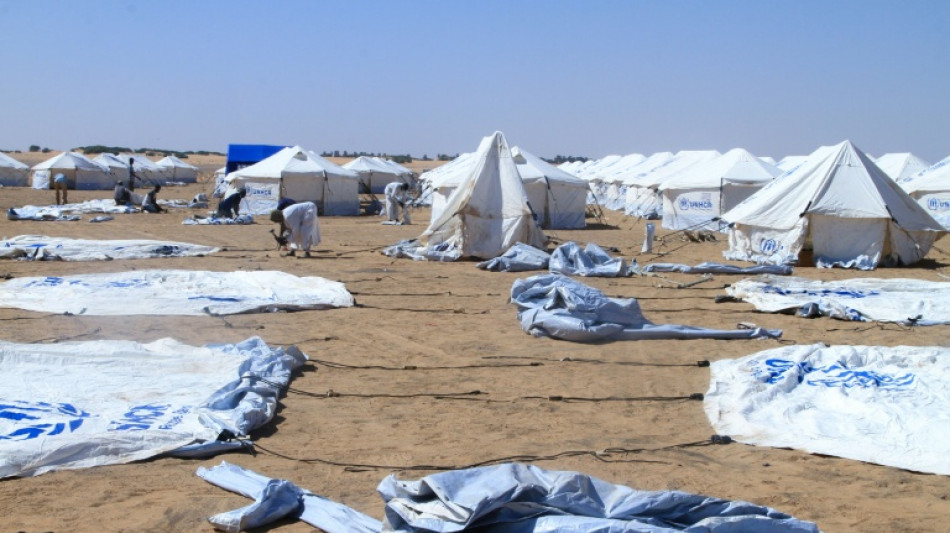
Sudan's displaced and exhausted doctors treat fellow El-Fasher survivors / Photo: Ebrahim HAMID - AFP/File

 Trump slams NBA's LeBron James for national anthem actions

 Australia sanctions North Koreans over 'fraudulent' IT work, cybercrime
 UK singer-songwriter Raye wins Mercury Prize for second album

 Antonelli needs ‘perfect weekend’ to realise title dream

 Reclaiming the walls in a former Salvadoran gang hotspot

 Musk wants to merge SpaceX and Tesla: Here's what to know

 Musk's wants to merge SpaceX and Tesla: Here's what to know

 Hashimoto sweeps to gymnastics world all-around title

 Super Bowl MVP Walker returns to Seattle with unbeaten Chiefs

 Red Bull advisor Marko slams Horner memoir as 'collection of untruths'

 France reports first human Shamonda virus case, says no health risk

 Rekindled Gucci desirability fails to light flame under Kering sales

 Thousands rally as Serbia heads to pivotal poll

 Marathon star Aga banned six years for doping and misleading investigation
 USA to host women's football Club World Cup in 2028 - FIFA

 Finland grants licence for world's first nuclear waste repository
 'Old-fashioned' South Africa thump Australia to level Test series
 No more taking out the trash at your Airbnb
 Swiss supreme court upholds Guatemala ex-police chief sentence
 UN climate disaster fund moves to provide $20 mn aid for Nepal

 Africa faces 'complex' Ebola outbreak after spread to Nigeria: WHO
 American detained in Russia arrives in US: lawyer

 Pentagon, Lockheed announce deal for 850 F-35 jets over 10 years

 French authorities seek to ban or curb fresh protests

 Nearly all coral reefs risk collapse in 50 years: IUCN

Overwhelmed health workers rushed from patient to patient in makeshift tents in Sudan, trying to help even though they too had barely escaped the fall of El-Fasher to paramilitary forces.
"We're not in good shape," said Ikhlas Abdallah, a general practitioner who arrived from the western Darfur city now in the hands of the Rapid Support Forces, which have been battling the Sudanese army since April 2023.
"But we have to be okay to provide care to those who need it," she told AFP.
She spoke from Al-Dabbah camp, located in army-held territory about 770 kilometres (480 miles) northeast of El-Fasher, which endured an 18-month siege before falling to the RSF last month.
"Psychologically, what can we do? Like all those displaced from El-Fasher, our feelings are indescribable."
At the camp, which is funded by a Sudanese businessman, hundreds of families sleep in nylon tents or on plastic mats laid across the sand.
In one patch of blue canvas shelters, some 60 doctors, nurses and pharmacists have assembled what passes for a clinic: a makeshift pharmacy, a rudimentary laboratory and tents used as short-stay wards.
Plastic chairs serve as examination tables. Ambulances borrowed from the nearby town of Al-Dabbah function as mobile clinics.
Men carry buckets of water for the communal kitchens and improvised latrines while women stir massive pots over open flames. They serve the traditional Sudanese dish assida to families for free.
"We all come from the same place," said Elham Mohamed, a pharmacist who also fled El-Fasher.
"We understand them and they understand us," she told AFP.
- 'Death, captivity or ransom' -
Every day, dozens of people arrive with respiratory infections, diarrheal diseases, skin conditions and eye infections -- ailments that spread quickly in crowded conditions with little clean water.
"We are doing everything we can, but resources are scarce," said Ahmed al-Tegani, a volunteer doctor with the International Organization for Migration.
Some patients "require specialised care" that is not available in the camp, he told AFP.
Abdallah fled the Saudi Maternity Hospital in El-Fasher after the RSF overran the army's last stronghold in Darfur on October 26.
She said she arrived safely in Al-Dabbah "only because they (the RSF) did not know we were doctors".
To the paramilitary group, she said, identifying as medical personnel meant "death, captivity or ransom".
While escaping, she and her colleagues treated the wounded secretly, often without bandages.
"If the RSF discovered someone had received medical care, they beat them again," she said.
Throughout the two-year conflict, both warring sides have repeatedly and deliberately targeted doctors and hospitals.
The World Health Organization has documented 285 attacks on healthcare since the war began. They have killed at least 1,204 health workers and patients and wounded more than 400.
- 'No one left to save' -
Before fleeing, Abdallah spent weeks working around the clock in the maternity hospital. It was the last functioning medical facility in El-Fasher and suffered repeated attacks during the siege.
In October alone, the WHO reported four attacks on the hospital.
Abdallah remembers one night in October when a drone struck the building.
"I went home early that evening," she recalled, "and later I heard the sound of a drone. It fell on the hospital.
"When we rushed there, there was no one left to save."
"Bodies were unrecognisable. People were torn into pieces," she said.
"It didn't feel real. Horror like in the movies."
Two days after El-Fasher fell, an attack on the hospital killed 460 patients and staff, according to the WHO.
The city remains cut off from communications, with the RSF controlling access to Starlink satellite services.
For Abdallah, the journey to Al-Dabbah -- which involved checkpoints, arbitrary killings and rampant looting and sexual violence -- was "worse than inside El-Fasher".
Most people "were beaten" and "more people died on the road than" in the city itself.
Sudan's conflict has already killed tens of thousands of people and displaced nearly 12 million, creating the world's largest displacement and hunger crises.
On a recent visit to displacement camps in Sudan, UN humanitarian chief Tom Fletcher said the country faced enormous needs and highlighted the need to develop a stronger health system.
E.Aziz--SF-PST