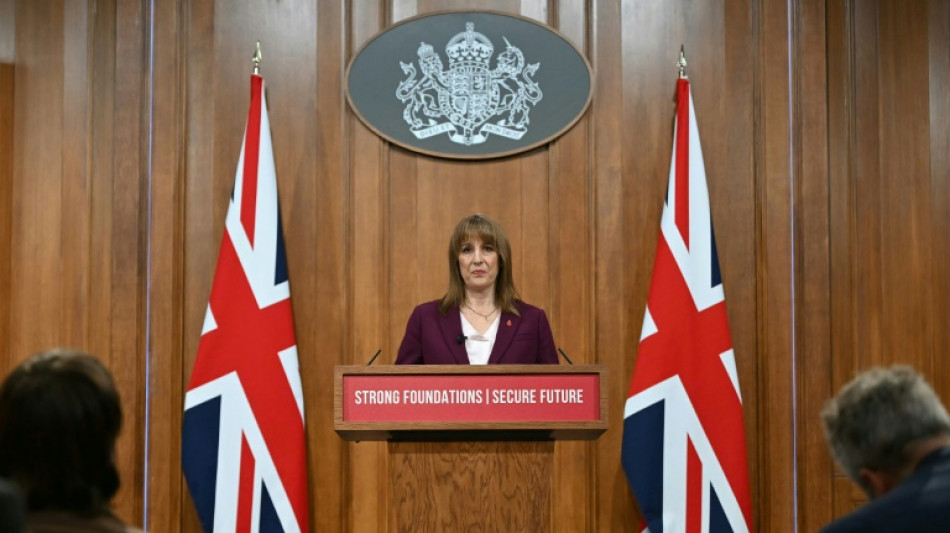
UK budget tests Labour govt's credibility / Photo: JUSTIN TALLIS - POOL/AFP

 Trump slams NBA's LeBron James for national anthem actions

 Australia sanctions North Koreans over 'fraudulent' IT work, cybercrime
 UK singer-songwriter Raye wins Mercury Prize for second album
 Antonelli needs ‘perfect weekend’ to realise title dream
 Reclaiming the walls in a former Salvadoran gang hotspot

 Musk wants to merge SpaceX and Tesla: Here's what to know
 Musk's wants to merge SpaceX and Tesla: Here's what to know
 Hashimoto sweeps to gymnastics world all-around title

 Super Bowl MVP Walker returns to Seattle with unbeaten Chiefs

 Red Bull advisor Marko slams Horner memoir as 'collection of untruths'

 France reports first human Shamonda virus case, says no health risk

 Rekindled Gucci desirability fails to light flame under Kering sales

 Thousands rally as Serbia heads to pivotal poll

 Marathon star Aga banned six years for doping and misleading investigation

 USA to host women's football Club World Cup in 2028 - FIFA
 Finland grants licence for world's first nuclear waste repository
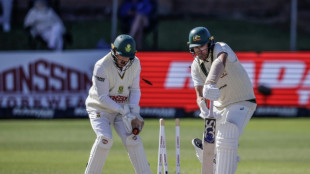 'Old-fashioned' South Africa thump Australia to level Test series

 No more taking out the trash at your Airbnb

 Swiss supreme court upholds Guatemala ex-police chief sentence
 UN climate disaster fund moves to provide $20 mn aid for Nepal
 Africa faces 'complex' Ebola outbreak after spread to Nigeria: WHO
 American detained in Russia arrives in US: lawyer
 Pentagon, Lockheed announce deal for 850 F-35 jets over 10 years

 French authorities seek to ban or curb fresh protests
 Nearly all coral reefs risk collapse in 50 years: IUCN

Britain's centre-left Labour government unveils its annual budget Wednesday, with expected tax rises to curb debt and fund public services threatening to further dent its weak poll ratings.
Prime Minister Keir Starmer has promised a "Labour budget with Labour values", vowing to reduce National Health Service waiting times and ease a prolonged cost-of-living crisis.
But finance minister Rachel Reeves faces a challenge: shoring up Labour's credibility with voters as hard-right Reform UK gains popularity, while convincing investors the government has its finances under control.
Economists estimate that Reeves, whose official title is chancellor of the exchequer, must find some £20 billion ($26 billion) to balance the books.
It could prove to be a tall order as Britain grapples with a deficit near five percent of gross domestic product, elevated inflation and a stagnating economy as unemployment climbs.
The yield on 30-year UK government bonds this year hit its highest level since 1998, with concerns growing about soaring state debt.
A bad market response to the budget meanwhile risks investors selling UK debt, making it more expensive for the government to borrow and finance its spending plans.
- 'Political backlash' -
The government has reportedly scrapped plans for an income-tax rise that would have broken campaign promises.
That prompted expectations for Reeves to rely instead on a series of smaller tax rises.
"There isn't that much room to manoeuvre without facing a political backlash," James Wood, professor of political economy at the University of Cambridge, told AFP.
He said that "the best way to balance the budget would be to increase the tax-burden of middle income households, who are Labour's core support base".
The government is instead expected to further freeze income tax thresholds, pushing more workers into higher brackets, and is reportedly set to also raise levies on luxury properties, gambling and banks.
Labour has struggled to consistently grow the UK economy since returning to power in July 2024 following 14 years of Conservative party rule.
Reeves hiked a tax on businesses in her inaugural budget last year -- a move that has been blamed for Britain's weak economic growth.
UK gross domestic slowed to 0.1 percent in the third quarter, down from 0.3 percent in the second quarter and 0.7-percent in the first three months of this year.
The uncertainty has left some employers hesitant to hire.
"Normally, we have taken on extra staff over the Christmas period," Craig MacLeod, owner of the Innes Bar in Inverness, Scotland, told AFP.
"We've held off on that at the moment to find out what happens in the budget."
- Spending -
Under pressure from its own ranks, the government has also backtracked on plans to cut disability benefits and fuel payments to pensioners.
"What we won't do is inflict austerity on the country," Starmer pledged in parliament last week.
The government is widely expected to lift a cap on family benefits, reduce taxes on energy and even expand some social spending.
"There are unlikely to be any large spending cuts," Jonathan Portes, an economics professor at King's College London, told AFP.
He argued that the government would opt to "avoid hitting lower and middle income workers, so most of the burden will fall on higher income workers, better off pensioners and business".
K.Hassan--SF-PST