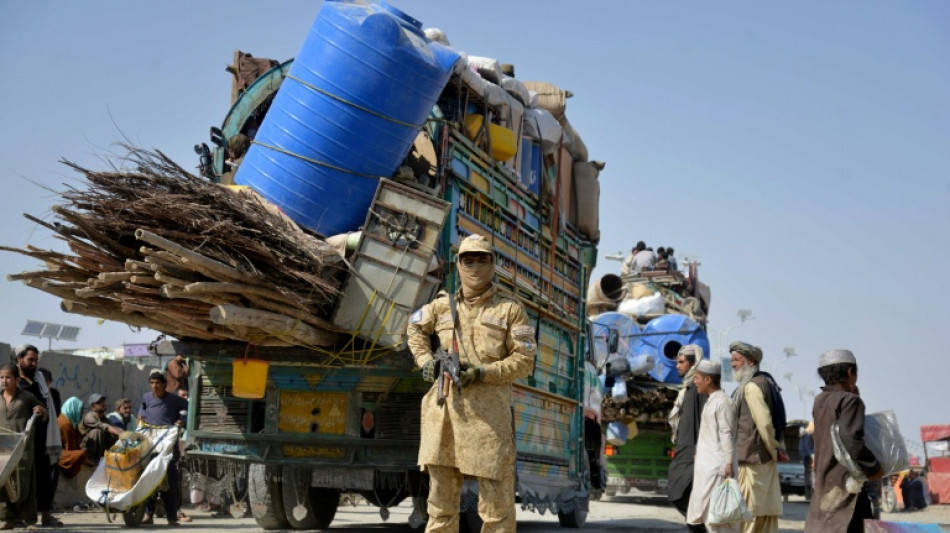
Afghanistan seeks new trade routes as Pakistan ties sour / Photo: Sanaullah SEIAM - AFP/File

 Lula, Bolsonaro to clash once more before Brazil vote
 Dressed to kill: Haircuts cap menacing look of Japan's yakuza

 Napa Valley's wineries feel Trump's tariff squeeze

 Venezuela protests demand return of Nobel winning leader Machado

 Marquez tops incident-packed opening practice for Australian MotoGP

 New York votes to ban Central Park horse carriages after decades of debate

 Australia face selection headaches after 'shambolic' South Africa defeat

 Around 150,000 rally in Belgrade as Serbia heads to pivotal poll

 Hamilton sets sights on racing in African grand prix

 Bournemouth hammer 10-man Milan, Juventus denied at the death

 Judge orders Trump to give deposition in BBC lawsuit by Dec 11

 'Fake' pollsters hit US midterms

 Global markets retreat as tech mood sours, oil prices jump

 Juventus denied at the death, Sunderland make point in Poland in Europa League

 Tens of thousands rally as Serbia heads to pivotal poll

 Monet's 'Iris' fetches 50 mn euros at Paris auction

 L'Oreal sees double-digit sales growth

 Sri Lanka stun England with huge chase after Brook's 202

 Guatemala sentences former police officers in gay couple's killings

 Nelson's erotic dream letter features in London auction
 Canada opens free trade talks with Turkey

 Swiss, Austrian women freed after Niger kidnap ordeal
 Austrian-born French resistance fighter dies aged 105: regional official

 Paris shop-owners and residents prepare for fresh protests
 French, Japanese authors try to write novel on one-day train ride

Afghanistan is scrambling to diversify its trade partners after a deadly border clash with Pakistan last month brought ties to their lowest point in years, affecting people on both sides of the frontier.
The South Asian neighbours have been locked in an increasingly bitter dispute since the Taliban took over Kabul in 2021, with Islamabad accusing Afghanistan of harbouring the militants behind cross-border attacks -- charges the Taliban government denies.
Abdul Ghani Baradar, Afghanistan's deputy prime minister for economic affairs, urged traders last week to "redirect their trade toward other alternative routes instead of Pakistan".
Pakistan is landlocked Afghanistan's top trading partner, supplying rice, pharmaceuticals and raw materials, while taking in 45 percent of Afghan exports in 2024, according to the World Bank.
More than 70 percent of those exports, worth $1.4 billion, are perishable farm goods such as figs, pistachios, grapes and pomegranates.
Dozens of Afghan trucks were stranded with rotting produce when the frontier shut on October 12 due to deadly cross-border fire, which was followed by a fragile truce.
Losses have topped $100 million on both sides, and up to 25,000 border workers have been affected, according to the Pakistan Afghanistan Joint Chamber of Commerce and Industry (PAJCCI), which seeks to promote bilateral trade.
Baradar warned traders that Kabul would not intervene if they kept relying on Pakistan.
Wary of further disruptions, the Taliban government is now hedging its bets with Iran, Central Asia -- and beyond.
- Pomegranates to Russia -
Trade with Iran and Turkmenistan has jumped 60–70 percent since mid-October, said Mohammad Yousuf Amin, head of the Chamber of Commerce in Herat, in western Afghanistan.
Kabul also sent apples and pomegranates to Russia for the first time last month.
Russia is the only country to have officially recognised the Taliban administration.
Taliban leaders crave wider recognition and foreign investment, but sanctions on senior figures have made investors wary.
The vast market in India is a prime attraction. On Sunday, state-owned Ariana Afghan Airlines cut freight rates to the country of 1.4 billion people.
Two days later, Kabul sent its commerce and industry minister to New Delhi.
"Afghanistan has too many fruits and vegetables it cannot store because there are no refrigerated warehouses," said Torek Farhadi, an economic analyst and former IMF adviser.
"Exporting is the only way," he told AFP. And quickly, before the products spoil.
Kabul touts Iran's Chabahar port as an alternative to Pakistan's southern harbours, but Farhadi noted it is farther, costlier and hampered by US sanctions on Tehran.
- 'Distraught' -
"It's better for both countries to end this trade war... They need each other," Farhadi said.
Afghanistan relies on Pakistan's market of 240 million people and its sea access, while Islamabad wants Afghan transit to reach Central Asia for textile and energy trade.
Pakistan says the closure curbs militant infiltration, but its economy is also feeling the pinch.
In Peshawar, near the frontier, Afghan produce has all but vanished from markets.
Grapes cost four times more, and tomatoes have more than doubled to over 200 rupees (70 cents) a kilogram, an AFP correspondent found.
On Monday, the PAJCCI urged Islamabad to act, warning of mounting costs as shipping containers bound for Afghanistan and Central Asia remain stuck in Pakistan.
Each container is racking up $150–$200 in daily port charges, the group said, adding: "With thousands of containers stuck, the collective economic burden has become unbearable and continues to grow with each passing day."
Truck driver Naeem Shah, 48, has been waiting at the Pakistani border town of Chaman with sugar and cooking oil bound for Afghanistan.
"I haven't been paid for a month. No matter who I call, they say there is no money because the border is closed," he told AFP.
"If it doesn't reopen, we will be distraught."
B.Khalifa--SF-PST