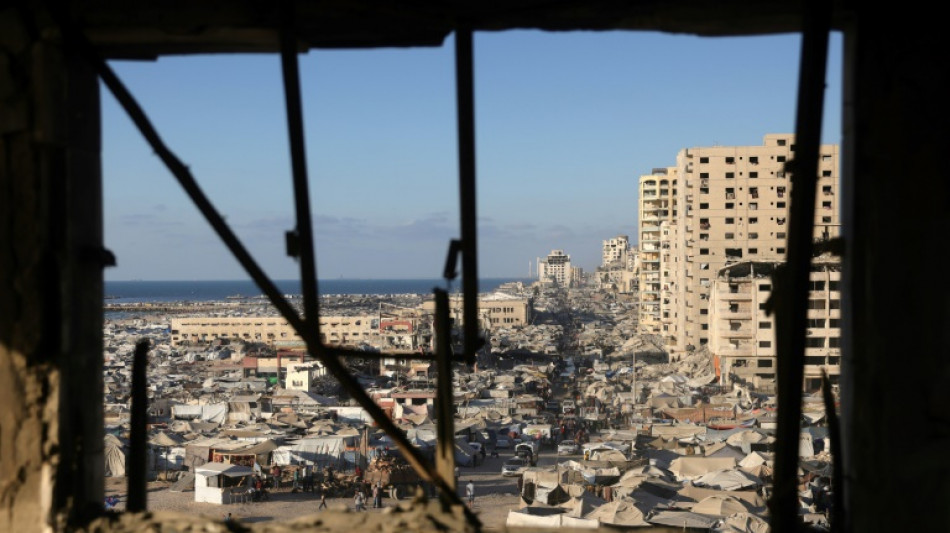
Coffee and cash: how Hamas pays its civil servants in secret / Photo: BASHAR TALEB - AFP

 Antonelli storms to pole for US Grand Prix

 Alvarez fires Atletico to win against Deportivo

 Japan's Nakai wins Grand Prix de France for second straight year

 Ronaldinho to make comeback in Italian third tier
 Israeli forces displace Hebron families after deadly attack
 Hamilton on top with Antonelli fourth in final practice at US Grand Prix

 Beier late show sends Dortmund top of Bundesliga

 Police and protesters clash again at Albanian anti-government rally
 Arteta hails mentality as Arsenal go level with Man City

 Clashes break out in Paris, other cities amid fresh protests
 Bouthier kicks Vannes to first Top 14 win of season

 Thousands rally for Lula and Bolsonaro on eve of tight Brazil vote

 Red-hot Fuellkrug bags Bremen brace, Leipzig win

 Thousands gather at new Albanian anti-government rally
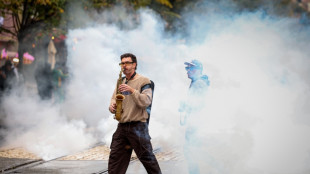
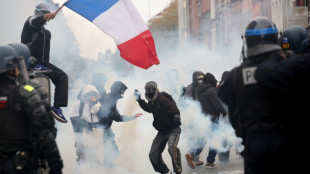 French police fire tear gas during fresh protests

 Suspect detained after fire wrecks Hitler's mountain retreat
 Alexander Skarsgard and his viral 'Wicker' transformation

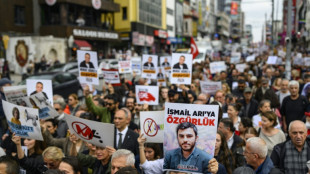 Thousands protest in Turkey over journalists' arrests, media shutdowns

 Man City beaten by Aston Villa to end perfect Premier League start

 Luis Enrique says PSG unbothered by Lyon match switch
 US gymnast Richard wins floor exercise gold at worlds
 Moltzan upstages Shiffrin to win season-opening World Cup giant slalom

 Infantino says backed by 'vast majority' in bid for re-election

 Police fire tear gas as new French protests kick off

 Police fire tear gas as new French demonstrations kick off
One of thousands of public servants in Gaza's Hamas-run government, Karim, a public works ministry employee, received what seemed like an ordinary message on his phone: an invitation "for a coffee".
The text gave a time for a meeting near a school sheltering displaced people amid the wreckage and rubble of nearly two years of war between Hamas and Israel in the Palestinian territory.
Karim, who like others interviewed by AFP asked to use a pseudonym, explained how he went to the meeting in July terrified of a possible Israeli attack, but found "an employee I knew waiting for me".
He "gave me 1,000 shekels ($298)," the 39-year-old said, adding that that was only part of his pre-war salary of 2,900 shekels.
The war has destroyed public infrastructure and put most government employees out of work, but testimonies gathered by AFP from civil servants confirm Hamas is still paying some salaries, at least in part and with delays.
Israel has dealt a series of body blows to Hamas and its institutions over the past two years, decimating the Palestinian Islamist movement that seized total control of Gaza in 2007.
In response to Hamas's unprecedented attack on Israel on October 7, 2023, the Israeli army launched an offensive against the group, which according to the health ministry in the Gaza Strip has killed at least 63,746 people.
Residents in Gaza explained they try to avoid being close to people linked to Hamas or its fighters, for fear of the Israeli military locating and targeting them with strikes that often kill or injure those around them.
According to witnesses, the army has repeatedly targeted people sent by Hamas to deliver salaries.
- 'Escaped death' -
Alaa, a teacher at a public school in Gaza City, last received a salary in June.
The mother of five had received a text message asking her to go to a school sheltering displaced people in northern Gaza.
When she arrived, "the school had just been bombed and the employee in charge of distributing salaries had fled. Thank God I was late, I escaped death."
She had to return to the area the next day to receive her salary, she said.
The Israeli army regularly carries out strikes on schools, where displaced people shelter, accusing fighters from Hamas and other militant groups of using them as bases and command posts.
Before the war, Hamas's government employed an estimated 40,000 people, drawing from revenue from customs duties and taxes to run public services.
From 2021 until the start of the war in Gaza in 2023, Qatar pledged $360 million in annual funding to the Palestinian territory, at Israel's request, which included salaries of civil servants such as doctors and teachers. Doha has denied providing financial aid to Hamas.
Hamas officials had claimed, before the war in Gaza, to have received financial support from Iran, though the Islamic republic has never confirmed providing funds.
According to an official familiar with the matter in Gaza who spoke to AFP on condition of anonymity, Hamas obtained cash mainly through smuggling via tunnels dug near the border or by sea, despite Israel's blockade.
In February 2024, the Israeli army released videos of safes and bags containing large sums of money (in shekels, US dollars and Jordanian dinars) that it said it had discovered in tunnels under Gaza, along with documents it claimed proved cash transfers from Iran to Hamas.
Jamil, 43, an accountant at a government institution, told AFP Hamas "stored hundreds of millions of dollars in tunnels or safe places for difficult times such as war", without providing further details.
- 'Mafia' -
The Israeli military has hit Hamas's infrastructure and targeted financial leaders like Ismail Barhoum, who was killed in March in an Israeli strike.
Israel has "bombed Hamas-owned banks, places where money was stored, and assassinated financial system officials, but that didn't stop the process," he said.
According to a Hamas source who spoke to AFP on condition of anonymity, senior officials receive their salaries in secret where they live, in displacement camps or schools turned shelters, "so as not to be exposed to strikes."
Jamil explained the salary payment process is "very complex", changing according to the security situation.
Hamas "is keen to pay part of the salaries as soon as the funds are available", he added.
But officials interviewed by AFP complain their wages are not enough to meet basic needs, in a territory where the UN declared famine last month.
Others complained that only civil servants who are members of Hamas get paid.
Massoud, an officer in the Hamas police force, said he recently received a message on his wife's phone inviting him to "have tea".
His wife was pleasantly surprised, grateful that his salary had arrived.
But the money "is not enough to eat, and we are hungry," he told AFP.
"We're with the resistance," he said of Hamas, but added the group should have been "prepared for such hellish times".
Abdallah, 38, a teacher, last received his salary (950 shekels) in July, stretching it, like most Gazans who still manage an income, to feed 20 extended family members after his three brothers were killed near aid distribution sites.
"I said goodbye to my wife and children without telling them I was going to get my salary."
This way of being paid is "painful, it's like you're working for the mafia."
F.Qawasmeh--SF-PST