'I made it': Germans reflect on Merkel's 2015 migrant influx / Photo: John MACDOUGALL - AFP

 Antonelli storms to pole for US Grand Prix

 Alvarez fires Atletico to win against Deportivo

 Japan's Nakai wins Grand Prix de France for second straight year

 Ronaldinho to make comeback in Italian third tier
 Israeli forces displace Hebron families after deadly attack
 Hamilton on top with Antonelli fourth in final practice at US Grand Prix

 Beier late show sends Dortmund top of Bundesliga
 Police and protesters clash again at Albanian anti-government rally
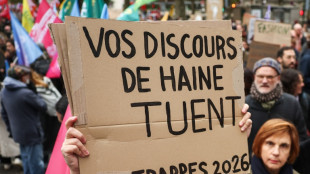
 Arteta hails mentality as Arsenal go level with Man City

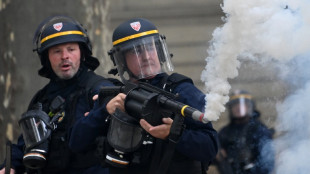 Clashes break out in Paris, other cities amid fresh protests
 Bouthier kicks Vannes to first Top 14 win of season

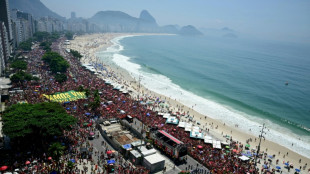 Thousands rally for Lula and Bolsonaro on eve of tight Brazil vote

 Red-hot Fuellkrug bags Bremen brace, Leipzig win

 Thousands gather at new Albanian anti-government rally
 French police fire tear gas during fresh protests

 Suspect detained after fire wrecks Hitler's mountain retreat
 Alexander Skarsgard and his viral 'Wicker' transformation

 Thousands protest in Turkey over journalists' arrests, media shutdowns
 Man City beaten by Aston Villa to end perfect Premier League start
 Luis Enrique says PSG unbothered by Lyon match switch
 US gymnast Richard wins floor exercise gold at worlds
 Moltzan upstages Shiffrin to win season-opening World Cup giant slalom
 Infantino says backed by 'vast majority' in bid for re-election

 Police fire tear gas as new French protests kick off

 Police fire tear gas as new French demonstrations kick off
The images have gone down in history: lines of exhausted men and women carrying their belongings on their backs, trudging through central Europe in early September 2015.
Many were headed for Germany, where then chancellor Angela Merkel decided late on September 4 to keep open the borders in response to the migrant crisis.
Within a few months, Germany had welcomed hundreds of thousands of people, most of them fleeing conflicts in Syria, Iraq or Afghanistan -- a watershed moment that would prove deeply divisive for the country.
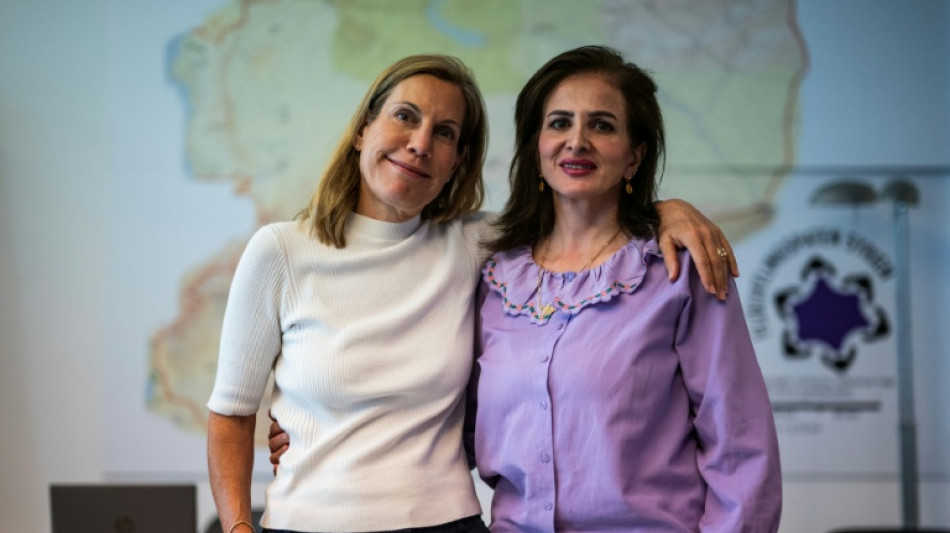
Some of those involved at the time -- as refugees, officials or volunteers -- have shared their memories with AFP.
- The refugee: 'I made it' -
Syrian Asmaa Hweja, 53, is proud of how far she's come since arriving in Germany 10 years ago, but reliving her 12-day journey to get there is still painful.
Hweja, an engineer by training, decided in 2015 to flee the Syrian city of Homs amid the worsening civil war.
Together with her two children, then 13 and 15, she set off on their journey, at one point crammed into a "totally sealed" vehicle "with so many people, like animals".
"I thought that we would die because there was no more oxygen," she told AFP.
From Turkey they took an overloaded dinghy to a Greek island before trekking across the Balkan route.
"I asked myself how I managed," she said, tears welling in her eyes.
By the time she walked into Austria she said her feet were "swollen" and her shoes were "kaput".
After the family eventually reached Berlin, she said, they had to start "from less than zero".
"I had to learn the language, look after the children, take care of all the administrative procedures."
At a time when the city's social services were overwhelmed, she remembers getting up "at 4:00 am and then having to wait six or seven hours for appointments".
But the other memories of that time are of "many German volunteers" who brought refugees food and drink.
Hweja is now a German citizen, a full-time employee at two refugee aid associations and her two children are both studying.
"Thank God, I think I made it," she smiled.
- The volunteer: 'Achieve great things' -
For Katrin Albrecht, 2015 was also a life-changing year.
As she watched the mass refugee flight on TV, Albrecht, now 54, remembers her feeling of "helplessness".
She began volunteering for a charity by helping refugees "find apartments and move house", and within a year she had left her job as a business communications consultant and was working full time for the group.
The organisation's main service is a sponsorship scheme for Syrians wanting to apply for a visa for Germany so that they don't have to "flee across the Mediterranean".
The scheme has enabled some refugees already settled in Germany to bring their family members to the country.
The reunions "were so moving, every time", she told AFP, giving the example of a father seeing his child for the very first time at the airport.
Albrecht wishes that more people would "realise what society has already achieved".
"When we work together we can achieve great things," she said.
- The border official: A 'frightening' year -
Markus Hiebl, the mayor of the small town of Freilassing on the Austrian border, said that 2015 was at times a "frightening" year.
Back then he was a municipal official, and remembers that "we were, so to speak, the gateway to Germany, where 1,500 refugees and asylum seekers arrived every day".
A former furniture store was quickly transformed into a welcome centre for people to stay.
He said "around 160,000 people in total were taken in, registered and given humanitarian support" -- 10 times the town's population at the time.
In reference to Merkel's famous phrase "wir schaffen das" (We can do this), Hiebl says that it was perhaps "not totally thought through".
"We would come up with a concrete plan," perhaps involving the distribution of refugees among several states, he said.
- The chancellor: 'Enormous task' -
Merkel herself has always appeared unmoved by the controversy her decision provoked and accusations it helped fuel the rise of the far-right Alternative for Germany (AfD) party.
"If I went back to 2015, I would take the same decision again based on the situation as it was then," she recently told the ARD TV channel.
Whereas 400,000 refugees were expected at the beginning of 2015, by August the prediction was for 800,000, with the final figure topping one million.
Merkel admits the country was "not well prepared" for this "enormous task" and that there have been "disappointments".
Nevertheless she points to the "incredible effort" put in by many to welcome the new arrivals.
The lesson remains the same today, Merkel said: "If a problem arises, then we need to overcome it."
D.Khalil--SF-PST