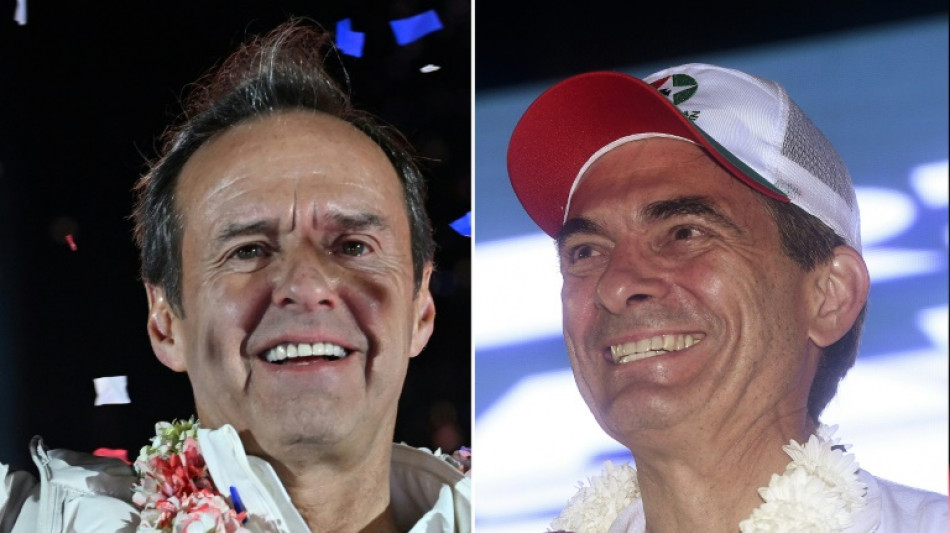
Two right-wing candidates headed to Bolivia presidential run-off: projection / Photo: Martin BERNETTI, Rodrigo URZAGASTI - AFP

 Last MotoGP race at Phillip Island cancelled due to weather in Marquez setback

 Sri Lanka seeks faster green energy shift after oil shocks
 Riyadh airport resumes flights following Houthi attacks

 'Call of Duty' North Korea invasion edition tops sales charts in South
 Musk accuses Ukraine of violating Starlink's terms of service
 Fed expected to hold rates steady days ahead of US midterms

 More Lula, or back to the Bolsonaros? Brazil votes in cliffhanger
 Jorge Martin out of Australian MotoGP with fracture: team
 Antonelli storms to US Grand Prix pole on weekend he can take title

 Apologetic Alvarez fires Atletico to win against Deportivo

 Lens beat PFC in Ligue 1 matchday impacted by social unrest

 Valkyries hit back against Dream to level WNBA Finals

 'Fighting for our rights': Paris protesters determined to march on
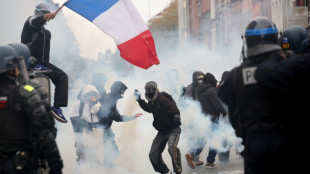
 Clashes break out in Paris, other French cities amid fresh protests
 Spurs seal rare win at Chelsea as Palmer sees red

 Nearly 1,000 arrested in French protests marred by 'elevated' violence: minister
 France extends detention of suspected racist shooter

 Andrade and Nemour star as Biles cheers at world gymnastics champs
 Nigeria's Tinubu defends record as economy bites ahead of election
 'Guiding star' Fuellkrug bags Bremen brace, Leipzig win
 Man City's perfect start ended by Aston Villa, Arsenal go joint-top

 Arsenal sink Everton to join Man City at Premier League summit
 France protests: Latest developments
 French ice dancers Cizeron and Fournier make golden start to season
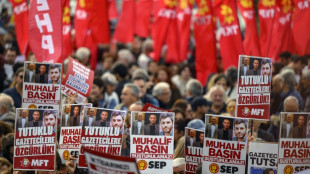 Thousands protest crackdown on media in Turkey

Two right-wing candidates were expected to advance to a run-off for Bolivia's presidency after topping the first round of elections on Sunday, ending two decades of leftist rule, according to early projections.
Center-right Senator Rodrigo Paz was the surprise frontrunner, with over 31 percent of the vote, according to separate projections by Ipsos and Captura pollsters based on partial results
He was followed by former right-wing president Jorge "Tuto" Quiroga in second with around 27 percent, the projections showed.
Millionaire businessman Samuel Doria Medina, who had been tipped to finish first, trailed in third with 19.5-20.2 percent, far ahead of the main leftist candidate, Senate president Andronico Rodriguez.
The election was dominated by the South American nation's worst economic crisis in a generation, which saw voters desert the ruling socialists in droves.
Annual inflation hit almost 25 percent in July as the country runs critically short of fuel and dollars, the currency in which most Bolivians keep their savings.
The vote brings the curtain down on 20 years of socialist rule, which began in 2005 when Evo Morales, an Indigenous coca farmer, was elected president on a radical anti-capitalist platform.
"The left has done us a lot of harm. I want change for the country," Miriam Escobar, a 60-year-old pensioner, told AFP after voting in La Paz.
- 'Day that will mark history' -
The main right-wing candidates have vowed to shake up Bolivia's big-state economic model and international alliances.
"This is a day that will mark the history of Bolivia," Quiroga said after voting in La Paz.
He has vowed to slash public spending, open the country to foreign investment and boost ties with the United States, which were downgraded under the combative Morales, who resigned in 2019 following mass protests over alleged election rigging.
Agustin Quispe, a 51-year-old miner, branded Quiroga a "dinosaur" and said he backed Paz, who campaigned on a populist programme of fighting corruption, cutting taxes and delvering "capitalism for all."
- Shock therapy -
Many Bolivians have cited the kind of shock therapy administered by President Javier Milei to turn around his country's inflation-wracked economy as a model for their homeland.
"What people are looking for now, beyond a shift from left to right, is a return to stability," Daniela Osorio Michel, a Bolivian political scientist at the German Institute for Global and Area Studies, told AFP.
Quiroga, who is on his fourth run for president, touted his experience in government and multilateral organizations as qualifying him for the task of saving Bolivia from bankruptcy.
He served as vice-president under ex-dictator Hugo Banzer and then briefly as president when Banzer stepped down to fight cancer in 2001.
- Morales looms large -
Morales, who was barred from standing for a fourth term, has cast a long shadow over the campaign.
The 65-year-old called on his rural Indigenous supporters to spoil their ballots over his exclusion and threatened mass protests if the right returns to power.
Bolivia enjoyed more than a decade of strong growth and Indigenous upliftment under Morales, who nationalized the gas sector and ploughed the proceeds into social programs that halved extreme poverty.
But underinvestment in exploration has caused gas revenues to implode, falling from a peak of $6.1 billion in 2013 to $1.6 billion last year.
With the country's other major resource, lithium, still underground, the government has nearly run out of the foreign exchange needed to import fuel, wheat and other key commodities.
S.Abdullah--SF-PST