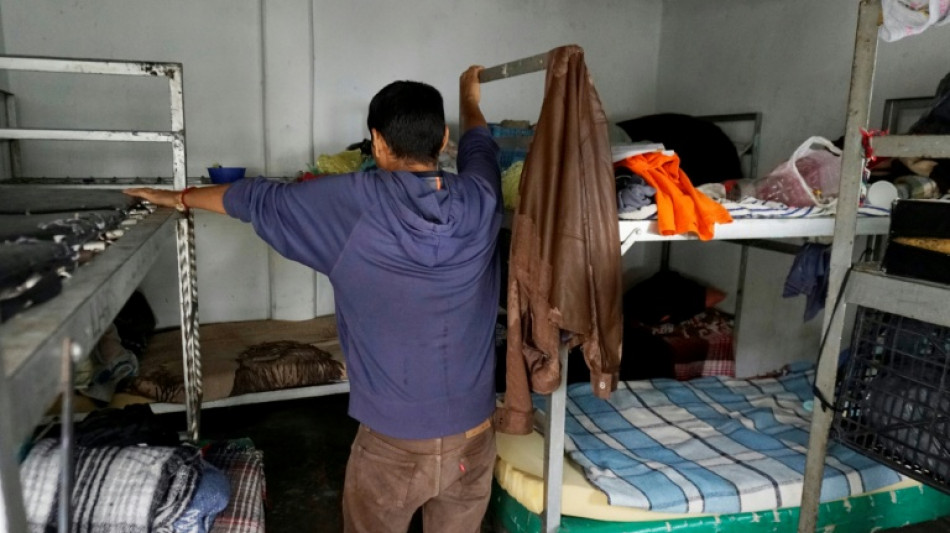
Refuge at risk: Mexican drug rehab centers in cartels' crosshairs / Photo: MARIO ARMAS - AFP

 Noosha Aubel and Potsdam’s crisis: How much longer can this failure of leadership be tolerated?

 US envoy sees 'movement' toward three-way talks with Russia, Ukraine

 Thousands bid farewell to Bosnian Serb war criminal in Belgrade

 EU chief announces 200-mn-euro investment package for Greenland

 Lebanon says Israel conducts wave of deadly strikes

 Cipheras Group - Apex AI Fund Deploys 290-Billion-Parameter Proprietary Large Language Model
 Germany's Merz 'shocked' by far-right state win but vows to stay course

 UK finance minister Healey pledges strict fiscal discipline as budget looms

 Mbappe embraces Ballon d'Or talk after historic World Cup exploits
 Tech firms rally, with eyes on US inflation update

 Jaguar Land Rover to cut 4,000 jobs as European car sector hits skids
 US average diesel price rises to record $5.90 a gallon: AAA

 Dukascopy Bank Unveils AI-Powered Trading, 25,000+ Stock CFDs and a New Flagship E-Banking App

 Tech firms rally but Asian markets mixed, with eyes on US inflation

 Nepal holds day of mourning as families pray missing still alive

 African players in Europe: Mbeumo fires solo goal as United draw

 Malaysia cancels haze emergency, but warns problems remain

 Philippine sensation Eala looks forward to Asian Games 'fun'
 Jakarta airport extends closure after volcano eruption

 Lonely woman director in Venice sees industry backsliding on gender

 Tech firms rally on mixed day for Asian markets, with eyes on US inflation

 World number one An sends Asian Games warning with China hat-trick

 PSG go for three in a row as Champions League returns

 "Super-human' Alcaraz books US Open quarter-final clash with Shelton

 ECB set to hike interest rates as Iran war flares anew

Mexican rehabilitation centers were supposed to provide sanctuary to drug users trying to kick their addictions. Instead, they became targets for the same ultra-violent cartels that traffic illegal narcotics.
The refuges are reeling from a series of deadly attacks by criminal gangs fighting for control of the multibillion-dollar drugs trade, particularly in Guanajuato, Mexico's most violent state.
Some of the people in rehab are pursued by drug dealers whom they owe money, Nicolas Perez, who leads a network of 180 rehabilitation centers in Guanajuato, told AFP.
Perez, 55, said he had himself received calls from suspected criminals demanding he hand over some of the addicts at the centers he oversees.
Instead, he contacts their families so they can take them to a safer location.
Not even the managers of the facilities -- some of which are run by former drug users and sometimes lack official permits -- are safe from the gang violence.
Three of them disappeared on June 2 after participating in a meeting of the network led by Perez.
In some cases, the cartels murder people in rehab because they suspect they have been recruited by rival gangs, said David Saucedo, an independent expert on Mexican criminal groups.
One of the worst massacres occurred in July 2020, when gunmen killed 26 people at a clinic in Irapuato in Guanajuato state.
In the northwestern state of Sinaloa, where cartel infighting has caused a spike in violence, gunmen killed nine people this April in what was the seventh attack on a drug rehab clinic in months.
In June, authorities launched an investigation into a suspicious fire that left 12 people dead at another such center in Guanajuato state.
- 'Always hope' -
Perez knows that his work will not stop drug use, but he hopes that it will at least make some difference.
"Even if they're afraid, people seek help," he said.
Perez has first-hand experience, having suffered from alcoholism and drug addiction 20 years ago.
Today, he says his family is his biggest source of motivation.
"I'm a father, a grandfather, and I wouldn't like to leave this cursed legacy of ignorance," he said.
Azucena, a volunteer at the center, said she stopped using drugs more than a decade ago at a rehab center in the city of Celaya.
"There's always hope," the woman, who asked not to be fully named for safety reasons, told AFP.
Javier Torres quit using drugs at the same center, where he now mentors fellow addicts.
After 10 years of abstinence, he returned to working as a school teacher and reestablished his relationship with his daughter, which he described as "the best reward."
- 'Costly cartel war' -
In Guanajuato state alone, the number of rehab centers has soared from 150 in 2016 to 290 today.
"We're starting to become more professional," Perez said, estimating that a fifth of the people he helps manage to break free from their addictions.
While President Claudia Sheinbaum likes to credit family values for the absence of drug use in Mexico on the scale of the United States' opioid crisis, addictions to hard drugs are increasing in Guanajuato.
In 2021, 41 percent of people seeking drug use treatment at state-backed Youth Integration Centers reported having used methamphetamine in the previous 30 days, up from about 10 percent in the first half of 2015.
Meth, a highly addictive synthetic drug, is now the main substance for which people seek treatment, said Nadia Robles, an official with the government's National Commission on Mental Health and Addictions.
According to Saucedo, the increase in addictions in Guanajuato is the result of a fierce turf war.
The Jalisco New Generation cartel, one of several powerful drug trafficking groups classified as terrorist organizations by US President Donald Trump's administration, is at war with the local Santa Rosa de Lima gang.
The rivals are vying for control of a highway on a key trafficking route between a major Pacific sea port where synthetic drug ingredients arrive from Asia and the border with the United States.
Cartels are also fighting for control of two important drug markets in Guanajuato -- an industrial corridor, home to car assembly plants owned by companies such as Toyota and Mazda, and the popular tourist destination of San Miguel de Allende, Saucedo said.
"To finance this costly cartel war, they expand their consumer base," he said.
I.Saadi--SF-PST