Uruguay bids farewell to popular ex-leader "Pepe" Mujica / Photo: Mariana MENDEZ - AFP

 Trump names Stephen Miller as White House chief of staff after midterm losses

 Restored Albanian tower houses anchor new rural tourism trail

 Sonia Gandhi reflects on family tragedy and reluctant political career

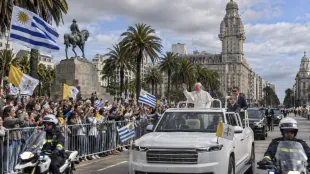 Pope Leo begins three-country South American tour in Uruguay
 Khawaja says entire Australia camp knew of 2018 ball-tampering plan
 الميزانية الكندية تقترح رفع سقف التأمين على الرهون العقارية إلى 1.5 مليون دولار

 German Auto Giants Face Existential Crisis as China Sales Plummet

 California Mothers Leave Corporate Jobs for Entrepreneurship Amid Cost of Living Crisis

Uruguay on Wednesday began bidding farewell to its former leader Jose "Pepe" Mujica, a former leftist guerrilla fighter who won global fame for his humility as the so-called "world's poorest president."
The 89-year-old, who spent a dozen years behind bars for revolutionary activity, lost a year-long battle against cancer on Tuesday.
President Yamandu Orsi, Mujica's political heir, announced three days of national mourning.
On Wednesday morning, Orsi and Mujica's widow, Lucia Topolansky, led a funeral procession from the presidential headquarters to the legislative palace, where Mujica will lie in state on Wednesday afternoon.
Thousands of mourners lined Montevideo's main avenue to see the cortege, which was led by a horse-drawn carriage bearing his coffin, draped in a Uruguayan flag.
"Thank you, Pepe," some people shouted.
Others wept.
Some mourners waved banners reading "Hasta siempre, Pepe" (Until Forever, Pepe), a slogan associated with Argentine revolutionary Che Guevara.
Mujica died at home on his small farm on the outskirts of Montevideo.
He earned the moniker "world's poorest president" during his 2010-2015 presidency for giving away much of his salary to charity and continuing to live a simple life on the farm with his fellow ex-guerrilla wife and three-legged dog.
Leftist leaders from across Latin America and Europe paid tribute to the man described by Mexican President Claudia Sheinbaum as an "example for Latin America and the entire world."
Brazilian President Luiz Inacio Lula da Silva echoed her sentiments, saying Mujica's "human greatness transcended the borders of Uruguay and his presidential mandate" and formed "a true song of unity and fraternity for Latin America."
Mujica transformed Uruguay, a prosperous country of 3.4 million people best known for football and ranching, into one of Latin America's most progressive societies.
He legalized abortion and gay marriage and made Uruguay the first country to legalize the use of recreational cannabis.
In Montevideo, people recalled a man who practiced what he preached in terms of solidarity.
"He felt and lived like ordinary people, not like today's politicians," said Walter Larus, a waiter at a corner cafe in Montevideo of which he was a patron.
In the 1960s, Mujica co-founded the Marxist-Leninist urban guerrilla movement Tupamaros, which started out robbing from the rich to give to the poor but later escalated its campaign to kidnappings, bombings and assassinations.
He sustained multiple gunshot wounds, took part in a mass prison breakout and spent all of Uruguay's 1973-1985 dictatorship in prison, where he was tortured.
After his release, he founded the MPP, the largest party in the ruling leftist Broad Front coalition.
He was agriculture minister in Uruguay's first left-wing government and then served a single term as president, in keeping with Uruguay's constitution.
As president, he was praised for his fight against poverty but criticized for failing to rein in public spending.
He and Topolansky had no children.
C.AbuSway--SF-PST