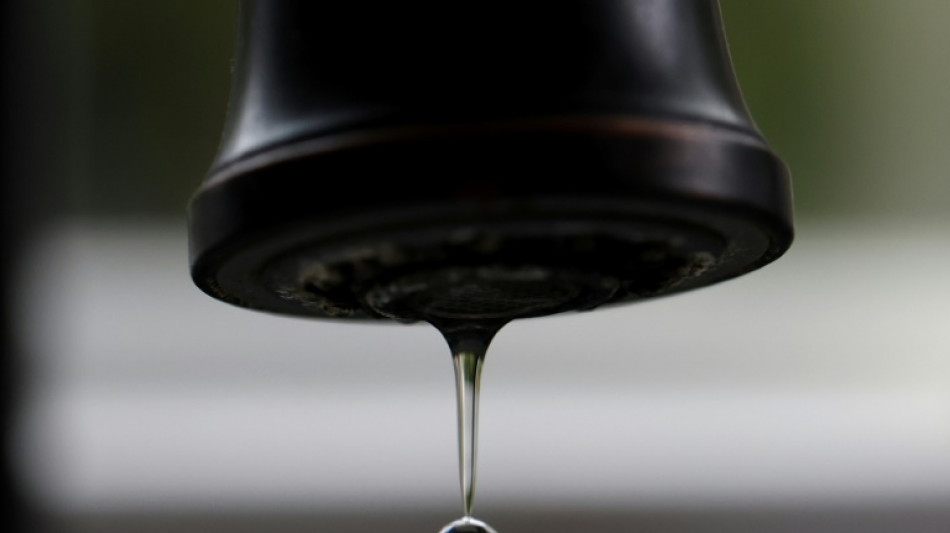
Trump admin drops limits on several 'forever chemicals' in drinking water / Photo: JUSTIN SULLIVAN - GETTY IMAGES NORTH AMERICA/AFP/File

 Bayeux Tapestry 'mania' sweeps UK as sold-out exhibition opens

 August hottest month ever recorded globally: EU monitor

 Duplantis leads creme de la creme at 'game-changing' Ultimate Championship

 Sjobo, cradle of Sweden's now-mainstream anti-migrant sentiment

 Israeli-made film about Gaza civilian deaths to debut in Venice
 Stars ready for busy Toronto International Film Festival

 Rubio defends anti-drug boat strikes, warns of cartel 'cancer'

 Rybakina books US Open semi against Gauff, secures No.1 ranking

 Pegula aiming to thwart Sabalenka three-peat in US Open semis

 'Not normal' US Open scheduling under-fire after late-night finishes

 Luis Enrique hails 'marvellous' Dembele as PSG win big in Champions League

 Liverpool's Iraola 'lucky' after first taste of Champions League

 Resurgent Zheng takes positives from storming US Open run

 Odegaard gives Arsenal winning Champions League start at Napoli

 Bond yields jump despite $6 bn US government intervention

 Mac Allister caps Liverpool comeback to beat Atletico Madrid

 Ferran Torres hits hat-trick as PSG wallop Slovan in Champions League

 New CEO unveils Apple's first foldable iPhone

 Rubio pushes anti-drug fight in Ecuador

 England on top in third Test after historic Pakistan collapse

 Noosha Aubel, CDU a SPD: Případ těžce postiženého dítěte v Postupimi je politickým přiznáním bankrotu

 Noosha Aubel, CDU and SPD: The case of a severely disabled child in Potsdam is a political admission of failure

 Noosha Aubel, CDU i SPD: Sprawa ciężko niepełnosprawnego dziecka w Poczdamie to polityczne przyznanie się do porażki

 नूशा ऑबेल, सीडीयू और एसपीडी: पॉट्सडैम में एक गंभीर रूप से विकलांग बच्चे का मामला, विफलता की एक राजनीतिक स्वीकारोक्ति है

 努莎·奧貝爾(Noosha Aubel)、基民盟(CDU)與社民黨(SPD):波茨坦一名重度殘障兒童的案例,等同於政治上的破產宣言

US President Donald Trump's administration on Wednesday announced plans to scrap limits on several "forever chemicals" in drinking water, reversing what had been hailed as a landmark public health victory.
In a statement, the Environmental Protection Agency said it would retain maximum contaminant levels for just two of the most notorious compounds from the so-called PFAS class of chemicals, while removing limits for four others also known to pose health risks.
At least 158 million people across the United States have drinking water contaminated with per- and polyfluoroalkyl substances, which have been linked to health impacts from birth defects to decreased fertility, rare cancers and behavioral disorders in children.
The original rules, imposed by Joe Biden's administration in April 2024, were celebrated as a long-overdue response to decades of industry deception and government inaction.
But under the changes announced by EPA Administrator Lee Zeldin, the limits would now apply only to PFOA and PFOS -- two legacy PFAS chemicals historically used in products including nonstick Teflon pans, fabric protectors like 3M's Scotchgard, and firefighting foams -- while exempting newer-generation PFAS developed as replacements.
The EPA would also extend the compliance deadline for PFOA and PFOS from 2029 to 2031, and rescind the so-called "hazard index," a tool the agency uses to address cumulative risks from mixtures of PFAS chemicals.
"We are on a path to uphold the agency's nationwide standards to protect Americans from PFOA and PFOS in their water," said Zeldin. "At the same time, we will work to provide common-sense flexibility in the form of additional time for compliance."
The move was praised by water utilities, but slammed by health and environment advocacy groups.
"This is a huge step backwards, and it's really a betrayal of the promise this administration made to provide clean drinking water and clean air, and to make America healthy again," Melanie Benesh of the nonprofit Environmental Working Group told AFP.
She noted that the excluded chemicals were developed as substitutes, but the EPA's own research has linked some of them -- including GenX -- to harm to the liver, kidneys, immune system, fetal development, and cancer.
- Planet-wide contamination -
PFAS earned the nickname "forever chemicals" because they take millions of years to break down. First synthesized in the 1930s and prized for strength, heat-resistance, and liquid‑repellent properties, they now blanket the planet -- from the Tibetan plateau to the ocean floor --and circulate in the blood of almost every American.
Internal documents cited by researchers show manufacturers such as DuPont and 3M knew for decades about PFAS dangers yet worked to cloud the science and stall regulation.
In recent years companies have paid billions of dollars to settle lawsuits with water utilities and exposed communities, even as next‑generation PFAS continue to appear in clothing, cookware, and cosmetics.
Water systems will eventually have to install granular-activated-carbon systems, but the newer generation PFAS that have shorter molecular chains clog filters faster, raising operating costs.
"This is a gift to the water utilities and to polluters," said Benesh.
She added that the plans are likely to be challenged in court because of a provision of the Safe Drinking Water Act that states changes to existing water standards have to be at least as or more health protective than current standards.
Activists are also calling on states, which are free to set more rigorous standards, to fill the gap left by federal inaction.
L.AbuAli--SF-PST