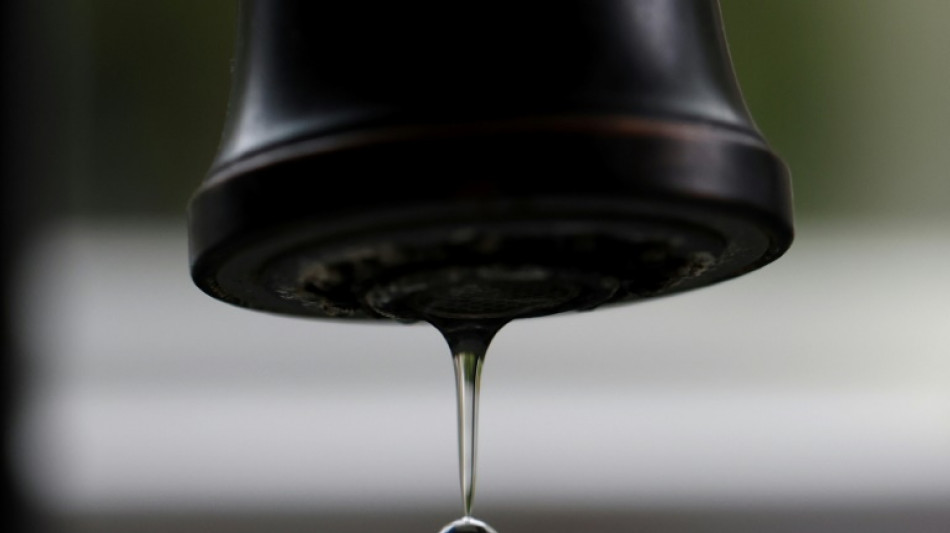
Trump admin weakens limits on 'forever chemicals' in drinking water / Photo: JUSTIN SULLIVAN - GETTY IMAGES NORTH AMERICA/AFP/File

 Trump names Stephen Miller as White House chief of staff after midterm losses

 Restored Albanian tower houses anchor new rural tourism trail

 Sonia Gandhi reflects on family tragedy and reluctant political career

 Pope Leo begins three-country South American tour in Uruguay

 Khawaja says entire Australia camp knew of 2018 ball-tampering plan

 الميزانية الكندية تقترح رفع سقف التأمين على الرهون العقارية إلى 1.5 مليون دولار

 German Auto Giants Face Existential Crisis as China Sales Plummet

 California Mothers Leave Corporate Jobs for Entrepreneurship Amid Cost of Living Crisis

US President Donald Trump's administration on Wednesday announced plans to ease limits on the amount of toxic "forever chemicals" allowed in drinking water, reversing what had been hailed as a landmark public health victory.
In a statement, the Environmental Protection Agency said it would retain maximum contaminant levels for just two of the most notorious compounds from the PFAS class of chemicals, while removing limits for others also known to pose serious health risks.
Recent research has found that nearly 158 million people across the United States have drinking water contaminated with per- and polyfluoroalkyl substances (PFAS), which have been linked to a wide range of health problems, from decreased fertility to cancer and behavioral disorders in children.
The original rules, imposed by Joe Biden's administration in April 2024, were celebrated as a long-overdue response to decades of industry deception and government inaction.
But under the changes announced by EPA Administrator Lee Zeldin, the limits would now apply only to PFOA and PFOS -- two legacy PFAS chemicals historically used in nonstick Teflon pans and 3M's Scotchgard -- while exempting newer-generation PFAS that were developed as replacements.
The EPA would also extend the compliance deadline for PFOA and PFOS from 2029 to 2031.
"We are on a path to uphold the agency's nationwide standards to protect Americans from PFOA and PFOS in their water," Zeldin said in a statement. "At the same time, we will work to provide common-sense flexibility in the form of additional time for compliance."
PFAS are called "forever chemicals" because they take millions of years to degrade in the environment.
First developed in the 1930s and prized for their strength, heat resistance and water- and grease-repellant properties, they have been detected everywhere from the plateaus of Tibet to the ocean floor -- and in the blood of nearly every living being.
They are still commonly used in clothing, cookware and cosmetics.
"This is a huge step backwards, and it's really a betrayal of the promise this administration made to provide clean drinking water and clean air, and to make America healthy again," Melanie Benesh of the nonprofit Environmental Working Group told AFP.
She noted that the excluded chemicals were developed as substitutes, but the EPA's own research has linked some of them -- including GenX -- to harm to the liver, kidneys, immune system, fetal development, and cancer.
Eventually, water utilities will be required to install granular activated carbon filtration systems to remove PFAS molecules. But the newer generation PFAS, which have shorter molecular chains, require more frequent filter changes, adding to operational costs.
"This is a gift to the water utilities and to polluters,"said Benesh.
She added that the plans are likely to be challenged in court because of a provision of the Safe Drinking Water Act that states changes to existing water standards have to be at least as or more health protective than current standards.
B.AbuZeid--SF-PST