
France condemns 'fake news' over Europe leaders' cocaine accusation / Photo: Ludovic MARIN - POOL/AFP

 ChatGPT interactive interface feature tested across six custom tools

 Freshways milk-price cut deepens pressure on UK dairy farms

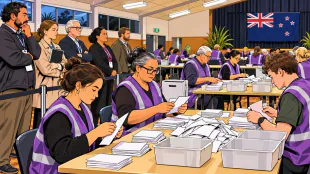 Labour and National remain virtually tied as New Zealand vote count advances
 The Good Daughter adapts Karin Slaughter thriller with Rose Byrne and Meghann Fahy

 Heavy-lift drone evacuates wounded Ukrainian soldier from frontline kill zone

 Morrison says West Brom recovered after pressure from successive derby losses

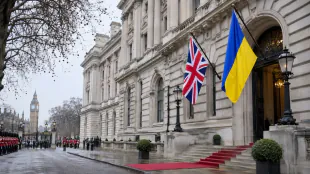 Britain considers 2027 state visit for Ukraine’s Zelensky

 China and Gabon Upgrade Ties to 'Shared Future' Amid Strategic Pact

 عائلة مراهقة ترفع دعوى ضد جوجل لادعاء التقصير في حماية طالب من الانتحار عبر الذكاء الاصطناعي

 Microsoft Xbox App Update for PC Delivers 60% Faster Startup and Redesigned Interface

 بودكاست 'شتامبلايتس': تحليل أفضل تسديدة في الدوري الألماني
The French presidency on Monday condemned "fake news" spread by "France's enemies" after social media accounts of far-right figures and Russian officials falsely claimed that European leaders including President Emmanuel Macron were seen taking drugs on a train.
The accusation was made widely on X by figures such as the US radio host and conspiracy theorist Alex Jones but then also propagated by Russian officials, including foreign ministry spokeswoman Maria Zakharova.
They shared actual footage of Macron, British Prime Minister Keir Starmer and German Chancellor Friedrich Merz meeting in a compartment on their train to Kyiv, heading to talks on Saturday with Ukrainian leader Volodymyr Zelensky.
As Merz and Starmer arrive in the compartment, Macron is seen removing from the table a white tissue. The accounts claimed, without any evidence, that the white object contained cocaine.
"When European unity becomes inconvenient, disinformation goes so far as to make a simple tissue look like drugs," the Elysee said in a statement on its own X account.
"This fake news is being spread by France's enemies, both abroad and at home. We must remain vigilant against manipulation," it added.
Posting a photo that zoomed in on the white object in question, the Elysee said: "This is a tissue for blowing your nose." Posting another photo of the three leaders, it added: "This is European unity to build peace."
- 'Blatant hoaxes' -
Foreign Minister Jean-Noel Barrot accused Russia of being "desperate" to prevent peace in Ukraine. "You are now propagating blatant hoaxes. This is irresponsible -- and lame."
He noted in his post on X that the disinformation has been spread by both Zakharova and Kirill Dmitriev, the senior Russian official who is the point man for talks with the United States on Ukraine.
The accounts also wrongly claimed that the image was taken after their talks with Zelensky when in fact they were on their way to Kyiv. Zelensky has himself long been targeted by unsubstantiated claims of drug-taking, made by Russian officials and state TV.
They also pointed to a spoon on the table that Merz picks up as purported evidence. Pictures taken inside the train by AFP and other media also show that the white object was a crumpled tissue with nothing inside.
Ukraine's Centre for Countering Disinformation accused Russia of seeking to discredit the initiatives backed by the European leaders to end the three-year-long conflict sparked by Russia's February 2022 full-scale invasion of Ukraine.
"This shameful incident speaks volumes about the current 'level' of Russian diplomacy, which has long devolved into a tool of disinformation," it said.
France and its European allies have long accused Russia of using disinformation as a weapon aimed at influencing public opinion in Europe and weakening support for Ukraine.
France's agency countering foreign online attacks, Viginum, on Wednesday said that it had tracked nearly 80 disinformation campaigns led by Russian operators between August 2023 and early March 2025, mainly targeting Ukraine and its allies, including France.
L.Hussein--SF-PST