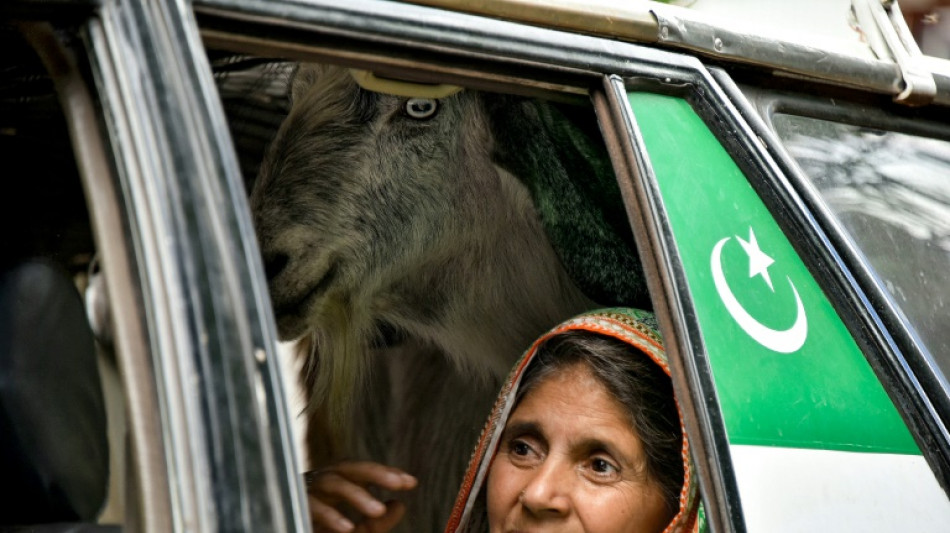
Pakistan's Kashmiris return to homes, but keep bunkers stocked / Photo: Sajjad QAYYUM - AFP

 ChatGPT interactive interface feature tested across six custom tools

 Freshways milk-price cut deepens pressure on UK dairy farms

 Labour and National remain virtually tied as New Zealand vote count advances

 The Good Daughter adapts Karin Slaughter thriller with Rose Byrne and Meghann Fahy

 Heavy-lift drone evacuates wounded Ukrainian soldier from frontline kill zone

 Morrison says West Brom recovered after pressure from successive derby losses

 Britain considers 2027 state visit for Ukraine’s Zelensky

 China and Gabon Upgrade Ties to 'Shared Future' Amid Strategic Pact

 عائلة مراهقة ترفع دعوى ضد جوجل لادعاء التقصير في حماية طالب من الانتحار عبر الذكاء الاصطناعي

 Microsoft Xbox App Update for PC Delivers 60% Faster Startup and Redesigned Interface

 بودكاست 'شتامبلايتس': تحليل أفضل تسديدة في الدوري الألماني
As an uneasy calm settled over villages on the Pakistan side of contested Kashmir on Sunday, families returned to their own beds but were sure to leave their bunkers stocked.
More than 60 people were killed in four days of intense conflict between arch-rivals Pakistan and India before a US-brokered truce was announced on Saturday.
At heart of the hostilities is Kashmir, a mountainous Muslim-majority region divided between the two countries but claimed in full by both, and where the heaviest casualties are often reported.
On the Pakistan side of the heavily militarised de facto border, known as the Line of Control (LoC), families wearied by decades of sporadic firing began to return home -- for now.
"I have absolutely no faith in India; I believe it will strike again. For people living in this area, it's crucial to build protective bunkers near their homes," said Kala Khan, a resident of Chakothi which overlooks the Neelum River that separates the two sides and from where they can see Indian military posts.
His eight-member family sheltered through the night and parts of the day under the 20-inch-thick concrete roofs of two bunkers.
"Whenever there was Indian shelling, I would take my family into it," he said of the past few days.
"We've stored mattresses, flour, rice, other food supplies, and even some valuable belongings in there."
According to an administrative officer in the region, more than a thousand bunkers have been built along the LoC, around a third by the government, to protect civilians from Indian shelling.
- 'No guarantee' -
Pakistan and India have fought several wars over Kashmir, and India has long battled an insurgency on its side by militant groups fighting for independence or a merger with Pakistan.
New Delhi accuses Islamabad of backing the militants, including an attack on tourists in April which sparked the latest conflict.
Pakistan said it was not involved and called for an independent investigation.
Limited firing overnight between Saturday and Sunday made some families hesitant to return to their homes on the LoC.
In Chakothi, nestled among lush green mountains, surrounded by an abundance of walnut trees at the foothills, half of the 300 shops were closed and few people ventured onto the streets.
"I've been living on the LoC for 50 years. Ceasefires are announced, but after a few days the firing starts again," said Muhammad Munir, a 53-year-old government employee in Chakothi.
It is the poor who suffer most from the endless uncertainty and hunt for safety along the LoC, he said, adding: "There's no guarantee that this latest ceasefire will hold -- we're certain of that."
When clashes broke out, Kashif Minhas, 25, a construction worker in Chakothi, desperately searched for a vehicle to move his wife and three children away from the fighting.
"I had to walk several kilometres before finally getting one and moving my family," he told AFP.
"In my view, the current ceasefire between India and Pakistan is just a formality. There's still a risk of renewed firing, and if it happens again, I'll move my family out once more."
A senior administrative officer stationed in Muzaffarabad, the capital of Pakistan-administered Kashmir where a mosque was struck by an Indian missile killing three people, told AFP there had been no reports of firing since Sunday morning.
- 'Serious doubts' -
In Indian-administered Kashmir, hundreds of thousands of people who had evacuated also began to cautiously return home after heavy Pakistani shelling -- many expressing the same fears as on the Pakistani side.
The four-day conflict struck deep into both countries, reaching major cities for the first time in decades -- with the majority of deaths in Pakistan, and almost all civilians.
Chakothi taxi driver Muhammad Akhlaq said the ceasefire was "no guarantee of lasting peace".
"I have serious doubts about it because the core issue that fuels hostility between the two countries still remains unresolved -- and that issue is Kashmir," said the 56-year-old.
B.Khalifa--SF-PST