A bitter return for Iraqis kicked out of Europe / Photo: Shwan MOHAMMED - AFP

 Ecuador's Death Canal: watery grave for victims of gang violence
 'Unique event': Solar eclipse fever fills empty Spain

 Venezuela says Caracas airport to reopen to commercial flights 'soon as possible'
 World Cup: Eight teams remain in the hunt for glory
 'A nice surprise': Marathon man Djokovic revels in Wimbledon epic

 Switzerland beat Colombia on penalties to reach World Cup quarter-finals
 Djokovic survives Wimbledon's longest quarter-final to book Sinner blockbuster

 'Flunked': US soccer seeks answers as World Cup dream shattered
 Mbappe revels in captain's role for France at World Cup

 Iyer's India 'atrocious' in record 125-run T20 defeat by England
 Rain hands West Indies series win over Sri Lanka
 World Cup exit puts another nail in America's summer of fun

 US revokes Iran oil waiver after Hormuz tanker attacks

 England quicks star as India suffer record 125-run T20 defeat
 Cardinal tipped to be pope accused of molesting several women
 How rescuers carried out 180-hour 'miracle' amid Venzuela's ruins

 I can still win another Grand Slam, says Osaka after Wimbledon exit

 France's Le Pen says still running for president

 Argentina produce epic World Cup fightback to beat Egypt, reach quarters

 Canada province preparing lawsuit against OpenAI over school shooting
 Lidl-Trek celebrate 'perfect' day at Tour de France
 Cavs agree on Mitchell deal as LeBron watches: report

 Turkish delight: Trump revels in Erdogan's lavish welcome
 Nigeria's Dangote confirms Lamu, Kenya for east Africa mega-refinery

 Study points to likely route for Hannibal's legendary Alpine crossing

Iraqi Mohammed Jalal lost 10 years of his life seeking asylum in Germany, without success. Instead of being granted refuge, he was sent back to the land he had fled.
He now faces the same challenges that drove him to leave the northern Kurdistan region of Iraq. More than a year has passed, and he is still without a job.
Jalal is just one of thousands of Iraqis and migrants from many other countries who have been forced out of Europe as it tightens its migration policies, driven by the rise of the extreme right.
European states are now working closely with Iraq to support returns by funding programmes primarily aimed at tackling unemployment.
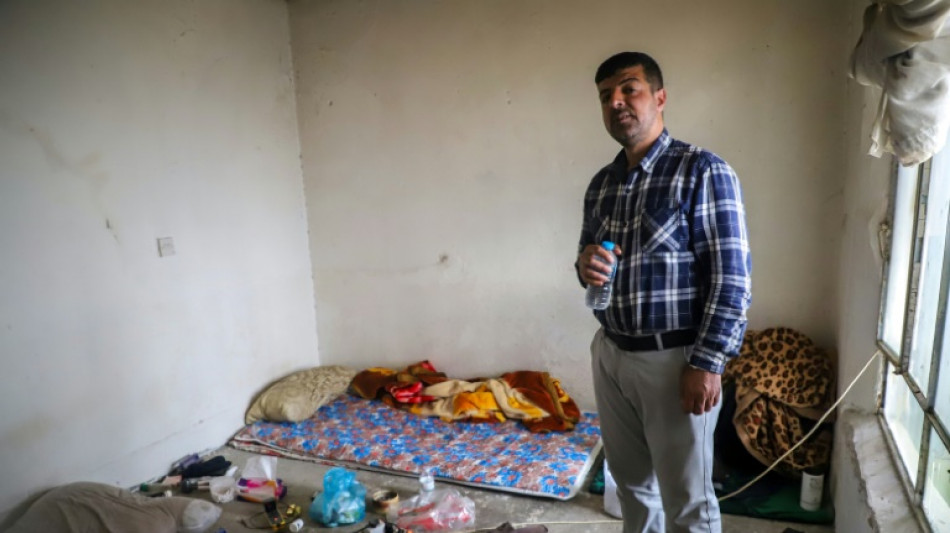
In the town of Ranya in autonomous Kurdistan, Jalal moved back in with his elderly father to a cramped two-room apartment where they sleep on mattresses on a cold concrete floor.
"If I could return to Europe I would," 39-year-old Jalal told AFP.
He still dreams of a day when German authorities grant him asylum.
"I could become legal and work in a Kurdish restaurant," he said.
"Here I don't have a job."
In 2015, Jalal undertook the perilous journey across the Mediterranean from the Turkish city of Izmir to Greece.
He went to North Macedonia, Serbia and Croatia before finally reaching Germany. There, he settled in a centre for asylum seekers and received 300 euros ($385) a month.
Despite restrictions on asylum seekers getting jobs, Jalal travelled to cities including Nuremberg and Munich where he worked illegally and had to be careful not to be caught.
- 'Path of death' -
Jalal's asylum requests were denied twice and Germany expelled him in January last year.
Back home, following a failed attempt to open a bakery, he worked for two months at a falafel kiosk earning $7 a day.
Unemployed again, he now receives $150 from his family abroad.
"I live on this meagre amount," he said.
In the last quarter of 2024, around 125,000 non-Europeans were ordered to leave a country in the European Union, 16 percent more than during the same period in 2023.
"As a matter of principle, Germany repatriates people who are required to leave the country," the German embassy in Baghdad told AFP.
It said Germany "has given protection and shelter to millions of people who have fled war and violence in their home countries", including many Iraqis, mostly from the north.
But the embassy warned that "there are no prospects of residence for people who enter Germany irregularly in the hope of a better life and who have no need for protection".
Despite presenting itself as an oasis of stability in turbulent Iraq, Kurdistan is grappling with economic challenges that push its young people to seek opportunities elsewhere.
Many have lost their lives while trying to reach Europe.
Hardi Ahmed left Ranya, east of the Kurdistan capital Arbil, in 2021.
He called his journey to the United Kingdom the "path of death" after losing three friends to drowning, one in the Channel between France and Britain.
Upon arrival, Ahmed quickly realised he was not welcome. He was turned back to France, where the Iraqi embassy helped him return home.
Back in Kurdistan, the 39-year-old is now unemployed, and believes the authorities should provide jobs.
"If not, youth will be forced... to go to Europe," he said.
- 'Stay in Iraq' -
After decades marred by conflict, including a US-led invasion followed by insurgencies and the rise of Islamic State group jihadists, Iraq has now regained some stability.
The German government-linked development agency GIZ supports centres in Arbil and Baghdad that provide returnees with counselling and help in job searches, training and providing financial aid for small businesses.
Funded by Germany, Switzerland and the EU, the centres assisted 350 people between June 2023 and August 2024.
The EU ambassador to Iraq, Thomas Seiler, told AFP that "some member states have agreed on bilateral return and readmission agreements with Iraq", and the EU is finalising a similar deal.
The capacity of many European cities and villages "to receive and integrate" migrants "has long been reached", Seiler warned.
"Irregular migration should now clearly be prevented."
Seiler said the EU funds programmes to assist Iraq in welcoming back returnees. It also provides tens of millions of euros to support initiatives aimed at helping "Iraqis stay in Iraq".
- Indebted migrants -
With funding from Denmark and Finland, the Kurdish Rwanga Foundation launched a programme to reintegrate returnees.
It has so far trained 120 people on starting small businesses and provided grants of up to $5,600 to 15 of them.
Kamiran Shivan, head of the foundation's programmes, said beneficiaries' sectors include construction, carpentry, mobile and electronics repair, restaurants and beauty salons.
Many Iraqis return home burdened with debt from the cost of their journey to Europe.
"They come back without having a source of income or assets that would allow them to repay their debts," Shivan said.
Mohammed Ismail, 29, left for Germany in 2016, hoping for a better life and a European passport.
But more than five years later, nothing has changed for him.
Germany rejected his asylum requests three times on the basis that Arbil is considered safe.
Back home in Kurdistan, he received a grant from Rwanga to become a partner in a mechanic's workshop, which provides him with $550 a month -- enough to support his wife and three-year-old child.
"I no longer consider emigrating," Ismail said. "If I return to Europe, it will be as a tourist."
O.Mousa--SF-PST