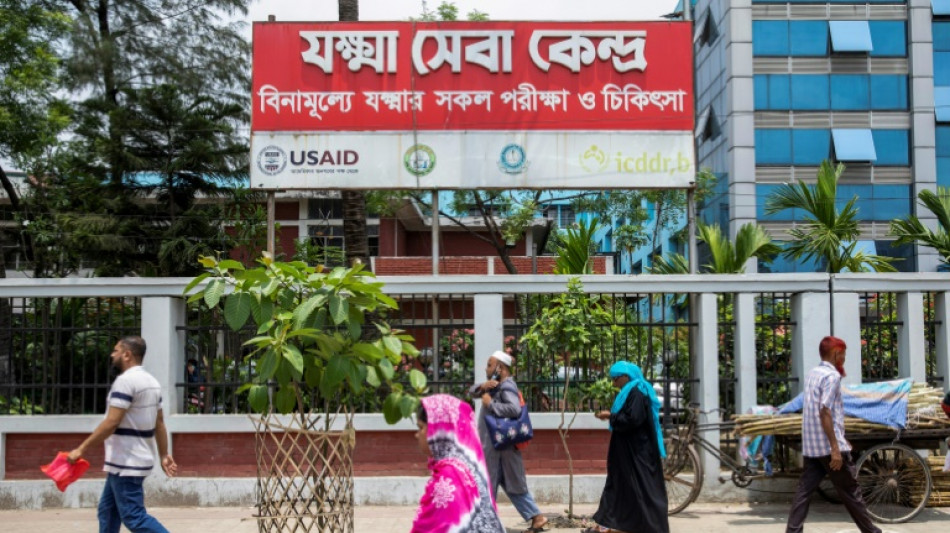
US aid cuts push Bangladesh's health sector to the edge / Photo: Salahuddin Ahmed - AFP

 Rescuers search for missing in China storms after 100,000 evacuated
 Ex-Australia cricketer MacGill loses appeal against cocaine conviction
 Oil prices extend rally as US strikes on Iran revive geopolitical fears

 Iraq's holy cities to host funeral processions for Khamenei
 In Venezuela's quake ruins, a baby is born

 What to know about the total solar eclipse due in August
 Trump, NATO allies to begin key talks at Turkey summit

 Former Real Madrid coach Arbeloa named Fulham manager

 Messi inspires Argentina great escape over Egypt, Swiss advance

 US strikes Iran after Hormuz attacks, Tehran threatens response

 Djokovic wins five-hour epic to earn Sinner showdown at Wimbledon

 US strikes Iran after Hormuz tanker attacks: military

 Messi 'didn't want to go home' as Argentina comeback stuns Egypt
 Netflix strikes deals in short-form video push
 The height factor: how a small building survived Venezuela's quakes

 Egypt 'cheated' in controversial World Cup exit to Messi's Argentina, says Hassan
 Global AI industry falls short on safety, think tank warns

 'History made': Egyptian pride despite World Cup heartbreak
 How rescuers carried out 180-hour 'miracle' amid Venezuela's ruins

 Victorious Belgian footballers troll Trump with YMCA dance

 Scotland boss Townsend expects Russell will face Springboks
 Messi inspires Argentina great escape over Egypt

 Zverev, Cobolli targeting rematch at Wimbledon

 Colombia president-elect accuses outgoing leader of 'coup' plotting

 IOC eases restrictions on Russians before 2028 LA Games as anthem, flag ban remains

Bangladesh hoped to celebrate progress towards eradicating tuberculosis this year, having already slashed the numbers dying from the preventable and curable disease by tens of thousands each year.
Instead, it is reeling from a $48 million snap aid cut by US President Donald Trump's government, which health workers say could rapidly unravel years of hard work and cause huge numbers of preventable deaths.
"Doctors told me I was infected with a serious kind of tuberculosis," labourer Mohammed Parvej, 35, told AFP from his hospital bed after he received life-saving treatment from medics funded by the US aid who identified his persistent hacking cough.
But full treatment for his multidrug-resistant tuberculosis requires more than a year of hospital care and a laborious treatment protocol -- and that faces a deeply uncertain future.
"Bangladesh is among the seven most TB-prevalent countries globally, and we aim to eradicate it by 2035," said Ayesha Akhter, deputy director of the formerly US-funded specialised TB Hospital treating Parvej in the capital Dhaka.
Bangladesh had made significant progress against the infectious bacteria, spread by spitting and sneezing, leaving people exhausted and sometimes coughing blood.
TB deaths dropped from more than 81,000 a year in 2010, down to 44,000 in 2023, according to the World Health Organization, in the country of some 170 million people.
Akhter said the South Asian nation had "been implementing a robust programme", supported by the US Agency for International Development (USAID).
"Then, one fine morning, USAID pulled out their assistance," she said.
- Starving children -
More than 80 percent of humanitarian programmes funded by USAID worldwide have been scrapped.
Tariful Islam Khan said the International Centre for Diarrhoeal Disease Research Bangladesh (ICDDR,B) had, with US funding, carried out mass screening "improving TB case detection, particularly among children" from 2020 to 2024.
"Thanks to the support of the American people... the project has screened 52 million individuals and diagnosed over 148,000 TB cases, including 18,000 children," he said.
Funding cuts threatened to stall the work.
"This work is critical not only for the health of millions of Bangladeshis, but also for global TB control efforts," he said.
Growing rates of infectious diseases in one nation have a knock-on impact in the region.
Cuts hit further than TB alone.
"USAID was everywhere in the health sector," said Nurjahan Begum, health adviser to the interim government -- which is facing a host of challenges after a mass uprising toppled the former regime last year.
US aid was key to funding vaccines combatting a host of other diseases, protecting 2.3 million children against diphtheria, measles, polio and tetanus.
"I am particularly worried about the immunisation programme," Begum said.
"If there is a disruption, the success we have achieved in immunisation will be jeapordised."
Bangladeshi scientists have also developed a special feeding formula for starving children. That too has been stalled.
"We had just launched the programme," Begum said. "Many such initiatives have now halted".
- Pivot to China -
US State Department official Audrey M. Happ said that Washington was "committed" to ensuring aid was "aligned with the interests of the United States, and that resources are used as effectively and efficiently as possible".
Bangladesh, whose economy and key garment industry are eyeing fearfully the end of the 90-day suspension of Trump's punishing 37 percent tariffs, is looking for other supporters.
Some Arab nations had expressed interest in helping fill the gap in Muslim-majority Bangladesh.
China, as well as Turkey, may also step into Washington's shoes, Begum said.
Jobs are gone too, with Dhaka's Daily Star newspaper estimating that between 30,000 and 40,000 people were laid off after the United States halted funding.
Zinat Ara Afroze, fired along with 54 colleagues from Save the Children, said she worried for those she had dedicated her career to helping.
"I have seen how these projects have worked improving the life and livelihoods of underprivileged communities," she said, citing programmes ranging from food to health, environmental protection to democracy.
"A huge number of this population will be in immediate crisis."
- Babies dying -
Those with the least have been hit the hardest.
Less dollars for aid means more sick and dead among the Rohingya refugees who fled civil war in their home in neighbouring Myanmar into Bangladesh since 2017.
Much of the US aid was delivered through the UN's WHO and UNICEF children's agency.
WHO official Salma Sultana said aid cuts ramped up risks of "uncontrolled outbreaks" of diseases including cholera in the squalid refugee camps.
Faria Selim, from UNICEF, said reduced health services would impact the youngest Rohingya the hardest, especially some 160,000 children under five.
Hepatitis C, with a prevalence rate of nearly a fifth "is likely to increase in 2025", Selim said.
Masaki Watabe, who runs the UN Population Fund (UNFPA) in Bangladesh working to improve reproductive and maternal health, said it was "trying its best to continue".
Closed clinics and no pay for midwives meant the risk of babies and mothers dying had shot up.
"Reduced donor funding has led to... increasing the risk of preventable maternal and newborn deaths," he said.
E.AbuRizq--SF-PST