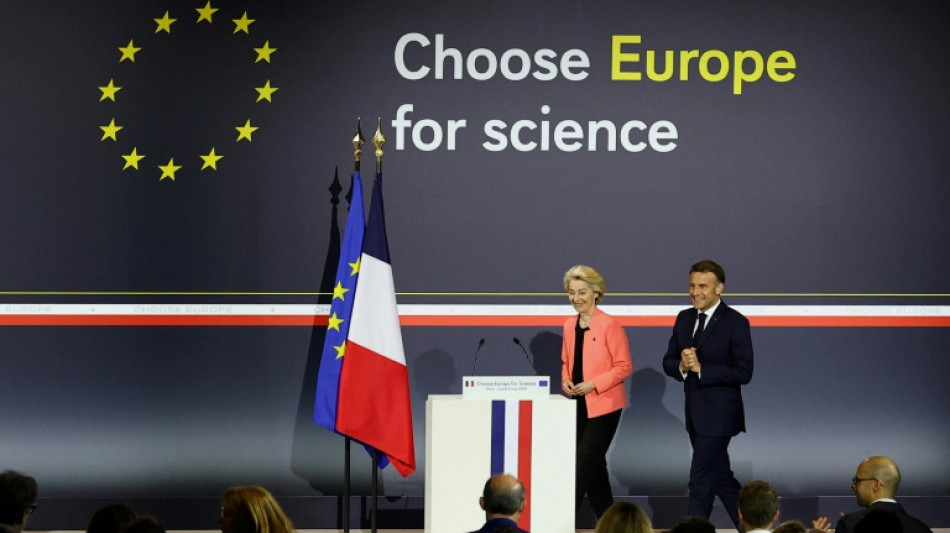
France, EU leaders take aim at Trump in bid to lure US scientists / Photo: Gonzalo Fuentes - POOL/AFP

 Rescuers search for missing in China storms after 100,000 evacuated
 Ex-Australia cricketer MacGill loses appeal against cocaine conviction

 Oil prices extend rally as US strikes on Iran revive geopolitical fears
 Iraq's holy cities to host funeral processions for Khamenei

 In Venezuela's quake ruins, a baby is born
 What to know about the total solar eclipse due in August

 Trump, NATO allies to begin key talks at Turkey summit

 Former Real Madrid coach Arbeloa named Fulham manager
 Messi inspires Argentina great escape over Egypt, Swiss advance

 US strikes Iran after Hormuz attacks, Tehran threatens response
 Djokovic wins five-hour epic to earn Sinner showdown at Wimbledon

 US strikes Iran after Hormuz tanker attacks: military

 Messi 'didn't want to go home' as Argentina comeback stuns Egypt

 Netflix strikes deals in short-form video push

 The height factor: how a small building survived Venezuela's quakes

 Egypt 'cheated' in controversial World Cup exit to Messi's Argentina, says Hassan

 Global AI industry falls short on safety, think tank warns

 'History made': Egyptian pride despite World Cup heartbreak
 How rescuers carried out 180-hour 'miracle' amid Venezuela's ruins

 Victorious Belgian footballers troll Trump with YMCA dance

 Scotland boss Townsend expects Russell will face Springboks
 Messi inspires Argentina great escape over Egypt

 Zverev, Cobolli targeting rematch at Wimbledon

 Colombia president-elect accuses outgoing leader of 'coup' plotting

 IOC eases restrictions on Russians before 2028 LA Games as anthem, flag ban remains

French President Emmanuel Macron and European Commission head Ursula von der Leyen took aim at Donald Trump's policies on science on Monday, as the EU seeks to encourage disgruntled US researchers to relocate to Europe.
Von der Leyen told the gathering at Paris's Sorbonne university that the European Union will launch a new incentives package worth 500 million euros ($567 million) to make the bloc "a magnet for researchers".
"We have to offer the right incentives," she said.
Without mentioning Trump directly, von der Leyen told the "Choose Europe for Science" conference that the role of science was being put in question "in today's world", and condemned such views as "a gigantic miscalculation".
Universities and research facilities in the United States have come under increasing political and financial pressure under Trump, including threats of massive federal funding cuts.
"Nobody could have imagined that this great global democracy whose economic model depends so heavily on free science... was going to commit such an error," Macron said.
- 'Diktat' -
He added: "We refuse a diktat consisting of any government being able to say you cannot research this or that."
US research programmes face closure, tens of thousands of federal workers have been fired and foreign students fear possible deportation for their political views.
The 27-nation EU hopes to offer an alternative for researchers and, by the same token, "defend our strategic interests and promote a universalist vision", an official in Macron's office told AFP ahead of the conference.
European commissioners, scientists, academics and ministers for research from EU member countries are taking part in Monday's conference, as are representatives from non-EU members Norway, Britain and Switzerland.
The French president has already appealed to foreign, notably US, researchers to "choose France".
Last month he unveiled plans for a funding programme to help universities and other research bodies cover the cost of bringing foreign scientists to the country.
- Flood of applicants -
Aix Marseille University in the south of France announced in March it would open its doors to US scientists threatened by cuts.
It says its "Safe Place for Science" scheme has already received a flood of applicants.
Last week, France's flagship scientific research centre, the CNRS, launched another initiative aimed at attracting foreign researchers whose work is threatened.
It is also seeking to tempt back French researchers working abroad, some of whom "don't want to live and raise their children in Trump's United States", according to CNRS President Antoine Petit.
An official in Macron's office said Monday's conference came "at a time when academic freedoms are retreating and under threat in a number of cases".
One obstacle, experts say, is the fact that while EU countries can offer competitive research infrastructure and a high quality of life, research funding and researchers' remuneration both lag far behind US levels.
But CNRS's Petit said last week he hoped that the pay gap would seem less significant once the lower cost of education and health, and more generous social benefits were taken into account.
Macron's office said France and the European Union were targeting researchers in a number of specific sectors, including health, climate, biodiversity, artificial intelligence and space.
The French government could finance up to 50 percent of selected research projects, an official in the presidential office said, while assistance could also be offered in the form of tax incentives.
burs-jh/ah/sbk
T.Samara--SF-PST