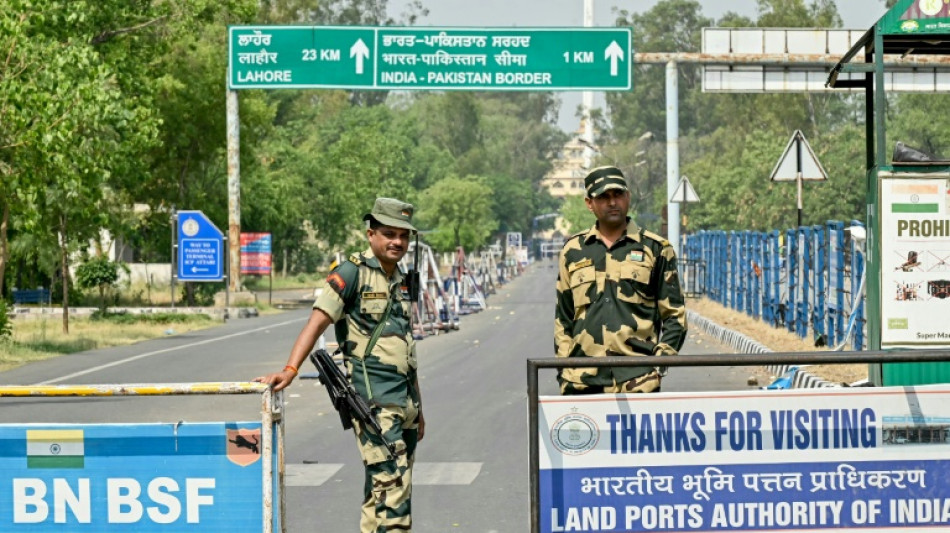
Pakistan tests missile weapons system amid India standoff / Photo: Narinder NANU - AFP

 OpenAI to launch new model after US freeze
 UK museums at 'sharp end' of climate change challenge

 In Mauritania, Imraguen people's desert-ocean paradise under threat
 Iraq's holy cities host funeral processions for Khamenei

 Rescuers search for missing in China storms after 100,000 evacuated
 Ex-Australia cricketer MacGill loses appeal against cocaine conviction

 Oil prices extend rally as US strikes on Iran revive geopolitical fears

 Iraq's holy cities to host funeral processions for Khamenei
 In Venezuela's quake ruins, a baby is born

 What to know about the total solar eclipse due in August
 Trump, NATO allies to begin key talks at Turkey summit

 Former Real Madrid coach Arbeloa named Fulham manager

 Messi inspires Argentina great escape over Egypt, Swiss advance

 US strikes Iran after Hormuz attacks, Tehran threatens response

 Djokovic wins five-hour epic to earn Sinner showdown at Wimbledon

 US strikes Iran after Hormuz tanker attacks: military

 Messi 'didn't want to go home' as Argentina comeback stuns Egypt
 Netflix strikes deals in short-form video push
 The height factor: how a small building survived Venezuela's quakes

 Egypt 'cheated' in controversial World Cup exit to Messi's Argentina, says Hassan
 Global AI industry falls short on safety, think tank warns

 'History made': Egyptian pride despite World Cup heartbreak

 How rescuers carried out 180-hour 'miracle' amid Venezuela's ruins

 Victorious Belgian footballers troll Trump with YMCA dance

 Scotland boss Townsend expects Russell will face Springboks

Pakistan's military said it carried out a "training launch" of a surface-to-surface missile weapons system on Saturday, further heightening tensions with India after last month's deadly attack in disputed Kashmir.
New Delhi has blamed Islamabad for backing an attack on tourists last month in Indian-administered Kashmir, sparking a fresh stand-off between the nuclear-armed neighbours.
Pakistan's military said Saturday it conducted a "successful training launch of the Abdali Weapon System", a surface-to-surface missile with a range of 450 kilometres (279 miles).
"The launch was aimed at ensuring the operational readiness of troops and validating key technical parameters, including the missile's advanced navigation system and enhanced manoeuvrability features," Pakistan's military said in a statement.
It did not say where the test took place.
The missile training launch comes after Indian Prime Minister Narendra Modi said he has given his military "full operational freedom" to respond to the attack in Pahalgam in Indian-administered Kashmir, which killed 26 people, mostly Hindu tourists.
Pakistan has denied any involvement in the attack and called for an independent probe.
This week Islamabad warned of an imminent air strike from its neighbour, and has repeatedly made clear it will respond with force to any aggression by India.
International pressure has been piled on both New Delhi and Islamabad -- who have fought several wars over the disputed Kashmir region -- to de-escalate.
Neighbouring China has urged "restraint", with the European Union warning Friday that the situation was "alarming.
In an interview with Fox News, US Vice President JD Vance called on India to respond to the attack in a way "that doesn't lead to a broader regional conflict".
He also urged Pakistan to "make sure that the terrorists sometimes operating in their territory are hunted down and dealt with".
- 'Message to the world' -
Analysts in Pakistan told AFP the missile launch was a warning shot.
"It clearly indicates that we have resources to counter India. This is not a message only for India but the rest of the world that we are well-prepared," said Hasan Askari Rizvi, a military analyst.
On Friday, Pakistan's Chief of Army Staff General Syed Asim Munir presided over a meeting of his top commanders about the "current Pakistan-India standoff", a military statement said.
Munir "underscored the critical importance of heightened vigilance and proactive readiness across all fronts".
Since the attack -- the deadliest in Kashmir on civilians in years -- India and Pakistan have exchanged tit-for-tat diplomatic barbs and expulsions, and shut border crossings.
The two sides have exchanged gunfire for nine consecutive nights along the militarised Line of Control, the de facto border, according to Indian defence sources.
Muslim-majority Kashmir, a region of around 15 million people, is divided but claimed in full between Pakistan and India.
Rebels on the Indian side have waged an insurgency since 1989, seeking independence or a merger with Pakistan.
India regularly blames its neighbour for backing gunmen behind the insurgency.
Islamabad denies the allegation, saying it only supports Kashmir's struggle for self-determination and regularly denounces rights abuses in the region.
P.Tamimi--SF-PST