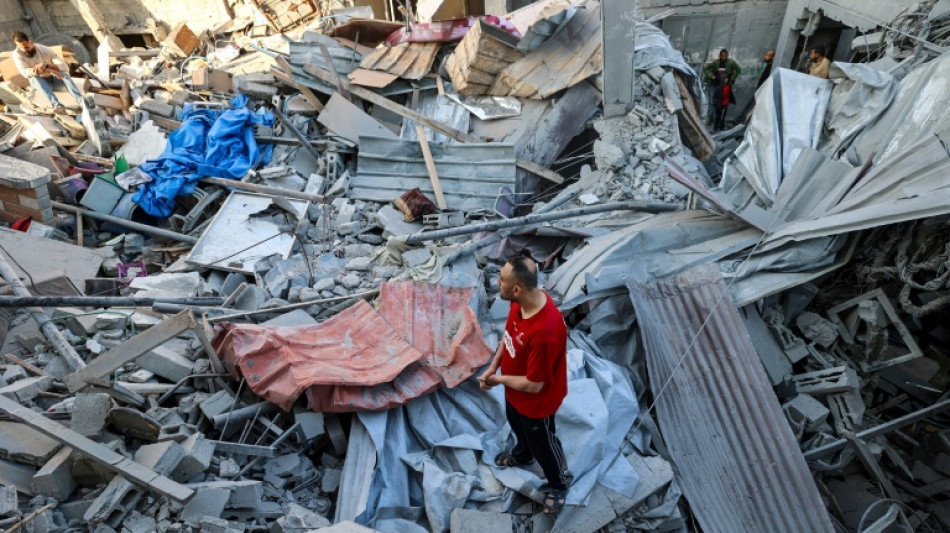
'Deadly blockade' leaves Gaza aid work on verge of collapse: UN, Red Cross / Photo: Eyad BABA - AFP/File

 OpenAI to launch new model after US freeze

 UK museums at 'sharp end' of climate change challenge

 In Mauritania, Imraguen people's desert-ocean paradise under threat
 Iraq's holy cities host funeral processions for Khamenei

 Rescuers search for missing in China storms after 100,000 evacuated

 Ex-Australia cricketer MacGill loses appeal against cocaine conviction

 Oil prices extend rally as US strikes on Iran revive geopolitical fears

 Iraq's holy cities to host funeral processions for Khamenei
 In Venezuela's quake ruins, a baby is born

 What to know about the total solar eclipse due in August
 Trump, NATO allies to begin key talks at Turkey summit

 Former Real Madrid coach Arbeloa named Fulham manager

 Messi inspires Argentina great escape over Egypt, Swiss advance

 US strikes Iran after Hormuz attacks, Tehran threatens response

 Djokovic wins five-hour epic to earn Sinner showdown at Wimbledon

 US strikes Iran after Hormuz tanker attacks: military

 Messi 'didn't want to go home' as Argentina comeback stuns Egypt

 Netflix strikes deals in short-form video push
 The height factor: how a small building survived Venezuela's quakes

 Egypt 'cheated' in controversial World Cup exit to Messi's Argentina, says Hassan

 Global AI industry falls short on safety, think tank warns

 'History made': Egyptian pride despite World Cup heartbreak

 How rescuers carried out 180-hour 'miracle' amid Venezuela's ruins

 Victorious Belgian footballers troll Trump with YMCA dance

 Scotland boss Townsend expects Russell will face Springboks

Two months into Israel's full blockade on aid into Gaza, humanitarians described Friday horrific scenes of starving, bloodied children and people fighting over water, with aid operations on the "verge of total collapse".
The United Nations and the Red Cross sounded the alarm at the dire situation in the war-ravaged Palestinian territory, demanding international action.
"The humanitarian response in Gaza is on the verge of total collapse," the International Committee of the Red Cross warned in a statement.
"Without immediate action, Gaza will descend further into chaos that humanitarian efforts will not be able to mitigate."
Israel strictly controls all inflows of international aid vital for the 2.4 million Palestinians in the Gaza Strip.
It halted aid deliveries to Gaza on March 2, days before the collapse of a ceasefire that had significantly reduced hostilities after 15 months of war.
Since the start of the blockade, the United Nations has repeatedly warned of the humanitarian catastrophe on the ground, with famine again looming.
The UN's World Food Programme (WFP) said a week ago that it had sent out its "last remaining food stocks" to kitchens.
- 'The blockade is deadly' -
"Food stocks have now mainly run out," Olga Cherevko, a spokeswoman for the UN humanitarian agency OCHA, told reporters in Geneva Friday via video link from Gaza City.
"Community kitchens have begun to shut down (and) more people are going hungry," she said, pointing to reports of children and other very vulnerable people who have died from malnutrition and ... from the lack of food".
"The blockade is deadly."
Water access was also "becoming impossible", she warned.
"In fact, as I speak to you, just downstairs from this building people are fighting for water. There's a water truck that has just arrived, and people are killing each other over water," she said.
The situation is so bad, she said that a friend had described to her a few days ago seeing "people burning ... because of the explosions and there was no water to save them".
At the same time, Cherevko lamented that "hospitals report running out of blood units as mass casualties continue to arrive".
"Gaza lies in ruins, Rubble fills the streets... Many nights, blood-curdling screams of the injured pierce the skies following the deafening sound of another explosion."
- 'Abomination' -
She also decried the mass displacement, with nearly the entire Gaza population being fprced to shift multiple times prior to the brief ceasefire.
Since the resumption of hostilities, she said "over 420,000 people have been once again forced to flee, many with only the clothes on their backs, shot at along the way, arriving in overcrowded shelters, as tents and other facilities where people search safety, are being bombed".
Pascal Hundt, the ICRC's deputy head of operations, also cautioned that "civilians in Gaza are facing an overwhelming daily struggle to survive the dangers of hostilities, cope with relentless displacement, and endure the consequences of being deprived of urgent humanitarian assistance".
The World Health Organization's emergencies director Mike Ryan said the situation was an "abomination".
"We are breaking the bodies and the minds of the children of Gaza. We are starving the children of Gaza," he told reporters on Thursday.
Cherevko slammed decision makers who "have watched in silence the endless scenes of bloodied children, of severed limbs, of grieving parents move swiftly across their screens, month, after month, after month".
"How much more blood must be spilled before enough become enough?"
S.Barghouti--SF-PST