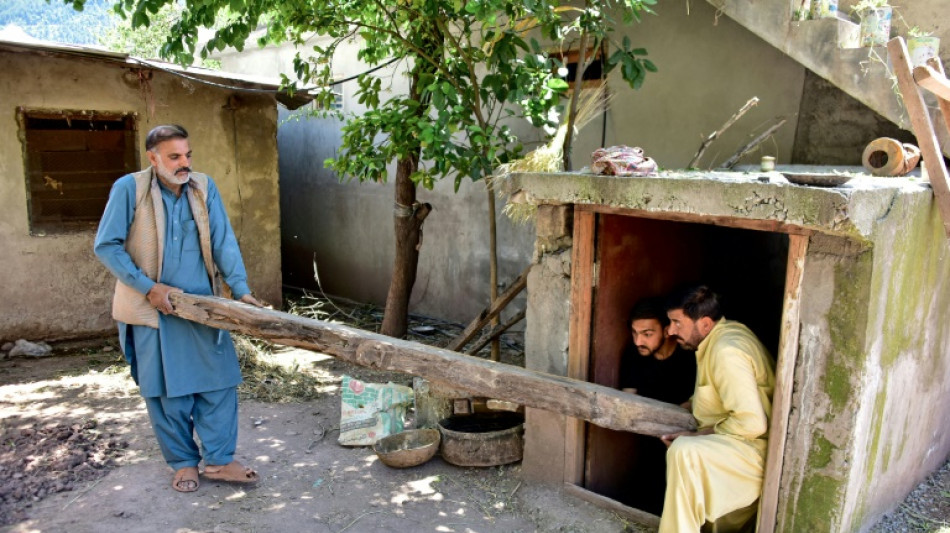
Kashmiris fortify bunkers anticipating India-Pakistan crossfire / Photo: Sajjad QAYYUM - AFP

 Oil prices surge, stocks slide as Trump says Iran ceasefire over

 Sunken wrecks, hot seas threaten fishermen on Italian isle

 Rescuers search for survivors of China storms as super typhoon nears

 Egypt file complaint against referee after controversial World Cup exit

 Apple loses challenge against EU digital competition rules

 Trump says Iran ceasefire 'is over'

 Rescuers search for missing in China storms after 100,000 flee

 OpenAI to launch new model after US freeze

 UK museums at 'sharp end' of climate change challenge

 In Mauritania, Imraguen people's desert-ocean paradise under threat
 Iraq's holy cities host funeral processions for Khamenei

 Rescuers search for missing in China storms after 100,000 evacuated

 Ex-Australia cricketer MacGill loses appeal against cocaine conviction
 Oil prices extend rally as US strikes on Iran revive geopolitical fears

 Iraq's holy cities to host funeral processions for Khamenei
 In Venezuela's quake ruins, a baby is born

 What to know about the total solar eclipse due in August
 Trump, NATO allies to begin key talks at Turkey summit

 Former Real Madrid coach Arbeloa named Fulham manager

 Messi inspires Argentina great escape over Egypt, Swiss advance

 US strikes Iran after Hormuz attacks, Tehran threatens response

 Djokovic wins five-hour epic to earn Sinner showdown at Wimbledon

 US strikes Iran after Hormuz tanker attacks: military

 Messi 'didn't want to go home' as Argentina comeback stuns Egypt

 Netflix strikes deals in short-form video push
Pulling logs and dusty building materials from a storage bunker outside his home in Kashmir, Riaz Awan readied the underground space to house his family as they braced for clashes between Pakistan and India to reach their border village.
Kashmiris living on both sides of the de facto border -- the Line of Control -- have been caught in the barrage of shells and bullets for decades as the nuclear-armed archrivals fight over the disputed region.
The long history of clashes has pushed many residents to build bunkers for shelter should their homes be caught in the crossfire.
"We've endured cross-border firing, which has been a tough experience, and we don't want our children to go through the same," Awan, a 51-year-old farmer, told AFP as he and his children cleared the bunker that had until recently stored straw.
In Chakothi village, around three kilometres (two miles) from the Line of Control, there are around 30 bunkers for a community of 60 families overlooked by Indian army check posts atop the surrounding green mountains.
- Threats every day -
Awan and his cousin Shabbir share the bunker they built in 2017, which cost them 300,000 Pakistani rupees ($1,000) -- a substantial amount in their impoverished village.
But they pulled together the funds to pay for safety.
A militant attack last week killed 26 people in Indian-administrated Kashmir, the worst attack on civilians in a Muslim-majority region in a quarter of a century.
India blamed the attack on Pakistan and accused it of "cross-border terrorism", a charge Islamabad vehemently denied.
In response, New Delhi and Islamabad downgraded diplomatic ties, withdrew visas and announced the closure of the main land border.
India says that its army has been exchanging fire with the Pakistani army for the past five days as both countries remain on edge, bracing for a potential military confrontation.
"Every day, India makes various threats, saying they will do this and that," said 52-year-old retired soldier Shabbir Awan.
"That is why we are cleaning these bunkers today, so that if needed, we can use them and make our lives safer."
Kashmir has been divided between India and Pakistan since their independence from British rule in 1947. Both claim the territory in full but govern separate portions of it.
Rebel groups have waged an insurgency in Indian-controlled Kashmir since 1989, demanding independence or a merger with Pakistan.
- 'Where else can we go?' -
Ridges and valleys intersected by the Line of Control host tens of thousands of heavily armed troops, with some rival outposts just a few dozen metres apart.
The Pakistan military says about 1.5 million residents live along the ceasefire line, long relying on a network of community bunkers and homemade shelters to weather the perennial bouts of unrest.
An average underground bunker is around 2.5 metres deep, 3.5 metres wide and 3.5 metres long. Those who can afford it reinforce all four sides with concrete, while others simply use mud walls.
"Our main concern is the safety of our children, protecting them is our biggest priority," said Saleema Bibi, a 40-year-old mother of four.
In 2017, "they even hit directly on top of our houses", she told AFP.
"We have no proper shelter or protection. We are living here -- where else can we go?" she said.
Naseema Bibi, a 46-year-old mother of four, owns a cow and two buffalos, making it hard for her to leave.
"We have livestock. We can't move anywhere," she said. So she is also working to clear a bunker.
"We are around eight families and it is difficult to adjust in one bunker," she told AFP.
"But children get panicked so we are concerned because of them."
S.AbuJamous--SF-PST