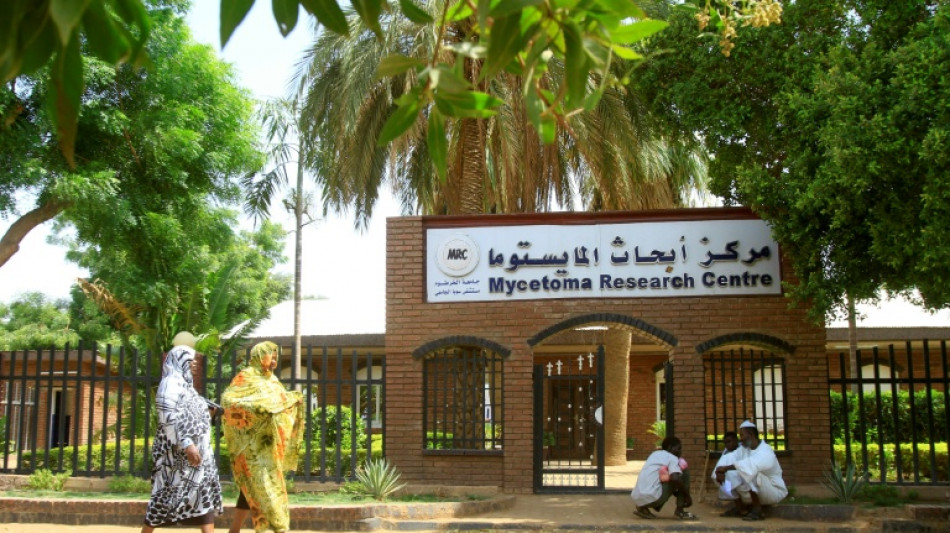
Sudan war destroys world's only research centre on skin disease mycetoma: director / Photo: ASHRAF SHAZLY - AFP/File

 Istanbul mayor ejected from court in corruption case
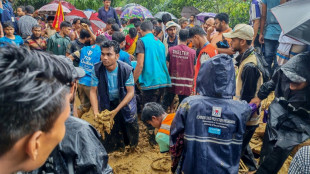 Landslide kills eight at refugee school in Bangladesh
 Cleary leads NSW past Queensland to regain State of Origin crown

 MEXC Adds Nine Ondo Tokenized Stock and ETF Trading Pairs Tied to AI Infrastructure Demand

 Oil prices surge, stocks slide as Trump says Iran ceasefire over
 Sunken wrecks, hot seas threaten fishermen on Italian isle

 Rescuers search for survivors of China storms as super typhoon nears

 Egypt file complaint against referee after controversial World Cup exit

 Apple loses challenge against EU digital competition rules

 Trump says Iran ceasefire 'is over'

 Rescuers search for missing in China storms after 100,000 flee

 OpenAI to launch new model after US freeze

 UK museums at 'sharp end' of climate change challenge

 In Mauritania, Imraguen people's desert-ocean paradise under threat
 Iraq's holy cities host funeral processions for Khamenei
 Rescuers search for missing in China storms after 100,000 evacuated

 Ex-Australia cricketer MacGill loses appeal against cocaine conviction
 Oil prices extend rally as US strikes on Iran revive geopolitical fears
 Iraq's holy cities to host funeral processions for Khamenei
 In Venezuela's quake ruins, a baby is born
 What to know about the total solar eclipse due in August
 Trump, NATO allies to begin key talks at Turkey summit

 Former Real Madrid coach Arbeloa named Fulham manager

 Messi inspires Argentina great escape over Egypt, Swiss advance

 US strikes Iran after Hormuz attacks, Tehran threatens response

The world's only research centre on mycetoma, a neglected tropical disease common among farmers, has been destroyed in Sudan's two-year war, its director and another expert say.
Mycetoma is caused by bacteria or fungus and usually enters the body through cuts. It is a progressively destructive infectious disease of the body tissue, affecting skin, muscle and even bone.
It is often characterised by swollen feet, but can also cause barnacle-like growths and club-like hands.
"The centre and all its infrastructure were destroyed during the war in Sudan," Ahmed Fahal, director of the Mycetoma Research Centre (MRC), told AFP.
"We lost the entire contents of our biological banks, where there was data from more than 40 years," said Fahal, whose centre had treated thousands of patients from Sudan and other countries.
"It's difficult to bear."
Since April 15, 2023, Sudan's army has been at war with the paramilitary Rapid Support Forces throughout the northeast African country.
The MRC is located in the Khartoum area, which the army last month reclaimed from the RSF during a war that has killed tens of thousands of people and uprooted more than 12 million.
Sudan's health care system has been left at the "breaking point", according to the World Health Organization.
Among the conflict's casualties is now the MRC, established in 1991 under the auspices of the University of Khartoum. It was a rare story of medical success in impoverished Sudan.
A video provided by the global Drugs for Neglected Diseases initiative (DNDi) shows collapsed ceilings, shelves overturned, fridges open and documents scattered about.
AFP was not able to independently verify the MRC's current condition.
The centre had grown to include 50 researchers and treat 12,000 patients each year, Fahal said.
Mycetoma is listed as a neglected tropical disease by the WHO.
The organisms that cause mycetoma also occur in Sudan's neighbours, including Chad and Ethiopia, as well as in other tropical and sub-tropical areas, among them Mexico and Thailand, WHO says.
For herders, farmers and other workers depending on manual labour to survive, crippling mycetoma infections can be a life sentence.
Drawing on the MRC's expertise, in 2019 the WHO and Sudan's government convened the First International Training Workshop on Mycetoma, in Khartoum.
"Today, Sudan, which was at the forefront of awareness of mycetomas, has gone 100 percent backwards," said Dr. Borna Nyaoke-Anoke, DNDi's head of mycetoma.
H.Nasr--SF-PST