Grief and discontent as Armenia marks WWI mass murders anniversary
/ Photo: KAREN MINASYAN - AFP

 Arteta blasts 'unacceptable' Sunderland penalty despite Arsenal win

 Mbappe at the double as Real Madrid sink Rayo

 Arsenal extend perfect Premier League start as Chelsea, Liverpool held

 US survive Spain scare to book World Cup final clash with France

 Celine Dion makes long-awaited return to stage in Paris
 Werro crowned Ultimate queen, US sweep 100m races

 Venezuelans outside Caracas say capital not sharing blackout burden

 Danish WWII drama wins top prize at Venice festival
 Chelsea boss Alonso yearns for 'boring game' after Hull make their point
 Werro outguns Hodgkinson to win women's 800m at Ultimate

 Moreira leads AC Milan fightback in Lazio draw
 Chelsea boss Alonso for yearns for 'boring game' after Hull make their point
 'Tired' Liverpool must adapt to schedule, says Iraola
 Stunning US fightback sets up Solheim Cup singles showdown

 Monaco's perfect Ligue 1 start ends with Strasbourg draw
 Ukraine's economy hobbled by Russian strikes

 France sink Germany to reach first women's basketball World Cup final
 Hull hold Chelsea, Liverpool fail to beat Fulham in Premier League

 Nmecha and Silva keep Dortmund perfect in Bundesliga

 Norris snatches thrilling Spanish GP pole from Antonelli

 'Great to have a race at home': Fans celebrate F1's Madrid return
 French IT giant Capgemini sells subsidiary after row over ICE links
 Thousands rally in Kosovo ahead of ex-leader's war crimes verdict

 Zelensky ready to meet Putin at G20 in Miami
 Gaza film, 'irreverent' Malkovich drama vie for Venice top prize
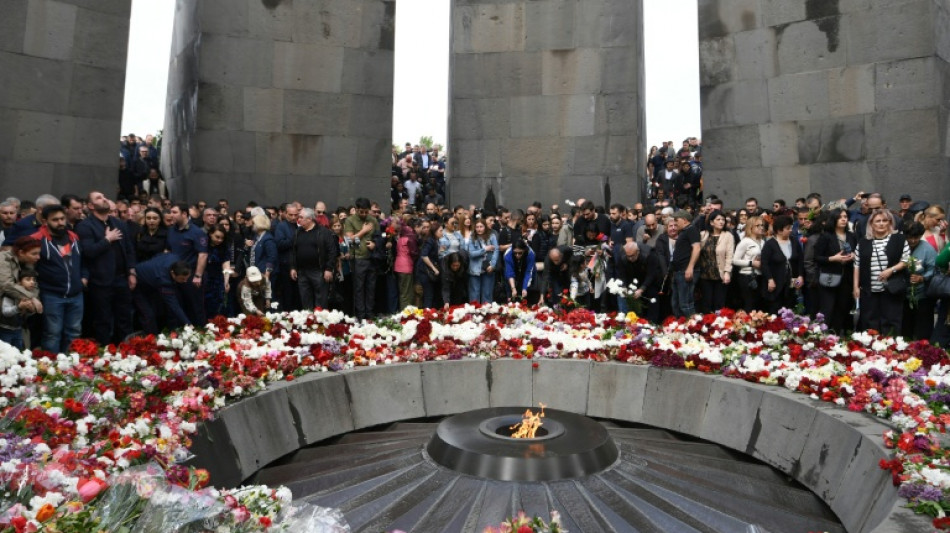
A sea of flowers blanketed the cold concrete of the brutalist memorial to the Armenian genocide on the Tsitsernakaberd hill, overlooking the capital Yerevan. Tens of thousands went there on Thursday to mourn the victims of World War I-era mass murders of ethnic Armenians by the Ottoman Empire.
But this time, the annual Genocide Remembrance Day was marked not only with grief, but also with some discontent that the Armenian government has stopped vociferously pushing for countries to recognise the massacres as a genocide amid progress in talks with Azerbaijan and Turkey.
According to Yerevan, up to 1.5 million people died between 1915 and 1916, when the Ottoman authorities, struggling on the battlefield, carried out repressions against the Christian Armenian minority, whom it viewed as pro-Russian traitors.
They were either killed or sent on deadly marches into the Syrian desert, deprived of food and water.
Turkey does not recognize this as genocide and denies the murders were systemic. It estimates Armenian deaths at 300,000-500,000 and claims that as many Turks died in civil strife after many Armenians sided with invading Russian forces.
Armenia and its influential global diaspora have long advocated for international recognition and to date, 34 countries, including the United States, France, Germany, Brazil, and Russia, have officially recognized the killings as genocide.
"What our government is even thinking? How can we trust Turkey, which openly supported Azerbaijan during the Karabakh war and still refuses to recognize the genocide?" said 72-year-old Aram Hayrapetyan, as he slowly climbed the hill up to the memorial in a solemn procession.
Relations between Ankara and Yerevan have been strained for decades over the massacres, which Armenia calls a genocide, and the Karabakh conflict, but Prime Minister Nikol Pashinyan has recently been pushing for a reset.
"We must not abandon the fight for international recognition -- for justice, and to ensure such a thing never happens again," added Hayrapetyan, who used to come to Tsitsernakaberd every year along with his wife, who recently died.
"She's gone, so I'm here for two today and I'll keep coming as long as I have strength in my legs," he told AFP.
This year, the unusual absence of any major official events in Yerevan on Genocide Remembrance Day left many disheartened, especially after Pashinyan recently told Turkish media that seeking genocide recognition was no longer a priority for Armenia.
"We must be strong to make sure their blood wasn't spilled in vain and to keep the memory of them," said Mher Madoyan, a 76-year-old economist with powder-white thick hair, who was wearing a tie.
- Fragile rapprochement -
Over the past four decades, Armenia and its neighbour, Turkic-speaking majority-Muslim Azerbaijan, backed by Ankara, fought two wars over the mountainous region of Karabakh amid a power vacuum left by the Soviet Union's collapse.
Karabakh was internationally recognised as part of Azerbaijan but was predominantly populated by Armenians.
In a swift offensive in September 2023, Baku regained full control of the region, prompting the exodus of more than 100,000 ethnic Armenians.
Last month, the two former Soviet republics agreed on the text of a long-anticipated peace treaty aimed at ending decades of hostilities, which could also pave the way for normalisation between Armenia and Turkey, which currently have no diplomatic relations.
But some remain sceptical.
"Of course, it would be nice to sign a peace agreement between Armenia and Azerbaijan, but I don't trust it," said Marine Balayan, a 65-year-old woman who lay flowers at the memorial.
"I am dubious, even after they sign it, that they won't go against our country again," she said.
"Every day, the Azerbaijanis put more and more humiliating demands on the table. Therefore, I don't think it is realistic to sign a peace agreement now," Aram Petrosyan, a 46-year-old lawyer, told AFP.
On Wednesday night, an Azerbaijani and a Turkish flag were burned as thousands sang patriotic songs accompanied by drumbeats in central Yerevan at a traditional torchlight procession on the eve of the Remembrance Day. The burning of the flags was later denounced by the prime minister's office.
"This is the fire of the souls of the one and a half million Armenians who died in the genocidal hell," said Gegham Manukyan, a lawmaker from nationalist party Dashnaktsutyun.
Q.Bulbul--SF-PST