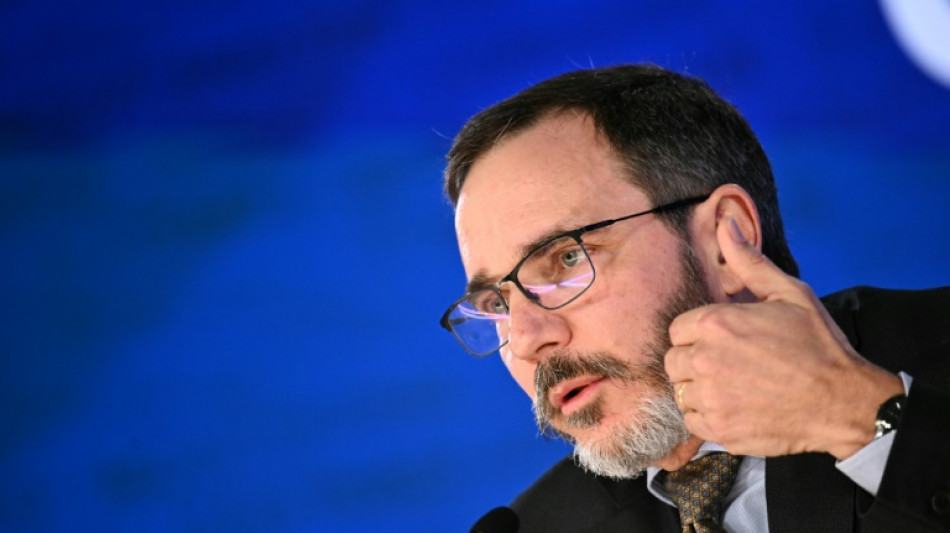
World could boost growth by reducing trade doubt: IMF chief economist / Photo: Mandel NGAN - AFP

 UN says pledges for global connectivity project pass $100 bn

 McIlroy hoping for 'home' comforts at Scottish, British Opens
 Noskova aims to emulate Kvitova after reaching first Wimbledon semi

 Britain's Fery becomes first wildcard to reach Wimbledon semis in 25 years
 Korda chases third major as Kim revisits Evian-winning chip

 Kooij wins Tour de France 5th stage in chaotic sprint finish

 Trump says Ukraine can make Patriot missiles

 Teenager arrested after two girls wounded in Germany school attack
 Farage vs Count Binface: hard-right leader's UK poll gambit

 Hong Kong's Robert Wun: the bold Millennial conquering Haute Couture

 IMF cuts 2026 world growth forecast, flags risks from new Mideast fighting
 Kostyuk sets up Wimbledon semi-final against Noskova
 Noskova reaches first Wimbledon semi-final
 Air Canada taps new CEO to replace chief who couldn't speak French

 Istanbul mayor ejected from court in corruption case

 Landslide kills eight at refugee school in Bangladesh
 Cleary leads NSW past Queensland to regain State of Origin crown
 MEXC Adds Nine Ondo Tokenized Stock and ETF Trading Pairs Tied to AI Infrastructure Demand

 Oil prices surge, stocks slide as Trump says Iran ceasefire over
 Sunken wrecks, hot seas threaten fishermen on Italian isle
 Rescuers search for survivors of China storms as super typhoon nears
 Egypt file complaint against referee after controversial World Cup exit
 Apple loses challenge against EU digital competition rules
 Trump says Iran ceasefire 'is over'

 Rescuers search for missing in China storms after 100,000 flee

Policymakers should find a way to reduce the uncertainty over trade policy kicked up by Donald Trump's tariff plans in order to boost global growth, the International Monetary Fund's chief economist said in an interview.
"The uncertainty in trade policy, and in policy generally right now, is a big drag on global activity," Pierre-Olivier Gourinchas told AFP ahead of Tuesday's publication of the IMF World Economic Outlook report.
"And the sooner we can lift it, the better off everyone will be," he said, adding: "Bringing back stability, clarity, predictability to the trading system is the first order of business."
In the updated outlook published as global financial leaders gather for the World Bank and IMF Spring Meetings in Washington, the Fund sees global growth cooling to 2.8 percent this year, a 0.5 percentage-point cut from its last forecast in January.
Global growth is then forecast to hit 3.0 percent in 2026, a 0.3 percentage-point markdown from January.
- 'Delay easing monetary policy' -
The IMF now expects 3.0 percent inflation this year, effectively stalling progress towards the US Federal Reserve's two percent long-term inflation target.
Higher inflation "will, of course, have implications for what the central bank will need to be doing," Gourinchas said.
If inflation developments prove to be persistent, the Fed "may have to delay easing monetary policy, or they may even have to start looking to increase and tighten the monetary policy rate," he added.
The impact of tariffs is also "quite significant" for China, Gourinchas said, adding that the IMF expects the levies to constrain growth by around 1.3 percentage points, counteracted somewhat by the fiscal measures Beijing introduced to prop up the economy last year.
As a result, the IMF has trimmed China's growth forecast by 0.6 percentage points, and now sees growth of just 4.0 percent this year, down sharply from the 5.0 percent growth seen in 2024.
- More modest Europe downgrade -
Europe is "slightly less" exposed to tariffs than the United States or China, and as such the tariff shock should be a little less pronounced, Gourinchas said.
The increased European defense spending announced in recent months should also provide "some fiscal support to economic activity in the European Union," he added, while warning that any additional spending would still need to be paid for over the longer term.
"We need to have targeted measures, temporary measures, that are sunsetting automatically," he said.
"When it comes to the permanent increases in defense... it has to be financed out of expenditure cuts somewhere else or new revenues," he added. "It cannot be financed by debt."
- Risk of social unrest -
The IMF warned in its report of an increased risk of social unrest due to several factors, including "dim medium-term growth prospects."
For low-income countries, a funding squeeze combined with the effects of less foreign aid funding from the likes of the United States, could be a recipe for challenges ahead.
"There may be sectoral dislocations, and maybe sectors of activities that are hit pretty hard by the tariffs, if they remain in place," Gourinchas said. "And there will be calls for support so that these sectors, households and businesses can adapt and adjust."
"Some countries have very limited fiscal space to start with," he added. "And so in the context in which there will be these additional demands, if they are unable to meet them, then that's when you could see social tensions increasing."
J.Saleh--SF-PST