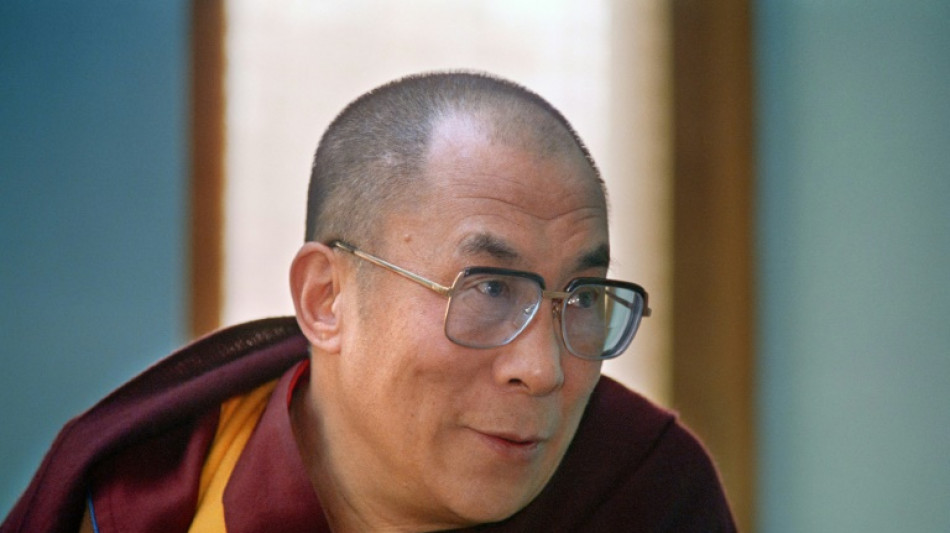
As Dalai Lama approaches 90, Tibetans weigh future / Photo: Douglas E. CURRAN - AFP

 UN says pledges for global connectivity project pass $100 bn

 McIlroy hoping for 'home' comforts at Scottish, British Opens
 Noskova aims to emulate Kvitova after reaching first Wimbledon semi
 Britain's Fery becomes first wildcard to reach Wimbledon semis in 25 years
 Korda chases third major as Kim revisits Evian-winning chip

 Kooij wins Tour de France 5th stage in chaotic sprint finish

 Trump says Ukraine can make Patriot missiles

 Teenager arrested after two girls wounded in Germany school attack
 Farage vs Count Binface: hard-right leader's UK poll gambit
 Hong Kong's Robert Wun: the bold Millennial conquering Haute Couture
 IMF cuts 2026 world growth forecast, flags risks from new Mideast fighting
 Kostyuk sets up Wimbledon semi-final against Noskova
 Noskova reaches first Wimbledon semi-final
 Air Canada taps new CEO to replace chief who couldn't speak French
 Istanbul mayor ejected from court in corruption case
 Landslide kills eight at refugee school in Bangladesh
 Cleary leads NSW past Queensland to regain State of Origin crown
 MEXC Adds Nine Ondo Tokenized Stock and ETF Trading Pairs Tied to AI Infrastructure Demand
 Oil prices surge, stocks slide as Trump says Iran ceasefire over
 Sunken wrecks, hot seas threaten fishermen on Italian isle
 Rescuers search for survivors of China storms as super typhoon nears
 Egypt file complaint against referee after controversial World Cup exit
 Apple loses challenge against EU digital competition rules
 Trump says Iran ceasefire 'is over'
 Rescuers search for missing in China storms after 100,000 flee
When the Dalai Lama turns 90 in July, the Buddhist monk, who for many exiled Tibetans personifies dreams of a free homeland, will ask if they want a successor.
For the charismatic Nobel Peace Prize-winning leader, his landmark birthday will be a time to encourage people to plan for an eventual future without him and address whether there will be another Dalai Lama.
The answer, at least according to his translator of nearly four decades, is clear: yes.
"I know for a fact that he has received petitions from across the Tibetan Buddhism communities, including some from inside Tibet," said Thupten Jinpa, 66, a Buddhist scholar who helped produce the leader's latest book, "Voice for the Voiceless".
Jinpa believes the post, which he likens to a Buddhist "papal institution" not only for Tibet but also encompassing the Himalayan regions of India, Bhutan and Nepal, as well as Mongolia and some Russian republics, will continue.
"My hope is that before his birthday, July 6, he will issue a final statement," Jinpa said, speaking in India, where the Dalai Lama has been based since fleeing into exile in 1959.
"If my guess is right, and he says that the continuity of the institution will remain, that means then there will be a new Dalai Lama."
Many exiled Tibetans fear China will name a successor to bolster control over a land it poured troops into in 1950.
- 'Almost unthinkable' -
The current Dalai Lama was identified in 1936 when, aged two, he passed a test by pointing to objects that had belonged to the post's previous occupier.
He was hailed as the 14th reincarnation of the Dalai Lama, a role that stretches back more than 600 years.
"One constant in everybody's life has been the presence of the Dalai Lama," said Jinpa, who fled Tibet with his parents as a baby, around the same time the Dalai Lama escaped.
If there is to be a 15th, the Dalai Lama has said he will "leave clear written instructions" on what will happen after his death.
Jinpa, who trained as a monk before completing his doctorate at the University of Cambridge, said that a foundational principle of Buddhism was the contemplation of impermanence.
"Anything that comes into being will come to an end," he said. "Where there is birth, there will be death."
But he said the Dalai Lama -- who has said he wants to live until he is 113 -- also wants followers to confront a future, someday, without him.
"The idea of a world without him is almost unthinkable," Jinpa said. "But that will happen, and His Holiness has himself been very explicit in making sure that people are thinking about it."
- 'Symbol of a nation' -
Jinpa said that plans for the future had long been in progress.
The Dalai Lama stepped down as his people's political head in 2011, passing the baton of secular power to a government chosen democratically by 130,000 Tibetans around the world.
"He has already prepared the formal political structure for carrying on the struggles of the Tibetan cause beyond his lifetime," Jinpa said.
"But one of the things that he can't just transfer to an elected body... is the moral authority, and his status as the symbol of a nation, and a symbol of the aspiration of the Tibetan people," he added.
"This is why the continuity of the Dalai Lama institution becomes important."
China, which says Tibet is an integral part of the country, insists the Dalai Lama "has no right to represent the Tibetan people".
Jinpa said the Dalai Lama is only advocating for greater Tibetan autonomy.
"If we were asking for independence, it's a completely different thing," he said.
- 'People's heart' -
The Dalai Lama has already said that if there "is a consensus that the Dalai Lama institution should continue", then the Office of the Dalai Lama -- the Gaden Phodrang Trust in India's Himalayan hill town of McLeod Ganj -- would hold the responsibility for the recognition of the next leader.
He has also made it clear that any successor would by necessity be "born in the free world".
In 1995, Beijing selected its own child as the Panchen Lama, another influential Tibetan religious figure, and detained a Dalai Lama-recognised six-year-old, described by rights groups as the world's youngest political prisoner.
"The Chinese will choose another 'Dalai Lama', that's for sure," Jinpa said. "It will be ridiculous, but they will do it."
But he is confident that Tibetans will not acknowledge whoever Beijing selects.
"They can suppress, they can ban, they can force," said Jinpa, noting that Beijing forbids the Dalai Lama's photograph in Tibet.
"But you can never change people's heart. What's in the heart belongs to the individual, and the loyalty will always be to this Dalai Lama, and whoever is going to be chosen through the traditional system."
T.Ibrahim--SF-PST