
EU lists seven 'safe' countries of origin, tightening asylum rules / Photo: Nicolas TUCAT - AFP

 South African election results renew debate over identity-based voting

 South African voters report smoother local election but declining IEC trust

 Dolly Parton museum and Nashville hotel open after singer’s death

 George and Amal Clooney attend New York political-comedy reading
 British buyers pay substantial premiums for period-home appearance

 Thomas Markle released to house arrest after child-abuse-image charge

 Dawn of War 4 developers chose Adeptus Mechanicus for tactical variety

 Italy face unbeaten South Africa in Turin Nations Championship match

 ChatGPT interactive interface feature tested across six custom tools

 Freshways milk-price cut deepens pressure on UK dairy farms
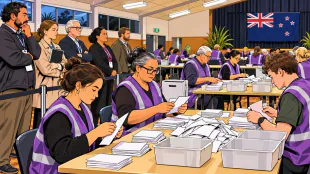 Labour and National remain virtually tied as New Zealand vote count advances

 The Good Daughter adapts Karin Slaughter thriller with Rose Byrne and Meghann Fahy

 Heavy-lift drone evacuates wounded Ukrainian soldier from frontline kill zone

 Morrison says West Brom recovered after pressure from successive derby losses

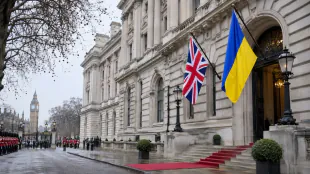 Britain considers 2027 state visit for Ukraine’s Zelensky

 China and Gabon Upgrade Ties to 'Shared Future' Amid Strategic Pact
The European Union on Wednesday published a list of seven countries it considers "safe", in a bid to speed up migrant returns by making it harder for citizens of those nations to claim asylum in the bloc.
The list -- which includes Kosovo, Bangladesh, Colombia, Egypt, India, Morocco and Tunisia -- would need to be approved by the bloc's parliament and members before entering force.
The move, criticised by rights groups, is set to allow EU governments to process asylum applications filed from citizens of those countries more quickly -- by introducing a presumption that such claims lack merit.
"Many member states are facing a significant backlog of asylum applications, so anything we can do now to support faster asylum decisions is essential," said Magnus Brunner, the EU's commissioner for migration.
Brussels has been under pressure to clamp down on irregular arrivals and facilitate deportations, following a souring of public opinion on migration that has fuelled hard-right electoral gains in several countries.
The commission said EU candidate nations would also in principle meet the criteria to be designated as safe countries.
But it also laid out exceptions, including when they are hit by a conflict -- something that would for example exclude Ukraine.
The EU had already presented a similar list in 2015 but the plan was abandoned due to heated debates over whether or not to include Turkey, another candidate for membership.
The list published Wednesday can be expanded or reviewed over time and was drawn up looking at nations from which a significant number of applicants currently come, the commission said.
Several member states already designate countries they deem "safe" with regard to asylum -- France's list for instance includes Mongolia, Serbia and Cape Verde.
The EU effort aims to harmonise rules and ensure that all members have the same baseline.
States can individually add countries to the EU list, but not subtract from it.
Asylum cases will still have to be examined individually, ensuring that existing safeguards remain in place and asylum-seekers are not rejected outright, the commission added.
- 'Hollowing out refugee rights' -
The plan has to be approved by the European Parliament and member states before it can enter into force.
But it has already come under fire from civil society groups, with some lamenting the inclusion of countries with a patchy human rights record like Tunisia and Egypt.
"Anyone who applies for protection in the EU should have their individual claim assessed fully and on its own merits -- regardless of where they are fleeing from," said Meron Ameha Knikman of the International Rescue Committee.
She described the proposal as "part of a broader trend towards deterrence and hollowing out refugee rights".
The European Commission noted that Tunisia has detained political figures, lawyers, judges and journalists, while in Egypt rights and opposition activist may face arbitrary arrest and torture.
But the population as a whole did not "face persecution or real risk of serious harm".
"This is a flagrant violation of a fundamental human right, the right to asylum, as an individual right," the Tunisian Forum for Economic and Social Rights, an NGO, told AFP decrying the EU plan.
Irregular border crossings detected into the European Union were down 38 percent to 239,000 last year after an almost 10-year peak in 2023, according to EU border agency Frontex.
But led by hawks including Italy, Denmark and the Netherlands, EU leaders called in October for urgent new legislation to increase and speed up returns and for the commission to assess "innovative" ways to counter irregular migration.
Currently fewer than 20 percent of people ordered to leave the bloc are returned to their country of origin, according to EU data.
Last month the commission unveiled a planned reform of the 27-nation bloc's return system, which opened the way for member states to set up migrant return centres outside the EU.
Italy's Interior Minister Matteo Piantedosi Wednesday hailed the EU's latest move as "a success for the Italian government".
S.Abdullah--SF-PST