Automakers hold their breath on Trump's erratic US tariffs / Photo: Ronny HARTMANN - AFP/File

 PSG's Lee set to join Atletico Madrid
 Iran plays with fire, but calculates Trump will hold back

 Oil surges, stocks slide as Trump says Iran ceasefire over

 Meta to build $9 billion data center in western Canada

 Rogers backs Kane to outshine Haaland in World Cup showdown
 Some US Fed officials considered June rate hike on war fallout

 UN launches appeal for nearly $300 mn in Venezuela quake relief
 US to remove Syria from terror blacklist, in new boost to Sharaa

 Court rejects Trump request to restore his name to Kennedy Center

 MLB pitching great Verlander to retire after 2026 season

 Artificial cloud brightening could tame El Nino, but with risks: study

 Shocked and shaken, Venezuela quake survivors get psychological help

 France, Morocco kick off blockbuster World Cup quarter-finals

 Amorim hails 'ambitious' AC Milan, promises to learn Italian
 Cancer survivor Traeen takes the long road to Tour yellow
 Easing Russian Olympic restrictions 'terrible', says Wimbledon star Kostyuk

 'Unbelievable' Kooij wins Tour de France 5th stage in chaotic sprint finish
 Britain's Fery to face Zverev in Wimbledon semi-finals

 Zverev sees off Fritz to make first Wimbledon semi-final

 Barcelona sets new heat record at 40.7C: weather agencies

 'The Pitt,' 'Hacks' lead Emmy nominations

 France lose appeal against Olise booking at World Cup
 Putellas joins star cast at London City Lionesses

 Oil back at $80, stocks slide as Trump says Iran ceasefire over
 Vast crowds mourn Khamenei in Iraq's holy cities

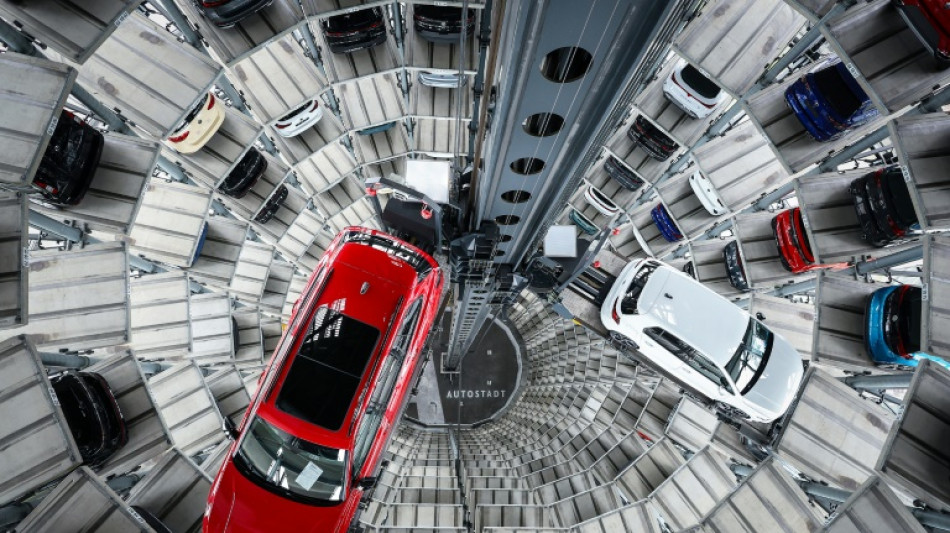
US President Donald Trump's aggressive but fast-changing trade policy has foisted difficult questions on carmakers that they have not yet been forced to answer.
While Trump has retreated from some of his most onerous tariffs, carmakers are on the hook for 25 percent levies on auto imports that went into effect on April 3.
But so far, the effects of that levy have been muffled because carmakers are still selling vehicles from inventory. Auto companies and industry watchers expect this dynamic to persist for at least a few more weeks.
But if the tariffs stay in place -- a big if given Trump's tendency to reverse course -- automakers will need to decide how much of the hit to absorb and how much to pass on.
"No one in this entire value chain can just absorb it," Kjell Gruner, president of Volkswagen Group of America, said Tuesday.
"We can't say, 'Oh the customers need to swallow it.' That price increase would be too high," Gruner told an industry conference. "We can't also say the dealers need to. Nor can we."
A priority is clear communication to customers, said Gruner, adding that pricing changes would not be made overnight.
Tariff talk dominated Tuesday's Automotive Forum held just ahead of the annual New York International Auto Show.
Since returning to the White House in January, Trump's myriad tariff announcements have been at the center of his administration's economic policy.
Trump reversed course last Wednesday on the most onerous of his "reciprocal" tariffs for every country except China following upheaval in financial markets.
But other tariffs have stayed in place, such as a 25 percent levy on steel and aluminum imports, which affects automakers, along with the direct levy on automobile imports.
On Monday, Trump opened the door to walking back his 25 percent tariff on all auto imports, saying he was "looking at something to help some of the car companies."
One of Trump's aims with tariffs is to boost US manufacturing.
But industry experts note that automobile capital investments are multi-year commitments that require confidence in a stable commercial environment -- something undermined by constant changes in policy.
Patrick Manzi, chief economist at the National Automobile Dealers Association, opened Tuesday's proceedings with a downcast outlook on the economy.
"I expect to see consumers holding off on big-ticket items," said Manzi, who has raised his odds for a US recession to 60 percent.
- Aggressive pricing -
Automakers emphasized their commitment to US investments, with Volvo touting its ramping of production at a South Carolina factory and Nissan pointing to a recent decision to maintain a second shift at a Tennessee assembly plant as the companies seek to boost US output.
Hyundai North America chief Randy Parker pointed to the South Korean conglomerate's announcement of a $21 billion new steel plant in Louisiana announced last month at a White House event with Trump.
Parker, who quipped that US tariff policy might have changed since he last checked his phone, described the company's strategy as "quite simple."
"Our plan is to sell cars period," he said. "Sell like hell."
Hyundai has promised to hold prices steady in the short run, joining other brands like Nissan and Ford that have announced consumer-friendly pricing actions amid the tariffs.
These moves contributed to a surge in US auto sales in March as shoppers fast-forwarded purchases to get ahead of tariffs.
These trends have continued thus far into April, said Thomas King, president of the data and analytics division at JD Power.
King does not expect the US car market to see a significant hit from tariffs until the third quarter.
But by the fourth quarter, King expects auto prices to be up around five percent due to the tariffs, resulting in about an eight percent drop in US auto sales.
These figures are based on the current economic outlook.
"If we were to have a recession, it would be obviously a bigger gap," King said.
V.AbuAwwad--SF-PST