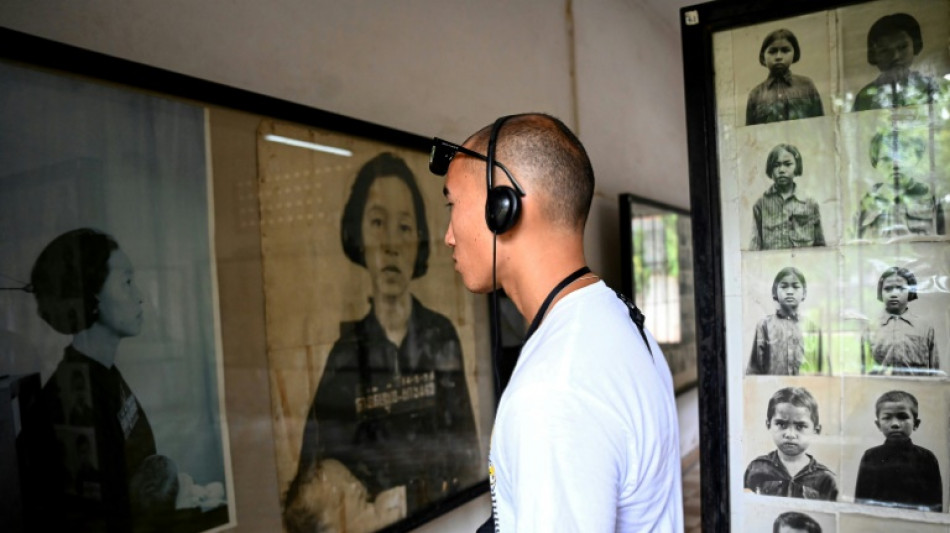
Cambodia genocide denial law open to abuse, say critics / Photo: TANG CHHIN Sothy - AFP

 Trump orders new strikes on Iran over attacks on shipping in Hormuz

 PSG's Lee set to join Atletico Madrid
 Iran plays with fire, but calculates Trump will hold back

 Oil surges, stocks slide as Trump says Iran ceasefire over
 Meta to build $9 billion data center in western Canada

 Rogers backs Kane to outshine Haaland in World Cup showdown
 Some US Fed officials considered June rate hike on war fallout

 UN launches appeal for nearly $300 mn in Venezuela quake relief
 US to remove Syria from terror blacklist, in new boost to Sharaa
 Court rejects Trump request to restore his name to Kennedy Center

 MLB pitching great Verlander to retire after 2026 season

 Artificial cloud brightening could tame El Nino, but with risks: study

 Shocked and shaken, Venezuela quake survivors get psychological help

 France, Morocco kick off blockbuster World Cup quarter-finals

 Amorim hails 'ambitious' AC Milan, promises to learn Italian

 Cancer survivor Traeen takes the long road to Tour yellow

 Easing Russian Olympic restrictions 'terrible', says Wimbledon star Kostyuk

 'Unbelievable' Kooij wins Tour de France 5th stage in chaotic sprint finish

 Britain's Fery to face Zverev in Wimbledon semi-finals

 Zverev sees off Fritz to make first Wimbledon semi-final

 Barcelona sets new heat record at 40.7C: weather agencies

 'The Pitt,' 'Hacks' lead Emmy nominations

 France lose appeal against Olise booking at World Cup

 Putellas joins star cast at London City Lionesses
 Oil back at $80, stocks slide as Trump says Iran ceasefire over
Survivors of the Khmer Rouge's genocidal regime welcome a beefed-up Cambodian law that forbids denying the movement's atrocities, but rights advocates and academics warn it could also stifle legitimate dissent.
Enacted last month ahead of this week's 50th anniversary of the Khmer Rouge seizing the capital Phnom Penh, the law threatens hefty jail sentences and fines for anyone who denies the genocide that killed around two million people between 1975 and 1979.
The atrocities committed by the Khmer Rouge are widely accepted by Cambodians save a dwindling group of ageing former cadres and soldiers who live mostly in the remote northwest.
The hardline Maoist group led by "Brother Number One" Pol Pot reset the calendar to "Year Zero" on April 17, 1975 and emptied cities in a bid to create a pure agrarian society free of class, politics or capital.
About a quarter of the population died -- of disease, starvation, overwork or by execution -- in the disastrous social engineering experiment memorably chronicled by the 1984 Oscar-winning movie "The Killing Fields".
Some activists, however, say former prime minister Hun Sen is using the law to burnish his legacy and stifle any opposition to his son and successor, Hun Manet.
The government is trying to "reinforce state narratives rather than to genuinely encourage historical accountability", said Sophal Ear, associate professor at Arizona State University.
"In practice, it could be another tool to silence dissent," he said.
Political analyst Ou Virak called the law a "mistake", adding: "A population that is afraid to discuss will be even more afraid to ask questions."
- 'I am the peacemaker' -
Now 72, Hun Sen was a commander under Pol Pot before he fled to Vietnam in 1977, joining other Cambodian defectors to lead the Vietnamese army's assault that drove the Khmer Rouge out of Phnom Penh.
In the more than 30 years Hun Sen ruled Cambodia he stifled dissent, critics say, equating opposition to his leadership as support for those he replaced.
"Hun Sen wants to impose his vision of things, saying: 'I am the peacemaker'," said Adriana Escobar Rodriguez of the French National Centre for Scientific Research.
One form of genocide denial tended to downplay Vietnam's role in ousting the Khmer Rouge, she said, but another stemmed from the fact that some "people still can't believe that Khmers could have killed other Khmers" -- referring to Cambodia's majority ethnic group.
Hun Sen has defended the stricter law, comparing it to similar legislation against Holocaust denial in Europe.
The 2013 law it replaced stemmed from a case involving one of Hun Sen's main opponents that took place just before national elections.
Kem Sokha was accused of describing notorious Khmer Rouge prison S-21 -- where an estimated 15,000 people were tortured to death -- as a Vietnamese fabrication.
He has spent lengthy periods in prison on various charges since, and is currently under house arrest on treason charges and banned from politics.
Chum Mey, one of a small handful of people who emerged alive from S-21, sells books describing his experiences outside the former prison, which was turned into the Tuol Sleng Genocide Museum.
He says it would be stupid for anyone to deny the Khmer Rouge's atrocities.
"There is evidence," the 94-year-old said.
"They killed my four children and my wife."
A.AbuSaada--SF-PST