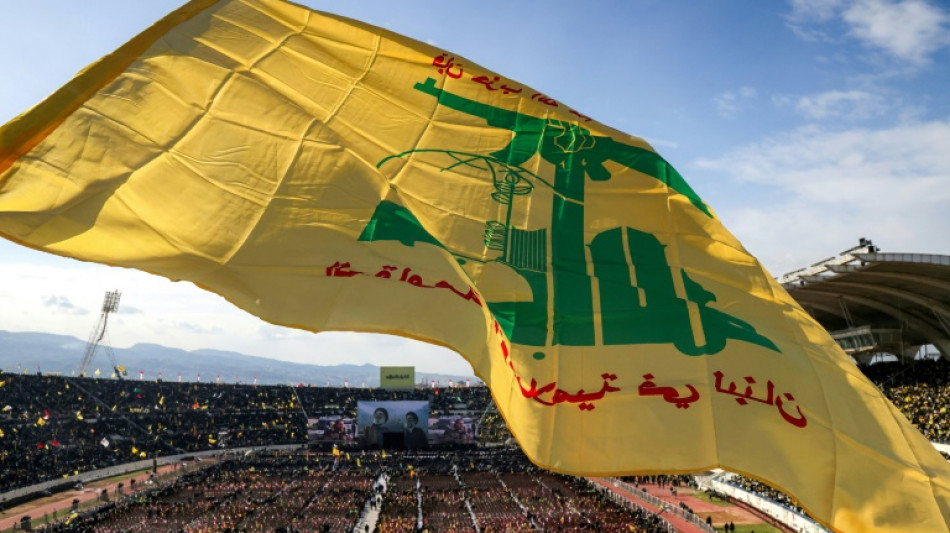
Disarming Lebanon's Hezbollah no longer inconceivable: analysts / Photo: IBRAHIM AMRO - AFP/File

 Trump orders new strikes on Iran over attacks on shipping in Hormuz

 PSG's Lee set to join Atletico Madrid
 Iran plays with fire, but calculates Trump will hold back

 Oil surges, stocks slide as Trump says Iran ceasefire over
 Meta to build $9 billion data center in western Canada
 Rogers backs Kane to outshine Haaland in World Cup showdown
 Some US Fed officials considered June rate hike on war fallout

 UN launches appeal for nearly $300 mn in Venezuela quake relief
 US to remove Syria from terror blacklist, in new boost to Sharaa

 Court rejects Trump request to restore his name to Kennedy Center

 MLB pitching great Verlander to retire after 2026 season
 Artificial cloud brightening could tame El Nino, but with risks: study

 Shocked and shaken, Venezuela quake survivors get psychological help

 France, Morocco kick off blockbuster World Cup quarter-finals

 Amorim hails 'ambitious' AC Milan, promises to learn Italian
 Cancer survivor Traeen takes the long road to Tour yellow
 Easing Russian Olympic restrictions 'terrible', says Wimbledon star Kostyuk

 'Unbelievable' Kooij wins Tour de France 5th stage in chaotic sprint finish

 Britain's Fery to face Zverev in Wimbledon semi-finals

 Zverev sees off Fritz to make first Wimbledon semi-final

 Barcelona sets new heat record at 40.7C: weather agencies

 'The Pitt,' 'Hacks' lead Emmy nominations

 France lose appeal against Olise booking at World Cup
 Putellas joins star cast at London City Lionesses
 Oil back at $80, stocks slide as Trump says Iran ceasefire over

The once unthinkable disarmament of Hezbollah could finally be within reach, as the United States pushes Lebanon to act and applies pressure to the group's backer Iran over its nuclear programme, analysts said.
Hezbollah was left badly weakened by more than a year of hostilities with Israel, beginning with the group's campaign of rocket fire at its arch-foe in support of ally Hamas, and culminating in a major Israeli bombing campaign and ground incursion into Lebanon.
In the months after the war, which devastated parts of the country and killed many of the movement's top leaders, Lebanon elected a president and formed a government after a more than two-year vacuum as the balance of power shifted.
The war "clearly changed the situation on ground in Lebanon", said David Wood from the International Crisis Group.
"It's conceivable to think that Hezbollah could move towards disarmament and potentially even participate in that process willingly," Wood told AFP.
Hezbollah was the only group that refused to disarm after Lebanon's 1975-1990 civil war. Bolstered by an arsenal once considered more powerful than that of the Lebanese army, it long presented itself as the country's best line of defence against Israeli aggression.
But both its stockpiles and its senior leadership were sapped by the conflict, with longtime leader Hassan Nasrallah among the commanders killed.
Under a November 27 truce, Hezbollah was to withdraw its fighters to the north of Lebanon's Litani River and dismantle any remaining military infrastructure in the south, while the Lebanese army was to deploy in the area.
Israel was meant to withdraw its troops, but it still remains in five points it deems "strategic" and conducts regular strikes on what it says are mostly Hezbollah targets.
A source close to Hezbollah told AFP that the group had ceded to the Lebanese army around 190 of its 265 military positions identified south of the Litani.
Visiting US deputy special envoy for the Middle East Morgan Ortagus, who is spearheading Washington's campaign to pressure the Lebanese government to disarm Hezbollah, this month said it should happen "as soon as possible".
Lebanese President Joseph Aoun, who has pledged a state monopoly on bearing arms, has said the issue requires national dialogue.
- 'Inevitable'? -
Hezbollah -- which was established after a 1982 Israeli invasion -- has already agreed to significant political compromises this year, including declining to stand in the way of the selection of the new president.
Hanin Ghaddar from The Washington Institute told AFP that Hezbollah's disarmament was "inevitable".
The only alternative to the Lebanese state disarming the group "is that Israel is going to do it" militarily, said Ghaddar, a critic of the group.
Retired south Lebanon intelligence chief General Ali Shahrour said after Hezbollah's recent setbacks "it is certainly not in its interest to engage in any war (with Israel) or confrontation against the (Lebanese) state" in opposition to disarmament.
He said talks between Hezbollah's patron Iran and the United States on curbing Tehran's nuclear programme would impact Iran-backed groups across the region.
Those negotiations kicked off last weekend, with US President Donald Trump threatening military action against Iran if they failed to reach a deal.
Several Hezbollah officials have said the group is ready for dialogue on Lebanon's defence strategy, including the issue of the group's weapons, but is not prepared to surrender them now.
Ghaddar said current Hezbollah leader Naim Qassem and the chief of its parliamentary bloc, Mohammed Raad, likely wanted "to play the time game" to avoid disarmament.
Hezbollah wants "to survive" as a military institution, she said, adding any internal divisions would centre on "how to go about it".
Several experts said Israel's ongoing troop presence along the border played into the group's hands.
"The Israelis are certainly providing Hezbollah with justification to retain its weapons," said Shahrour, the retired intelligence official.
- US-Iran talks -
The source close to Hezbollah, who spoke on condition of anonymity, said Lebanon's army lacked "the military capability to defend the south" against Israel.
They accused Washington of insisting Hezbollah's rockets be destroyed, rather than confiscated, in order to keep Lebanon's army weak.
The Crisis Group's Wood said Beirut's options included dismantling Hezbollah's military infrastructure or integrating its weapons and fighters into the regular army.
The "safest approach" is "to move cautiously and take time", he said.
"It is possible that Iran would seek to trade its support for regional allies, including Hezbollah, for concessions in negotiations with the US," Wood added.
Karim Bitar, a lecturer in Middle East Studies at the Sciences Po university in Paris, said the issue of what should come first -- Israel's full withdrawal or Hezbollah's disarmament -- was "a chicken and egg situation".
Hezbollah would likely surrender some heavy weapons while denying responsibility for arms held by individuals aligned with the group, he told AFP.
"In the absence of an Iranian green light, I doubt that Hezbollah would willingly relinquish its weapons to the Lebanese army, even if they are offered to form an autonomous battalion within the Lebanese army," he said.
"A lot of this will depend on the US-Iranian negotiations."
B.Mahmoud--SF-PST