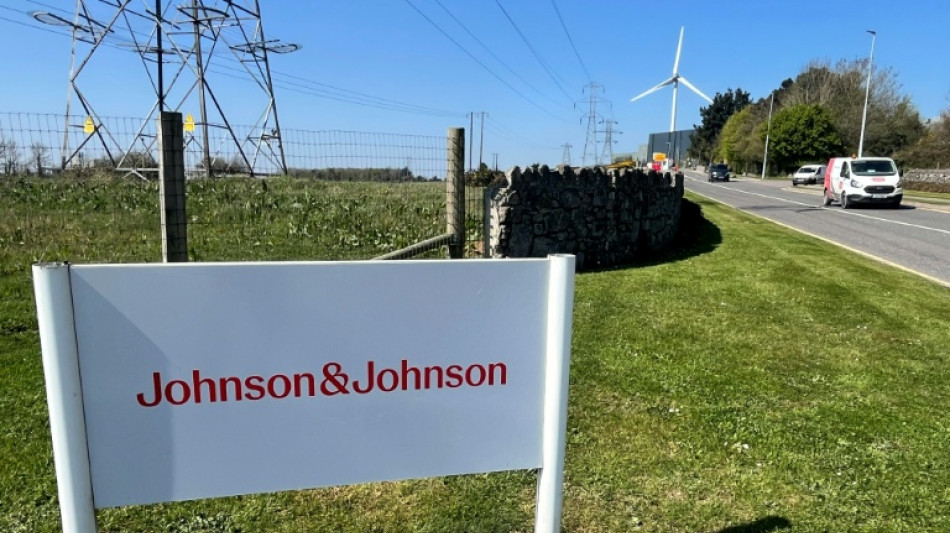
Trump tariffs unnerve locals in Irish 'pharma' hub / Photo: Peter MURPHY - AFP

 Democrat accused of rape exits key US Senate race

 Japan student Ito keeps place against Ireland as Jones returns

 Belgium bid to crack Spain's ironclad defence in World Cup quarter-final

 US man sentenced after swapping 17th century manuscript

 US launches new strikes on Iran after Trump vows to hit 'hard'
 Taylor Swift fans pay $25 for garbage from outside wedding

 After quakes, Venezuelans fear losing damaged homes

 PSG's Lee set to join Athletico

 Erdogan gave pistols to NATO leaders, Starmer says

 Nocera Expands Diversified Technology Strategy With Binding Agreement to Acquire an Equity Interest in INERGX, an Integrated Energy Storage and Power Platform for AI, Defense and Mission-Critical Demand
 China sends nuclear missile message as US looks elsewhere

 Justin Bieber added to 11-minute World Cup final halftime show

 Fery targets Wimbledon final birthday present after royal seal of approval

 Egypt file complaint against referee after World Cup exit
 Women's semi-finalists in uncharted territory at Wimbledon
 US man jailed after swapping 17th century manuscript

 UN maritime head urges halt to Hormuz transit to protect seafarers

 Trump skips new Air Force One on return from Turkey NATO summit

 New York building that buckled now 'stable,' says mayor

 UN says pledges for global connectivity project pass $100 bn

 McIlroy hoping for 'home' comforts at Scottish, British Opens

 Noskova aims to emulate Kvitova after reaching first Wimbledon semi

 Britain's Fery becomes first wildcard to reach Wimbledon semis in 25 years

 Korda chases third major as Kim revisits Evian-winning chip

 Kooij wins Tour de France 5th stage in chaotic sprint finish

Vast pharmaceutical factories pepper the green landscape in southern Ireland, but the wind turbines next to the plants outside Cork are in the eye of Donald Trump's global trade storm.
The area around the village of Ringaskiddy and its port in Cork harbour has emerged in recent decades as a base for US pharma giants where products such as Pfizer's Viagra pills are made and shipped off to the United States and worldwide.
Pharmaceuticals are now the motor of Ireland's economy, accounting for around 100 billion euros ($114 billion) in 2024, almost half of all Irish exports, and up around 30 percent from the previous year.
The sector also provides an estimated 20,000 well-paid jobs in County Cork, most of them around Ringaskiddy and the neighbouring commuter town of Carrigaline, and flushes a corporate tax bounty into the Irish exchequer.
But local people are sweating that the good times could end as Ireland has found itself in the crosshairs of the US president's tariff war.
Trump has warned repeatedly that pharmaceuticals are in his sights and that special tariffs for the sector are imminent.
Drug manufacturing "is in other countries, largely made in China, a lot of it made in Ireland... Ireland was very smart. We love Ireland. but we're going to have that," he said last month.
This week, Trump trained his eye on China and announced a 90-day tariff pause for the rest of the world, just hours after he said the pharma companies are "going to come back" to the United States due to tariffs, fuelling panicked uncertainty about the future in Cork.
"There's a lot of stress out there," Audrey Buckley, a councillor in Ringaskiddy, told AFP overlooking a construction site where a new motorway will connect the factories to the port.
"Parents are saying to me, 'Oh my God, should my daughter buy her first home, she's in the process of going through a mortgage. Will she have a job in a year's time?'"
Buckley remembers "the excitement" when Pfizer first appeared in the 1970s, kickstarting the area's development.
She finished school in the 1980s, a decade marked by economic depression and high unemployment in Ireland, when many young people were forced to emigrate to find work.
"Now many of us are thinking like, will our own children have to emigrate again?" she said.
- 'Doom and gloom' -
At Ringaskiddy's village bar "The Ferry Boat Inn" -- dubbed by locals "the FBI" -- daily chatter among customers gravitates toward Trump's latest manoeuvres, according to bartender Kelly Davis.
"If everything was to be uprooted and brought back to America it would send shockwaves through the village," the 39-year-old told AFP between pulling pints of Cork's locally made Murphy's stout.
On her way home after work, Shirin Banjwani, an analytics developer at one of the US-owned plants, admitted to AFP near Ringaskiddy port that she was "worried" about losing her job.
But the 29-year-old, originally from India, who works for Thermo Fisher Scientific, said the size of the plants means it would "take like five to six years" for them to shift to the United States if it happens.
"If Trump is planning to do that, it will take a lot of time," she said.
Six kilometres (3.7 miles) up the road, the population of Carrigaline has soared in line with employment growth at the factories over the decades.
New residential developments have mushroomed around the town, its population doubling to 20,000 in two decades, up from 1,000 in the early 1970s.
"This town used to be a village. Once the pharmaceuticals came, it changed everything. It has boomed," said Betty O'Riordan, a "Tidy Towns" group volunteer painting a park bench.
"A trade war will affect everybody, all those people with mortgages and high-purchase cars, where are they going to go?" the 70-year-old retired civil servant told AFP.
The owner of a swanky restaurant on Carrigaline's main street declined to comment, saying only that "there's too much doom and gloom already, no need for me to add more".
In Cork city's UCC university, Seamus Coffey, an economics lecturer, cautioned against doom-mongering.
"I think those factories are here for the time being. They'll see out their life cycle in Ireland," Coffey told AFP in the university's quadrangle.
"If tariffs were to become a permanent feature of global trade, and if there are changes, we'll see it further down the line with pipeline decisions about next investments," he said.
S.AbuJamous--SF-PST