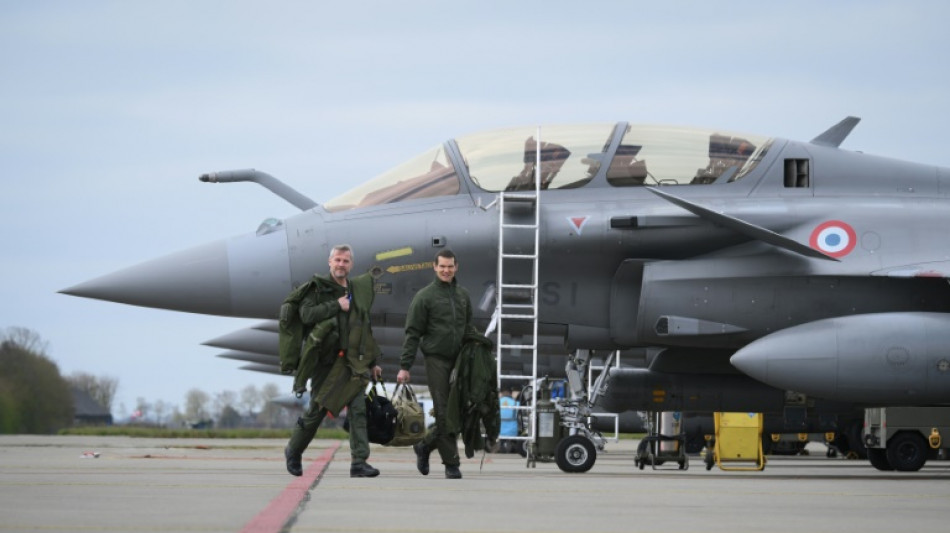
In skies, as on land, European forces face gaps if US pulls back / Photo: JOHN THYS - AFP

 Democrat accused of rape exits key US Senate race
 Japan student Ito keeps place against Ireland as Jones returns

 Belgium bid to crack Spain's ironclad defence in World Cup quarter-final
 US man sentenced after swapping 17th century manuscript
 US launches new strikes on Iran after Trump vows to hit 'hard'
 Taylor Swift fans pay $25 for garbage from outside wedding
 After quakes, Venezuelans fear losing damaged homes

 PSG's Lee set to join Athletico

 Erdogan gave pistols to NATO leaders, Starmer says
 Nocera Expands Diversified Technology Strategy With Binding Agreement to Acquire an Equity Interest in INERGX, an Integrated Energy Storage and Power Platform for AI, Defense and Mission-Critical Demand
 China sends nuclear missile message as US looks elsewhere
 Justin Bieber added to 11-minute World Cup final halftime show

 Fery targets Wimbledon final birthday present after royal seal of approval
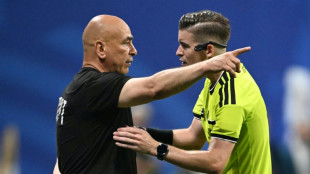 Egypt file complaint against referee after World Cup exit
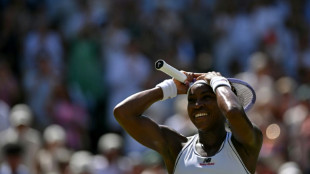 Women's semi-finalists in uncharted territory at Wimbledon
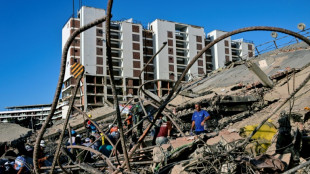
 US man jailed after swapping 17th century manuscript

 UN maritime head urges halt to Hormuz transit to protect seafarers

 Trump skips new Air Force One on return from Turkey NATO summit
 New York building that buckled now 'stable,' says mayor
 UN says pledges for global connectivity project pass $100 bn

 McIlroy hoping for 'home' comforts at Scottish, British Opens
 Noskova aims to emulate Kvitova after reaching first Wimbledon semi
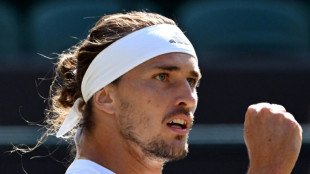
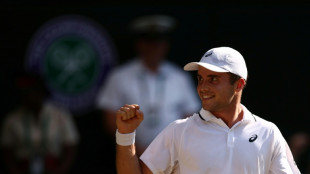 Britain's Fery becomes first wildcard to reach Wimbledon semis in 25 years

 Korda chases third major as Kim revisits Evian-winning chip

 Kooij wins Tour de France 5th stage in chaotic sprint finish
Fighter jets from the United States, France, Finland and Germany roar into the skies from a Dutch base as part of NATO's biggest air exercise this year.
The aim: to practice stopping -- and then defeating -- an enemy attack against the alliance as Russia's war in Ukraine fuels fears in Europe.
But while NATO focuses on the menace from the east, another potential threat is looming from within the alliance.
Since returning to office, US President Donald Trump has sowed doubt over Washington's commitment to underpinning European security and his administration has warned it could move forces away from the continent to deal with challenges elsewhere like China.
For now, NATO commanders insist nothing has changed -- showcased by the latest drills.
"We recently elected a new president, and we're still trying to figure out the exact policies that they're going to be coming out with," General James Hecker, the top US and NATO air commander in Europe, told reporters during the exercises.
"I think you're going to see us hand in hand with the Europeans for quite some time."
But if Trump does decide to withdraw US forces, there are fears that could leave European militaries struggling to plug gaps in key areas as they race to face off against an emboldened Moscow.
While attention often centres on the roughly 100,000 US troops currently stationed on the continent, above them in the skies, commanders and experts point to multiple areas where Europe could struggle without Washington.
Those include air defences, spy planes and satellites, electronic systems that can jam radar, tankers to refuel jets mid-flight and hulking aircraft used to transport troops.
"Hypothetically, if the environment over Taiwan deteriorates, the US is going to look to move key assets" from Europe, said Douglas Barrie from the International Institute for Strategic Studies.
- 'Best equipment' -
European nations have hiked defence spending since Russia's 2022 full-scale invasion of Ukraine and are set to go even further, under pressure from Trump.
But while purchases of the latest US F-35 fighter jets have risen in recent years -- acquiring systems in which Europe lags will be costly and time-consuming.
"It would take three to five years for some systems, five to 10 years for others, depending on where you wanted to spend your money," Barrie said.
Not to mention assets such as satellite systems and strategic nuclear bombers that would take decades to replace -- if they can ever really be substituted.
Doubts over Trump's reliability have also fuelled questions about whether Europe should keep buying equipment from the United States.
Worries he could hobble F-35s by refusing software updates or spare parts have led several countries to reconsider purchases -- and prompted renewed calls from the likes of France to cut reliance on Washington.
"This is a real opportunity for Europe to question its own model and possibly its own dependencies," said French air force general Laurent Rataud.
But while equivalents for much of the equipment do exist in Europe, production times are often long and the continent doesn't yet produce a fifth-generation stealth jet like the F-35.
"It's of the utmost importance that my women and men have the best equipment," said Dutch air force chief Andre Steur.
"For me it's less relevant where that kit is built."
- 'No match' -
Despite gaps in their inventories, NATO's European members insist they'd be able to handle a fight for the skies against Russia -- even without the United States.
"We actually have some pretty strong air forces," Lieutenant Colonel Martin Friis, a Danish officer at NATO's air command, told AFP.
"Some of them maybe have gotten smaller, but the technology, the weapons and the training is, compared to what we see from at least one potential opponent -- they're no match."
During the Cold War, the NATO alliance believed it would have air dominance over the Soviet Union thanks to its technological superiority.
As the threat receded after the fall of Communism, air forces often downsized and readapted to new missions in places like Afghanistan, where their opponents lacked firepower.
NATO has closely watched how Moscow failed to gain air superiority in Ukraine against Kyiv's much smaller force, and learnt its lessons.
Commodore Marcel van Egmond, head of the Dutch air combat command, said he is confident that European countries would have the upper hand over Russia -- at least in the early days of any conflict.
"But we need help for the longer fight, maybe from the US," he told AFP.
"The long-term sustainment, in terms of capacity that we have, might be a challenge."
Z.AlNajjar--SF-PST