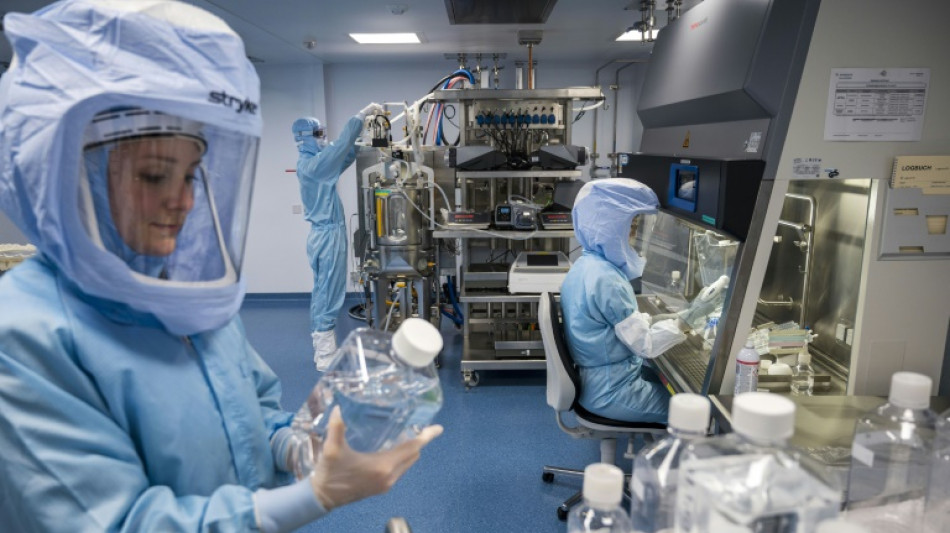
WHO pandemic agreement talks face deadline crunch / Photo: Thomas Lohnes - AFP

 Democrat accused of rape exits key US Senate race

 Japan student Ito keeps place against Ireland as Jones returns
 Belgium bid to crack Spain's ironclad defence in World Cup quarter-final
 US man sentenced after swapping 17th century manuscript

 US launches new strikes on Iran after Trump vows to hit 'hard'
 Taylor Swift fans pay $25 for garbage from outside wedding
 After quakes, Venezuelans fear losing damaged homes

 PSG's Lee set to join Athletico
 Erdogan gave pistols to NATO leaders, Starmer says
 Nocera Expands Diversified Technology Strategy With Binding Agreement to Acquire an Equity Interest in INERGX, an Integrated Energy Storage and Power Platform for AI, Defense and Mission-Critical Demand
 China sends nuclear missile message as US looks elsewhere
 Justin Bieber added to 11-minute World Cup final halftime show

 Fery targets Wimbledon final birthday present after royal seal of approval
 Egypt file complaint against referee after World Cup exit
 Women's semi-finalists in uncharted territory at Wimbledon
 US man jailed after swapping 17th century manuscript

 UN maritime head urges halt to Hormuz transit to protect seafarers

 Trump skips new Air Force One on return from Turkey NATO summit

 New York building that buckled now 'stable,' says mayor

 UN says pledges for global connectivity project pass $100 bn

 McIlroy hoping for 'home' comforts at Scottish, British Opens

 Noskova aims to emulate Kvitova after reaching first Wimbledon semi

 Britain's Fery becomes first wildcard to reach Wimbledon semis in 25 years

 Korda chases third major as Kim revisits Evian-winning chip

 Kooij wins Tour de France 5th stage in chaotic sprint finish

The outcome of years-long negotiations on a global agreement on tackling future pandemics remained in doubt ahead of a final deadline Friday.
Five years after Covid-19 killed millions -- and with new health threats lurking, from H5N1 bird flu to measles, mpox and Ebola -- pressure is mounting for a landmark deal on pandemic prevention, preparedness and response.
"Having a framework that brings nations together and plans for the next pandemic will save thousands if not millions of lives," insisted WHO emergencies director Michael Ryan.
But President Donald Trump's decision to withdraw the United States from the World Health Organization and his large-scale dismantling of US health institutes is a new threat to the global health risk surveillance system, experts warn.
"It's now or never," said Sueri Moon, co-director of the Global Health Centre at the Geneva Graduate Institute.
In December 2021, WHO member states resolved to seek a deal aimed at preventing and preparing for future pandemics, to avoid the mistakes made during Covid.
Major disputes have slowed negotiations, including on how to share data on dangerous pathogens, and whether the transfer of the technology and know-how to produce vaccines, tests and treatments should be mandatory or voluntary.
- 'Unpredictable' -
After 13 rounds of discussions, countries have been meeting at the WHO headquarters in Geneva for final negotiations this week, with a Friday night deadline to iron out remaining problems.
The aim is to have a text ready for final approval during the WHO's annual assembly next month.
"The member states are working very hard," WHO chief Tedros Adhanom Ghebreyesus told reporters on Thursday, adding: "I hope they will reach a deal."
Ryan added that the negotiators were "making steady progress. But there are difficult issues on the table."
The number of disputed issues have steadily shrunk in recent months, with observers saying the main sticking point now is "political will".
The outcome is "unpredictable", a diplomatic source told AFP.
"Substantial progress" has been made on the draft text, "but differences remain on some key articles", China's mission in Geneva told AFP, calling on all parties to "display mutual understanding" to secure an agreement that is "meaningful, equitable and actionable".
- 'Very important' -
A new extension of the talks until May is possible, with NGOs and experts urging countries to compromise.
"It's very important to reach this agreement, even with a sub-optimal text," said Ellen 't Hoen, director of the Medicines Law and Policy NGO.
"That is much more preferable than having to negotiate such an agreement from scratch, because that will likely only happen after the next pandemic hits, and that would be an unacceptable situation."
Among the remaining sticking points are a so-called Pathogen Access and Benefit-Sharing System (PABS) proposed in the text.
The proposal calls for participating companies to provide the WHO with "rapid access" to 20 percent of their production of pandemic-related health products, including "at least 10 percent of their real time production" in the form of donations.
Some countries, especially producer states, have meanwhile balked at what they consider high thresholds.
While the talks could in theory continue even after next month's assembly, there is widespread concern that if the process drags on, the political will to conclude a deal would dissipate.
If that happens, "it will probably be too late", Moon said.
"The wind will go out of the sails."
H.Jarrar--SF-PST