
Hamas leadership operating behind veil of secrecy / Photo: Bashar TALEB - AFP

 Dana White Confirms Flight to Washington for Trump Meeting on Press Secretary Role
 Dengue Fever Expands Into High Himalayas as Climate Change Warms Nepal

 IoT Refrigerator Hacks Disrupt Blood Labs and Supermarkets Across Europe and US

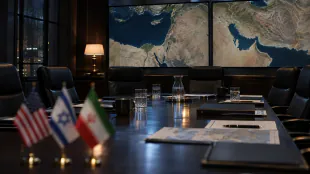 Post-election pressures complicate US and Israeli decisions on Iran
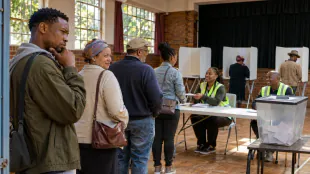
 UN members approve talks on treaty protocol against environmental crime

 Family-run West Sussex beach café prepares for first winter season

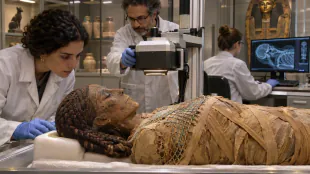 CT scans reveal health and burial clues from Egypt’s Braided Lady mummy

 Oxford faces complaints over lecturer’s classroom attire

 Kyren Wilson and John Higgins reach International Championship snooker final

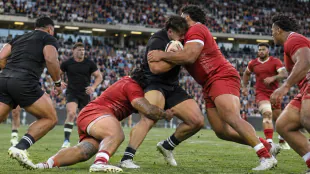 New Zealand and Tonga meet for place in Rugby League World Cup final
 Reports of unsafe AI-toy responses renew calls for child-safety rules

 Juneau food network combines difficult supply routes with deep sharing traditions

 India climbs green-transition ranking after first emissions decline in 25 years
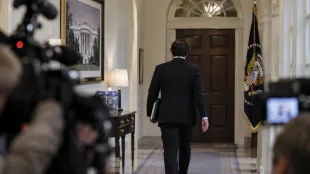 Trump names Stephen Miller as White House chief of staff after midterm losses

 Restored Albanian tower houses anchor new rural tourism trail
 Sonia Gandhi reflects on family tragedy and reluctant political career

 Pope Leo begins three-country South American tour in Uruguay
 Khawaja says entire Australia camp knew of 2018 ball-tampering plan
After Israel killed a string of its leaders, Hamas anointed new commanders to top ranks, this time shrouding their identities in secrecy to protect them from assassination.
Israel vowed to crush Hamas in retaliation for the October 7 attack, launching a blistering offensive in Gaza that has massively weakened the movement while reducing much of the territory to rubble.
Hamas's political chief Ismail Haniyeh, the head of its armed wing Mohammed Deif, and Yahya Sinwar, mastermind of the October 7 attack, have all been killed, as have a string of other commanders and political figures.
Yet unlike its Lebanese ally Hezbollah, whose cult of personality around its slain leader Hassan Nasrallah was a key pillar of its identity, Hamas has placed less of an emphasis on its top ranks.
The group has remained tight-lipped over the names of its top ranks, particularly the Ezzedine al-Qassam brigades.
"The name of the head of the Ezzedine al-Qassam Brigades will remain a secret," said a source close to Hamas's armed wing.
Researchers say it is likely that the role was inherited by Yahya Sinwar's younger brother Mohammed, whom Hamas put in charge of the hostages taken into Gaza in 2023.
"Yahya Sinwar's personality was rather unique" and militants viewed him as a "hero", said Laetitia Bucaille, who teaches political sociology at the INALCO institute of Middle East studies in Paris.
Mohammed Sinwar's blood link to the slain commander, coupled with his own experience in the brigades, have conferred upon him an automatic authority, she said.
- Collective leadership -
Israel vowed after October 7 to eradicate Hamas, and while the movement has suffered staggering losses, it has not been crushed.
According to Yasser Abu Heen, founder of the Gaza-based Safa news agency, the loss of so many of its leaders has impacted Hamas, "but only temporarily".
"These hits do not pose an existential crisis, Hamas has its own way of running its institutions," he said. "Israel will not be able to eradicate it."
Speaking to AFP on condition of anonymity, a member of Hamas's political bureau described how it acts as the movement's executive arm, voting on decisions and then taking action.
Political bureau membership is decided by the larger Shura Council, the equivalent of a parliament, he added.
"We will not know the new leaders' names. There's a push to keep their identities secret, and to maintain a collective sense of power," said Leila Seurat of the Arab Centre for Research and Political Studies in Paris.
"This isn't a movement based on a charismatic leadership."
While Hamas has survived thus far, it has yet to make the toughest decision of all concerning its future role in Gaza and in the Palestinian struggle for statehood.
Reduced under daily bombardment, Hamas faces demands not just from Israel but from powers around the world and even from some Palestinians to give up power.
- Dissent -
The Palestinian Authority, whose decades of corruption contributed to Hamas's ascent, has pitched itself as a credible ruling entity for the battered territory.
Within Hamas, discussions are raging on whether to hand over power.
According to sources cited by the Soufan Center in New York: "The internal debate has intensified to the point where some Hamas political leaders have considered breaking with the group's military leaders in Gaza."
Hamas is no stranger to division, with Seurat pointing to crises in the past over a range of issues from the Arab Spring to the movement's alliance with Iran.
But the war with Israel has brought to a head frustration among ordinary Gazans sick of a conflict that has killed many thousands and reduced their territory to rubble.
Musa Abu Marzouk, a leading Hamas figure involved in talks over the ceasefire with Israel, told The New York Times in late February that as far as he was concerned, "if it was expected that what happened would happen, there wouldn't have been October 7".
In March, hundreds of people took to the streets of Gaza, chanting "Out, out, Hamas out!", after a rare call to protest circulated via Telegram.
"Some Palestinians want Hamas to go. Some have always been opposed, while others are just fed up," said Seurat.
Pressure alone will not work, however, because Hamas has no viable competitor, and the people of Gaza simply do not have the means to stand up to it.
"They are still in control," said Bucaille. "While Hamas has been weakened, no one can stand up to it for now."
G.AbuHamad--SF-PST