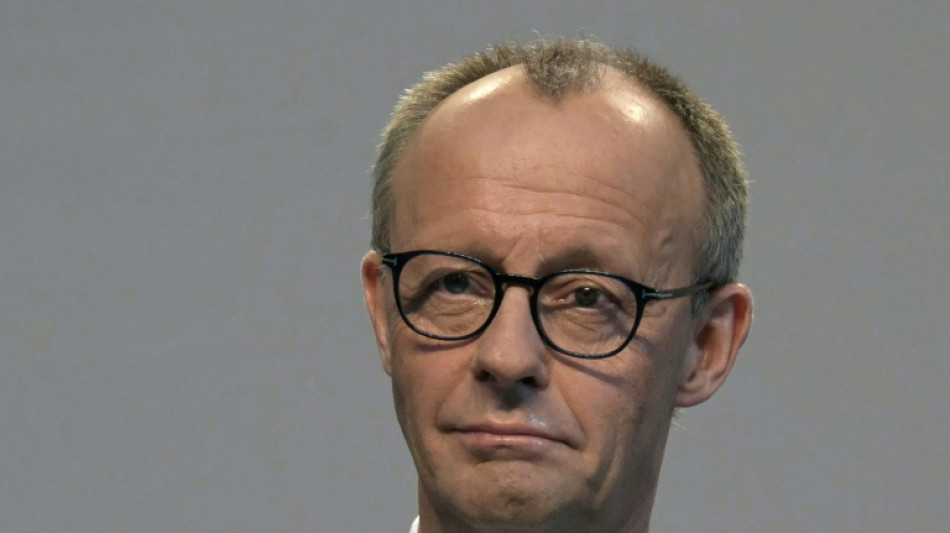
Germany 'back on track' says Merz, unveiling new coalition / Photo: Tobias SCHWARZ - AFP

 US, Iran trade new strikes in fight over Hormuz strait

 Modi eyes 'historic' chance to secure Australian uranium
 US crackdown on top AI fuels open-source surge
 EU moves closer to kicking kids off social media
 Protecting the protectors: racing to save Philippine mangroves
 Expanded World Cup; same old story as Europe dominates quarter-finals

 Morocco's Saibari out of France World Cup quarter-final

 Trump orders new strikes on Iran over attacks on shipping in Hormuz

 PSG's Lee set to join Atletico Madrid
 Iran plays with fire, but calculates Trump will hold back

 Oil surges, stocks slide as Trump says Iran ceasefire over

 Meta to build $9 billion data center in western Canada

 Rogers backs Kane to outshine Haaland in World Cup showdown
 Some US Fed officials considered June rate hike on war fallout

 UN launches appeal for nearly $300 mn in Venezuela quake relief
 US to remove Syria from terror blacklist, in new boost to Sharaa
 Court rejects Trump request to restore his name to Kennedy Center
 MLB pitching great Verlander to retire after 2026 season
 Artificial cloud brightening could tame El Nino, but with risks: study

 Shocked and shaken, Venezuela quake survivors get psychological help

 France, Morocco kick off blockbuster World Cup quarter-finals
 Amorim hails 'ambitious' AC Milan, promises to learn Italian
 Cancer survivor Traeen takes the long road to Tour yellow
 Easing Russian Olympic restrictions 'terrible', says Wimbledon star Kostyuk
 'Unbelievable' Kooij wins Tour de France 5th stage in chaotic sprint finish
Germany's next leader, the conservative Friedrich Merz, vowed Wednesday to "move the country forward again" by boosting the economy and defence as he presented a deal to launch his coalition government by early next month.
Merz is set to take over as leader of Europe's top economy just as US President Donald Trump has sparked global trade turmoil and raised deep fears about future transatlantic security ties.
Asked at a news conference if he had a message for Trump, Merz said in English that the country would meet its defence obligations and rebuild its economic competitiveness.
"Germany is back on track," he added.
Following the February election victory of his CDU/CSU alliance, Merz has struck a deal to forge a new government with the centre-left Social Democrats (SPD) of the now caretaker Chancellor Olaf Scholz.
"The coalition agreement is a signal of a new beginning... for our country," said Merz, whose party won the elections with 28.5 percent of the vote. The far-right AfD took second place.
- 'Europe can rely on Germany' -
In their 144-page coalition contract, the two big centrist parties vowed to "significantly" boost defence spending amid growing concerns about US commitment to European security under Trump.
The parties also said Germany would continue to support Ukraine as the United States looks to encourage a deal to end the war started by Russia's full-scale invasion over three years ago.
"We will provide comprehensive support to Ukraine so that it can effectively defend itself against the Russian aggressor and assert itself in negotiations," the agreement said.
Presenting the deal, Merz pledged that Germany would "reform and invest to keep Germany stable, make it safer and make it economically stronger again", adding that "Europe can rely on Germany".
The swift conclusion of the talks -- a process that has in past years dragged on for months in Germany -- is the result of "extraordinary external pressure", said political scientist Wolfgang Schroeder of Kassel University.
"The pressure is coming from Trump, the pressure is coming from the AfD, the pressure is coming from (Merz's) own ranks," he told news channel NTV.
- Migration crackdown -
The run-up to February's election was marked by a bitter debate on migration and a surge in support for the far-right Alternative for Germany (AfD), which scored a record 20 percent of the vote.
Merz on Wednesday said his government would "largely end irregular migration", promising tight border controls and a "repatriation offensive" targeting those in the country illegally.
Germany held general elections on February 23 after the collapse of Scholz's three-way coalition on November 6, the very day Trump was re-elected to the White House.
After the vote, Merz also pledged steps to build up Germany's long underfunded armed forces and to revive its economy, which has shrunk for two years in a row.
He has secured major financial firepower for his ambitious plans after the outgoing parliament approved hundreds of billions of euros in extra spending and a softening of Germany's strict debt rules.
However, this has exposed him to internal party criticism and accusations from the AfD that he has broken campaign pledges and caved in to key demands of the SPD.
- 'Power vacuum' -
Support for the AfD has continued to rise since the election. One survey for the Ipsos pollster on Wednesday rated it as Germany's most popular party on 25 percent -- a point ahead of the CDU/CSU.
Renate Koecher, head of the Allensbach Institute, said the rise of the AfD had been fuelled by Germany's political paralysis at a time of acute global and domestic crises.
"Problems are growing but at the same time we have no government capable of acting," Koecher told the Rheinische Post newspaper.
"The economy is facing increasing difficulties, and decisions are being made in the US that Europe, with Germany in a leading role, should be able to respond to quickly.
"And in this situation, we have a power vacuum. This fuels the unease among the population."
While the SPD plans to ask its members to sign off on the final deal, the CDU plans only to seek the approval of senior party figures.
K.AbuDahab--SF-PST