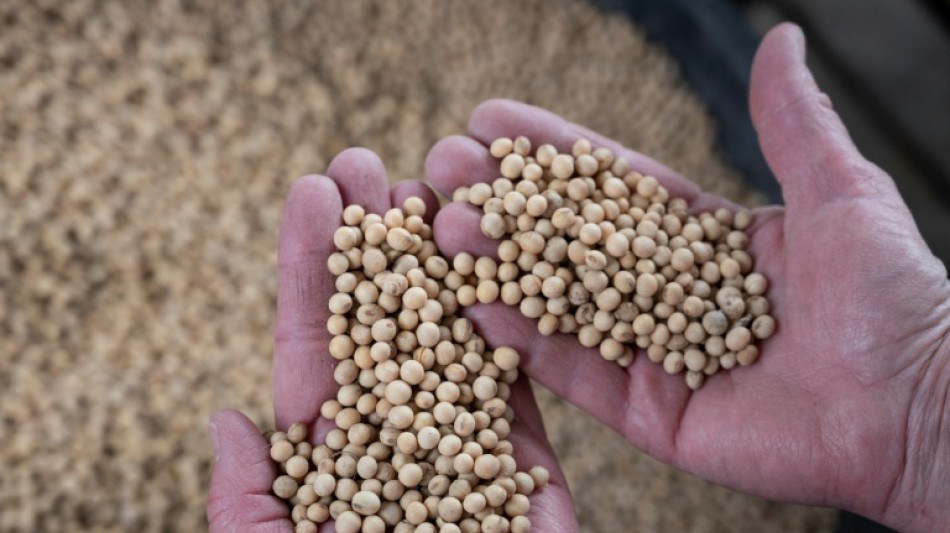
US soybeans, energy: Who is hit by China's tariff retaliation? / Photo: Johannes EISELE - AFP/File

 Alpacas, mini pigs on the loose after floods hit south China zoo

 All Blacks make five changes for Italy Nations Championship clash

 Western Europe records its hottest June as heatwaves surge: EU monitor
 Fashion's mystery man Margiela sells off his archives
 Nuclear test-scarred Marshall Islands criticises China missile

 Chip titan SK hynix to set price for mega US listing

 Crude extends rally as US-Iran flare-up rocks peace hopes

 Democrat accused of rape exits key US Senate race

 Japan student Ito keeps place against Ireland as Jones returns

 Belgium bid to crack Spain's ironclad defence in World Cup quarter-final
 US man sentenced after swapping 17th century manuscript

 US launches new strikes on Iran after Trump vows to hit 'hard'
 Taylor Swift fans pay $25 for garbage from outside wedding

 After quakes, Venezuelans fear losing damaged homes

 PSG's Lee set to join Athletico

 Erdogan gave pistols to NATO leaders, Starmer says
 Nocera Expands Diversified Technology Strategy With Binding Agreement to Acquire an Equity Interest in INERGX, an Integrated Energy Storage and Power Platform for AI, Defense and Mission-Critical Demand

 China sends nuclear missile message as US looks elsewhere
 Justin Bieber added to 11-minute World Cup final halftime show

 Fery targets Wimbledon final birthday present after royal seal of approval

 Egypt file complaint against referee after World Cup exit

 Women's semi-finalists in uncharted territory at Wimbledon
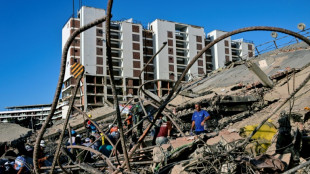
 US man jailed after swapping 17th century manuscript

 UN maritime head urges halt to Hormuz transit to protect seafarers

 Trump skips new Air Force One on return from Turkey NATO summit

US agricultural exports, fuels and manufactured goods are set to take a hit from China's blanket retaliation against President Donald Trump's sharp tariffs, with both sets of measures due to take effect next week.
After Trump announced a 34-percent new tariff on imports of Chinese goods -- taking the added rate imposed this year to 54 percent -- Beijing said it would slap an equivalent across-the-board tariff on US goods, among other countermeasures.
China used to target specific industries in a "mirror response" to US export restrictions, said Emily Benson of consulting firm Minerva Technology Policy Advisors.
But its broader plan unveiled Friday marks a "pretty significant warning shot" to the Trump administration to hold off further measures, she told AFP.
What is the state of US-China trade, and what US sectors stand to be impacted?
- US exports -
The United States exported $144.6 billion in goods to China in 2024, much less than the $439.7 billion it imported, Commerce Department data shows.
Among its exports, key sectors include electrical and electronic equipment and various fuels, alongside oilseed and grains.
But China likely has more confidence to retaliate this time compared with Trump's first presidency, when he engaged in a tit-for-tat tariff war with Beijing.
"While the US is still obviously a very important market, fewer firms are now existentially dependent on US suppliers," said Lynn Song, ING chief economist for Greater China.
She added that Beijing has also made efforts towards technological self-sufficiency.
- Agricultural goods -
"US farmers will bear a heavy burden," said Asia Society Policy Institute vice president Wendy Cutler.
Their agricultural exports to China could "become too expensive to be competitive" with Beijing's added tariffs, she told AFP.
Soybeans, oilseeds and certain grains were a key US export to China, amounting to $13.4 billion last year, US trade data showed.
"China bought 52 percent of our (soybean) exports in 2024," said American Soybean Association chief economist Scott Gerlt.
Given the size of its purchases, China cannot easily be replaced, he told AFP.
Soybean prices plunged on Friday's news.
- Fuels, machinery -
China also imported $14.7 billion of various fuels and oils from the United States last year.
Tariffs could impact the oil and gas industry in states like Texas, which alongside Louisiana saw such exports to China surge in 2023, said a US-China Business Council report.
And the US exported some $15.3 billion in electrical machinery to China last year, official trade data showed.
But semiconductor shipments have faltered on expanding US export controls on advanced tech.
- Chips impact -
Besides tariffs, China has restricted exports of rare earth elements and taken action against US firms -- including drone companies and those in the defense and aerospace sectors.
"China controls about 69 percent of rare earth element mining. They also control about 90 percent of refining," said Benson of Minerva Technology Policy Advisors.
"That's going to probably be a chokepoint moving forward," she added. This could affect semiconductor manufacturing, magnets, optics and lasers.
"Some of these are targeted, of course, at chips," she said.
With Washington and Beijing turning to a growing range of tools in their conflict, Benson warned that the US "is relatively exposed to these Chinese controls" without an industrial policy response providing "a major cash infusion to scale up domestic production."
T.Samara--SF-PST