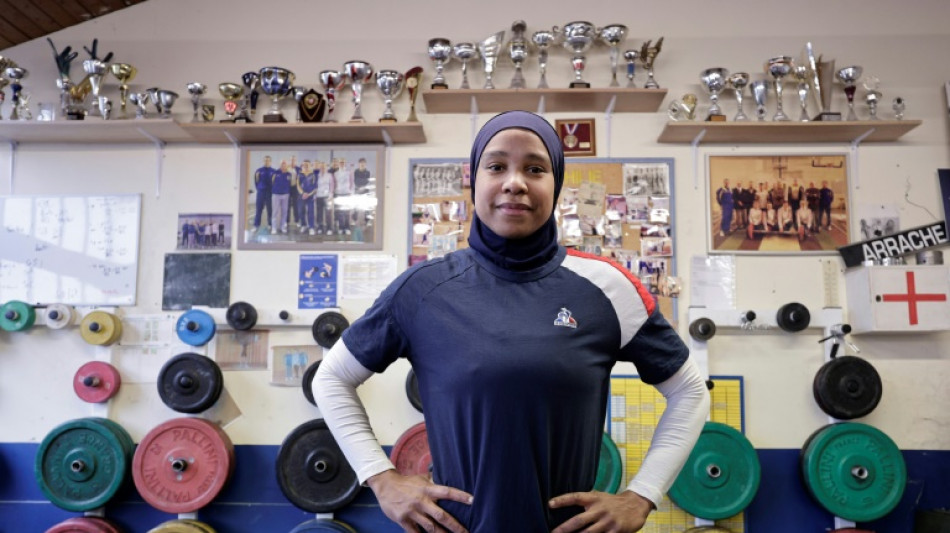
Athletes frustrated as France mulls Muslim headscarf ban in sport / Photo: STEPHANE DE SAKUTIN - AFP

 Crude stabilises after US-Iran flare-up rocked peace hopes
 Playmaker Jalibert moves to fullback as France swing axe for Australia clash
 Australian sprint star Gout out of U20 worlds with hamstring tear

 Unions to protest as Volkswagen thrashes out job cut plans
 Teeth bared in Greece's bear-human showdown
 Alpacas, mini pigs on the loose after floods hit south China zoo
 All Blacks make five changes for Italy Nations Championship clash
 Western Europe records its hottest June as heatwaves surge: EU monitor
 Fashion's mystery man Margiela sells off his archives
 Nuclear test-scarred Marshall Islands criticises China missile

 Chip titan SK hynix to set price for mega US listing
 Crude extends rally as US-Iran flare-up rocks peace hopes

 Democrat accused of rape exits key US Senate race

 Japan student Ito keeps place against Ireland as Jones returns
 Belgium bid to crack Spain's ironclad defence in World Cup quarter-final
 US man sentenced after swapping 17th century manuscript
 US launches new strikes on Iran after Trump vows to hit 'hard'
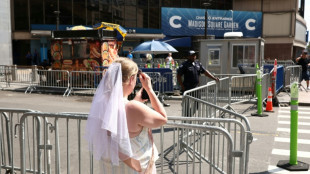 Taylor Swift fans pay $25 for garbage from outside wedding
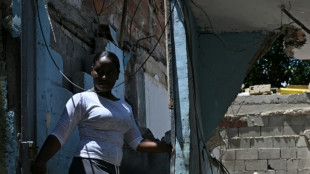 After quakes, Venezuelans fear losing damaged homes

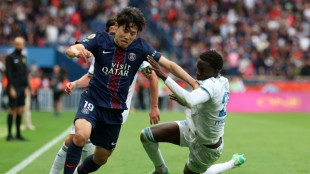 PSG's Lee set to join Athletico
 Erdogan gave pistols to NATO leaders, Starmer says
 Nocera Expands Diversified Technology Strategy With Binding Agreement to Acquire an Equity Interest in INERGX, an Integrated Energy Storage and Power Platform for AI, Defense and Mission-Critical Demand

 China sends nuclear missile message as US looks elsewhere
 Justin Bieber added to 11-minute World Cup final halftime show
 Fery targets Wimbledon final birthday present after royal seal of approval
On the outskirts of Paris, 44-year-old French Muslim weightlifter Sylvie Eberena concentrates hard and pushes 80 kilos of bar and weights clean over her veiled head.
The single mother made her four children proud when she became the French national champion in her amateur category last year, after discovering the sport aged 40.
But now the Muslim convert fears she will no longer be able to compete as the French government is pushing for a new law to ban the headscarf in domestic sports competitions.
"It feels like they're trying to limit our freedoms each time a little more," said Eberena, a passionate athlete who trains five days a week.
"It's frustrating because all we want is to do sport."
Under France's secular system, civil servants, teachers, pupils and athletes representing France abroad cannot wear obvious religious symbols, such as a Christian cross, a Jewish kippah, a Sikh turban or a Muslim headscarf, also known as a hijab.
Until now, individual national sports federations could decide whether to allow the hijab in domestic competitions.
But the new legislation aims to forbid the head covering in all professional and amateur competitions countrywide.
Backers say that would unify confusing regulation, boost secularism and fight extremism.
Critics argue it would be just the latest rule discriminating against visibly Muslim women.
- 'Symbol of submission' -
The bill passed in the Senate in February and is soon to go to a vote in the lower house of the French parliament.
Some proponents want to stop what they call "Islamist encroachment" in a country that has been rocked by deadly jihadist attacks in recent years.
But critics point to a 2022 interior ministry report finding that data "failed to show a structural or even significant phenomenon of radicalisation" in sport.
French Olympic judo champion Teddy Riner, a star of the 2024 Paris Games, last month said France was "wasting its time" with such debates and should think about "equality instead of attacking a single and same religion".
Right-wing Interior Minister Bruno Retailleau responded that he "radically disagreed", describing the headscarf as "a symbol of submission".
Eberena, who converted aged 19, said her head attire -- allowed by the weightlifting federation -- had never been an issue among fellow weightlifters.
She said the sport has even allowed her to make friends from completely different backgrounds.
"Sport brings us together: it forces us to get to know each other, to move beyond our prejudices," she said.
- 'Really sad' -
France's football and basketball federations are among those that have banned religious symbols, including the headscarf.
The country's highest administrative court in 2023 upheld the rule in football, arguing the federation was allowed to impose a "neutrality requirement".
United Nations experts last year called the rules in both sports "disproportionate and discriminatory".
It is difficult to estimate how many women might be prevented from competing if such legislation passes.
But AFP spoke to several women whose lives had already been affected by similar rules.
Samia Bouljedri, a French 21-year-old of Algerian origin, said she had been playing football for her club in the village of Moutiers for four years when she decided to cover her hair at the end of high school.
She continued playing with her team, but after her club was fined several weekends in a row for allowing her on the field, they asked her to take off her hijab or quit.
"That they ended my happiness, just like that, over a scarf made me really sad," she said.
France's brand of secularism stems from a 1905 law protecting "freedom of conscience", separating church and state, and ensuring the state's neutrality.
The country's constitution states that France is a secular republic.
Rim-Sarah Alouane, a researcher at University Toulouse Capitole, said the 1905 law, intended "to protect the state against potential abuses from religion", had been "weaponised" against Muslims in recent years.
French secularism "has been transformed into a tool in its modern interpretation to control the visibility of religion within public space, especially, and mostly, targeting Muslims," she said.
- 'Defend secularism' -
Sports Minister Marie Barsacq last month warned against "conflating" the wearing of a headscarf with radicalisation in sport.
But Justice Minister Gerald Darmanin said that if the government did not "defend secularism", it would empower the far right.
In the Oise region north of Paris, Audrey Devaux, 24, said she stopped competing in basketball games after she converted to Islam a few years ago.
Instead, she continued training with her former teammates and began coaching one of the club's adult teams, she said.
But when she goes to weekend games, she is not allowed onto the courtside bench with a headscarf -- so she is forced to yell out instructions from the bleachers.
"At school I learnt that secularism was living together, accepting everyone and letting everybody practice their religion," Devaux said.
"It seems to me they're slightly changing the definition."
C.Hamad--SF-PST