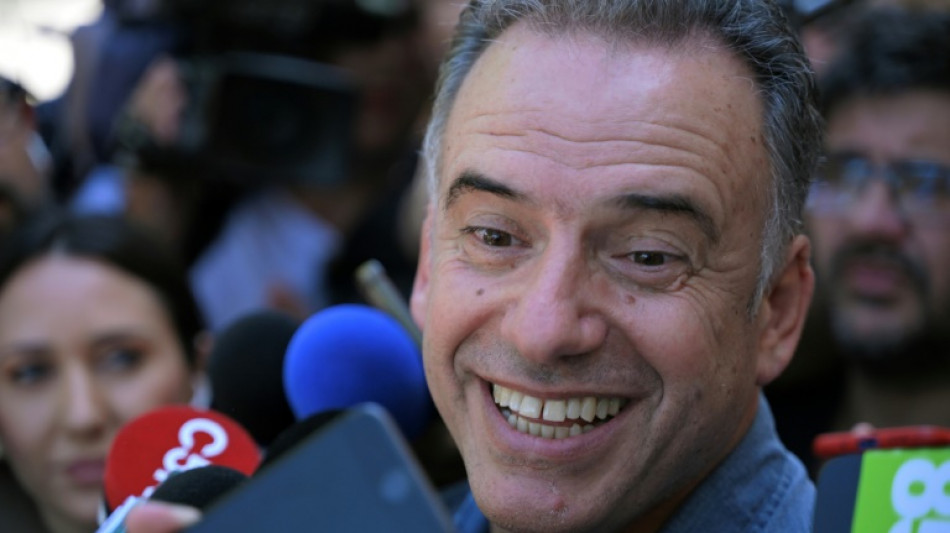
Left-wing candidate Orsi projected to win Uruguay election / Photo: Eitan ABRAMOVICH - AFP

 Trump says Denmark to give US 'permanent control' over Greenland security
 Kennedy Center: future unclear for iconic Washington arts hub

 Trump claims 'infinite' Greenland security deal with Denmark

 Helicopters battle wildfire threatening Ecuador's capital

 Brentford batter Chelsea to undo Alonso's promising start
 Kane hits Bundesliga century as Bayern rout Union
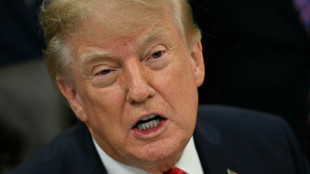 Trump says CNN, MS NOW, Politico banned from White House
 Hushing and hedging: US companies retreat on climate

 Springboks to face Fiji before 2027 Rugby World Cup
 Nigeria miners struggled to breathe in cell before 37 died: survivors

 McIlroy on the charge at PGA Championship as Reed withdraws

 McIlroy on the charge at PGA Championship

 Crisis-wracked Volkswagen warns of 10-bn-euro hit to profits

 Costa Rica's Grynspan tops third informal poll for UN chief: diplomat

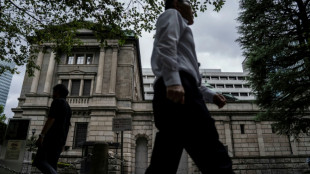
 Stock markets retreat after central bank rate hikes
 Russia labels director of Cannes Grand Prix winner a 'foreign agent'

 Macron warns of Russian 'hybrid' threat after meeting presidential hopefuls

 UN holds third informal poll for new chief
 Kulusevski return can spark Spurs: De Zerbi

 Shakira to cap off world tour with Madrid 12-gig run

 Isolated Syrian-Druze city blames Damascus for shortages
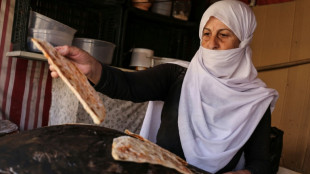 Isolated Syrian-Druze city shortages

 Dutch drop Depay for Germany match in Xavi's first pick

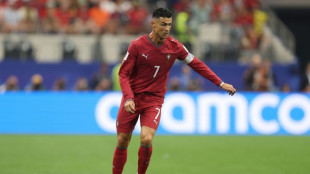 Ronaldo named in Portugal squad for Nations League
 Stock markets diverge after central bank rate hikes

Left-wing candidate Yamandu Orsi was projected to win Uruguay's presidential election, media reported Sunday, in a rebuke by voters of five years of conservative rule.
Uruguayans went to the polls for the second round of voting in what became a tight race between Orsi, of the Frente Amplio (Broad Front) alliance, and Alvaro Delgado of the National Party, a member of outgoing President Luis Lacalle Pou's center-right Republican Coalition.
Orsi received 49 percent of the vote to Delgado's 46.6 percent, according to an Equipos Consultores poll carried by TV station Canal 10, while the leftist politician was projected to have 49.5 percent of the vote against 45.9 percent for his opponent in a Cifra poll cited by Canal 12.
Orsi's campaign was boosted by support from Jose "Pepe" Mujica, a former guerrilla lionized as "the world's poorest president" because of his modest lifestyle during his 2010-2015 time in office.
Orsi, seen as an understudy of Mujica, had garnered 43.9 percent of the October 27 first-round vote -- short of the 50 percent needed to avoid a runoff but ahead of the 26.7 percent of ballots cast for Delgado.
The pair came out on top of a crowded field of 11 candidates seeking to replace Lacalle Pou, who has a high approval rating but is barred constitutionally from seeking a second consecutive term.
Polls had pointed to a narrow race Sunday, with Orsi only marginally ahead in stated voter intention in South America's second-smallest country.
Polls closed at 7:30 pm (2230 GMT).
- 'A very different world' -
Mujica, who is battling cancer and had to use a cane to walk into his polling station to vote, said Sunday: "Personally, I have nothing more to look forward to. My closest future is the cemetery, for reasons of age.
"But I am interested in the fate of you, the young people who, when they are my age, will live in a very different world."
A smiling Orsi cast his ballot Sunday in the rural Canelones region, to applause from supporters.
Delgado shook hands with polling station officials as he cast his vote in Montevideo.
"If I win, tomorrow I plan to invite candidate Orsi to come have some mate," Delgado said, referring to a traditional herbal infusion Uruguayans sip frequently.
Other parties within the Republican Coalition had thrown their support behind Delgado since the first round, boosting his numbers.
- Insecurity a worry -
A victory for Orsi will see Uruguay swing left again after five years of center-right rule in the country of 3.4 million inhabitants.
The Frente Amplio coalition broke a decades-long conservative stranglehold with an election victory in 2005, and held the presidency for three straight terms.
It was voted out in 2020 on the back of concerns about rising crime blamed on high taxes and a surge in cocaine trafficking through the port of Montevideo.
Polling numbers ahead of the vote showed perceived insecurity remains Uruguayans' top concern five years later.
A 72-year-old retiree who voted, Juan Antonio Stivan, said he just wanted the next government to guarantee "safety -- to be able to go out in the street with peace of mind, as an old person, as a young person, as a child."
Another voter, Aldo Soroara, a 60-year-old winegrower, said he expected whoever is elected as president to do "the best he can for the people," adding: "You can't ask for much more in these difficult times."
Voting is compulsory in Uruguay, one of Latin America's most stable democracies, with comparatively high per-capita income and low poverty levels.
During the heyday of leftist rule, Uruguay legalized abortion and same-sex marriage, became the first Latin American country to ban smoking in public places and the world's first nation, in 2013, to allow recreational cannabis use.
V.Said--SF-PST