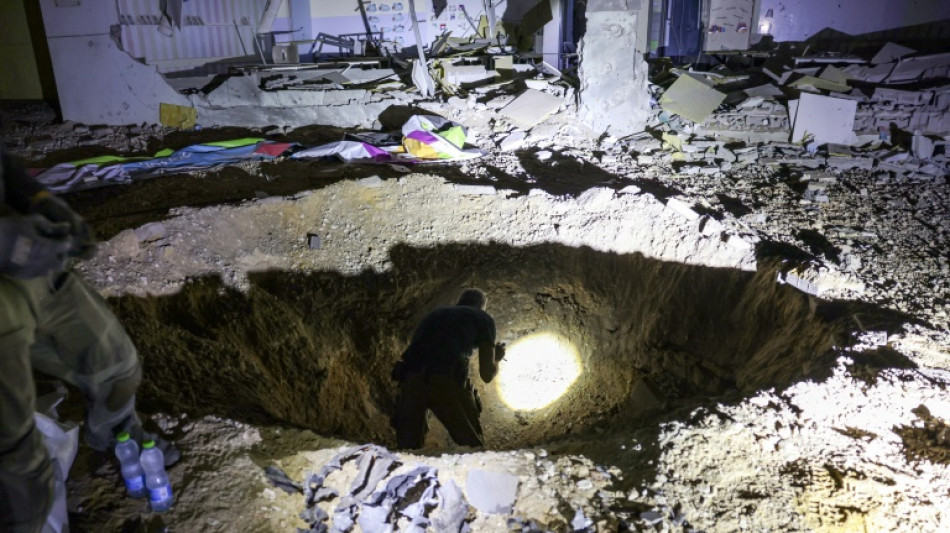
Missile barrage against Israel exposes Iran's limitations: analysts / Photo: Menahem KAHANA - AFP

 At UN, OpenAI's Altman calls 'for extreme care' in AI

 Hamilton gives thumbs up to Gulf GPs despite Iran conflict

 Leclerc admits going 'too far' in Hamilton shunt in Italy

 Row engulfs Dolly Parton's estate as manager accuses nephew of making threats
 Mandela Digital Extends Early Access Programme to 11 February 2027 Following Strong Response

 US seeks 11th Presidents Cup win in a row over global foes

 McDonald's to boost franchisees as inflation weighs on consumers
 Trump invites Putin to G20 summit in Miami

 Archaelogical 'breakthrough' could confirm origins of Paris

 ILO financial crisis takes centre stage in leadership race

 Stocks dip, oil soars despite Trump hailing "productive" Iran talks

 China's Xi to get rare airport welcome from Trump

 Turkey reassures investors over investment fund crisis
 Saka says England still have 'scar' from World Cup semi-final loss

 アレックス・ボディ氏とシュテファン・ハウプト教授、ルーマニアの伝説的な美術コレクションをめぐり提携に合意

 亞歷克斯·博迪與史蒂芬·豪普特教授就羅馬尼亞傳奇藝術收藏達成合作協議

 Алекс Боди и проф. д-р Стефан Хаупт договорились о сотрудничестве в рамках легендарной коллекции произведений искусства в Румынии

 French foreign minister says Palestinians 'must' hold polls

 Fresh Russian strikes on Ukraine's infrastructure kill seven

 Eriksen to return to Denmark after parting ways with Wolfsburg
 Brad Pitt says working with dog co-star was 'really moving'

 Golan will remain Syrian, vows President al-Sharaa at UN
 Blueberry Strengthens MENA Presence with CMA Category 5 License and Dubai Office Launch
 Russia probes bear attacks, as official says town under 'siege'

 Robertson tells Spurs to 'forget' past woes

Iran's missile barrage at Israel this week was meant as a warning that the Islamic republic can hit Israeli territory, but has instead exposed Iranian military limitations, analysts say.
In its second-ever direct attack on Israel, Iran launched some 200 missiles on Tuesday, with most of them -- but not all -- intercepted by Israeli air defences with help from allies.
Iran's Revolutionary Guards said the attack was in retaliation for Israel's killing of top Iranian and allied officials, including Hassan Nasrallah, leader of the Tehran-backed militant group Hezbollah who was targeted in a massive air strike on Beirut last month.
A similar Iranian assault in April saw barrages of missiles and drones launched at Israel, also in response to deadly Israeli attacks.
Analysts said the latest attack, despite being more substantial than the April one, was calibrated to boost Iran's deterrence but avoid provoking a potentially destructive full-out war with Israel.
And while the size of Iran's ballistic arsenal is unknown, analysts said it risks being exhausted.
Farzan Sabet, senior research associate at the Global Governance Centre in Geneva, said that Iran's stockpile of missiles that are "able to reach Israel is limited".
Tehran likely has the capability to "inflict serious damage on Israel" over a period of a few weeks or months, but not during a longer conflict, Sabet said.
- 'Eroding deterrence' -
The spate of high-profile killings were seen as massive intelligence failures for Tehran and its allies, compelling the Iranian leadership to respond in order "to maintain its credibility in the eyes of international and domestic audiences", according to Sabet.
"However, I believe they also calibrated the attack with the goal of not triggering a major Israeli and US response -- a very difficult needle to thread," he said.
Independent military expert Eva Koulouriotis said that "the Iranian regime's deterrence in the region has been eroding for some time".
In April, Iran's first direct attack on Israel "did not restore Iranian deterrence, but rather deepened its collapse", she said.
With Nasrallah's assassination and the late July killing in Tehran of Hamas chief Ismail Haniyeh, Israel appeared to restore its deterrence "which suffered a severe blow on October 7", Koulouriotis said.
That day, Haniyeh's Iran-backed Palestinian militant group launched its unprecedented attack on Israel, severely denting the reputation of Israeli intelligence and triggering the ongoing war in the Gaza Strip.
Iran's ability to arm its network of allied groups such as Hamas, Hezbollah and the Huthi rebels in Yemen, as well as Russia in its war against Ukraine, shows the capacity of its military industry.
But with no publicly available figures about Iran's stockpiles, Sabet said there are crucial questions about its launch capacity and replenishment rate.
"At what rate is its launch capacity and stockpile likely to be reduced over time by enemy counterattacks?" he said.
- Race for influence -
French Iran expert Bernard Hourcade said that despite the international focus on Tehran's controversial nuclear programme, "missiles have been the top priority of the entire Iranian military apparatus and the state."
He said that Iran's deterrence had been based on the existence around Israeli territory of Hamas and Hezbollah -- both deeply damaged by the current conflict -- as well as missiles, which for a second time caused relatively little damage to its regional foe.
"These three weapons have disappeared," said Hourcade.
"It's over, they are no longer credible."
Just hours before the latest attack, a senior White House official briefing reporters said Washington had "indications" that it was "imminent".
Iran has denied claims it had warned the United States through a third party, a move that could have helped reduce the actual damage and limit the international backlash while allowing Tehran to boast of retaliation against Israel.
"I think there was a kind of 'gentleman's agreement' within the Iranian government to say: 'Okay, we'll respond but in a way that's not excessive'," said Hourcade.
Broader geopolitical calculations may have come into play, possibly keeping the door open to reviving the 2015 nuclear deal with world powers to win sanctions relief in the hope of rescuing Iran's ailing economy.
According to Koulouriotis, "the equation in the Middle East today is that the restoration of Israeli deterrence... will be achieved by breaking Iranian deterrence in the region."
"The winner in this race will draw the map of influence in the Middle East for the coming decades."
Z.Ramadan--SF-PST