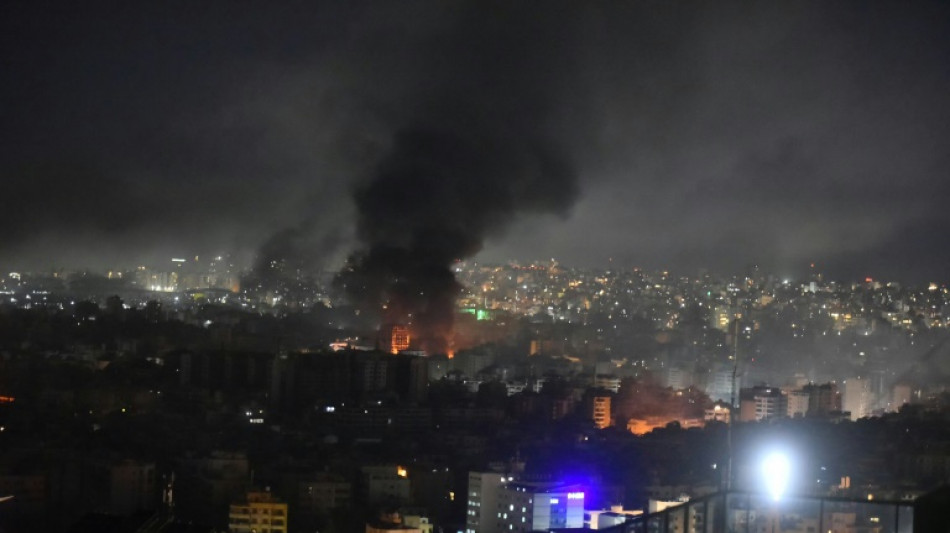
Deadly strike on central Beirut after Israel, Iran trade threats / Photo: Fadel ITANI - AFP

 At UN, OpenAI's Altman calls 'for extreme care' in AI
 Hamilton gives thumbs up to Gulf GPs despite Iran conflict
 Leclerc admits going 'too far' in Hamilton shunt in Italy
 Row engulfs Dolly Parton's estate as manager accuses nephew of making threats
 Mandela Digital Extends Early Access Programme to 11 February 2027 Following Strong Response

 US seeks 11th Presidents Cup win in a row over global foes
 McDonald's to boost franchisees as inflation weighs on consumers
 Trump invites Putin to G20 summit in Miami

 Archaelogical 'breakthrough' could confirm origins of Paris
 ILO financial crisis takes centre stage in leadership race
 Stocks dip, oil soars despite Trump hailing "productive" Iran talks

 China's Xi to get rare airport welcome from Trump
 Turkey reassures investors over investment fund crisis
 Saka says England still have 'scar' from World Cup semi-final loss

 アレックス・ボディ氏とシュテファン・ハウプト教授、ルーマニアの伝説的な美術コレクションをめぐり提携に合意
 亞歷克斯·博迪與史蒂芬·豪普特教授就羅馬尼亞傳奇藝術收藏達成合作協議

 Алекс Боди и проф. д-р Стефан Хаупт договорились о сотрудничестве в рамках легендарной коллекции произведений искусства в Румынии

 French foreign minister says Palestinians 'must' hold polls

 Fresh Russian strikes on Ukraine's infrastructure kill seven
 Eriksen to return to Denmark after parting ways with Wolfsburg
 Brad Pitt says working with dog co-star was 'really moving'

 Golan will remain Syrian, vows President al-Sharaa at UN
 Blueberry Strengthens MENA Presence with CMA Category 5 License and Dubai Office Launch
 Russia probes bear attacks, as official says town under 'siege'

 Robertson tells Spurs to 'forget' past woes

Israel carried out a deadly air raid Thursday in central Beirut after eight ground troops were killed near the Lebanese border, as it traded threats with its arch foe Iran over possible future attacks.
The Israeli military kept up its bombardment of the Lebanese capital after Iran launched its largest missile attack yet on Israel, which prompted Prime Minister Benjamin Netanyahu to warn Tehran would pay for its "big mistake".
As Israel weighs retaliation, President Joe Biden said the US was "fully supportive" of its ally but ruled out supporting a strike on Iran's nuclear sites.
Iran, which backs Lebanese militant group Hezbollah, said it would step up its response if Israel counterattacked, defying calls for de-escalation in a war that has cost more than 1,000 lives in Lebanon.
In Beirut, AFP journalists heard multiple explosions overnight and reported some buildings shaking.
One of the Israeli strikes hit a Hezbollah rescue facility, a source close to the group told AFP, killing at least six people, according to a Lebanese health ministry toll.
A total of 17 overnight air raids had hit Beirut by dawn on Thursday, Lebanon's official National News Agency (NNA) reported.
Israel, shifting its focus from the Gaza war sparked by Hamas's October 7 attack, says it is trying to secure its border with Lebanon so tens of thousands of Israelis displaced by nearly a year of hostilities with Hezbollah can return home.
Israeli bombing of Lebanon has displaced hundreds of thousands of people.
- Israeli soldiers killed -
The military has bombarded Hezbollah's south Beirut stronghold, having dealt a significant blow to the group last week by killing its leader, Hassan Nasrallah, in a massive strike.
A day after its military said it was conducting "targeted ground raids" in south Lebanon, Israel reported the first death of a soldier in the Israel-Hezbollah war, a toll that later rose to eight dead.
Hezbollah said it had forced Israeli soldiers to retreat, targeted an Israeli unit with explosives, and destroyed three Merkava tanks with rockets as they advanced on Maroun al-Ras village.
The Israeli military said it staged two brief incursions into Lebanon, ordering residents to flee more than 20 areas.
The military released footage that it said showed soldiers inside Lebanon, moving through villages and mountainous areas on foot, and announced it had deployed a second division to support the fighting.
Explosions in the Lebanese capital were audible kilometres away and came as the Israeli military ordered residents to leave multiple parts of densely populated southern Beirut in the early hours of Thursday.
Lebanon's health ministry said 46 people were killed and 85 others injured by Israeli strikes over the past 24 hours.
Earlier, Lebanon's disaster management agency said 1,928 people had been killed in Lebanon since Israel and Hezbollah began trading cross-border fire after the Gaza war erupted nearly a year ago.
- Iran missile attack -
The Syrian Observatory for Human Rights, a Britain-based war monitor, said an Israeli strike in Damascus killed four people, including Hassan Jaafar al-Qasir, son-in-law of the slain Hezbollah leader.
Hours after Israel announced the start of ground operations in Lebanon, Iran fired some 200 missiles, including hypersonic weapons, sending frightened Israeli civilians hurrying to shelters.
Israel said it intercepted most of the missiles. Two people were wounded by shrapnel and a school building was damaged.
The Israeli military said several Iranian missiles struck inside air force bases without causing any casualties or damage.
In Jericho in the occupied West Bank, a Palestinian was killed when "pieces of a rocket fell from the sky and hit him", the city's governor Hussein Hamayel said.
Israeli Defence Minister Yoav Gallant warned that "those who attack the state of Israel, pay a heavy price".
Iran's armed forces chief of staff, Major General Mohammad Bagheri, threatened to attack "with bigger intensity" if Israel made good on its pledge to retaliate.
Iranian President Masoud Pezeshkian also warned of a "stronger" response, though he stressed Iran was "not looking for war".
Iran's Revolutionary Guards said the missiles were fired in retaliation for Nasrallah's killing alongside its Quds Force commander Abbas Nilforoushan, as well as for the death of Hamas leader Ismail Haniyeh in a Tehran bombing in July.
- Global alarm -
In Israel's commercial hub Tel Aviv, resident Liron Yori said he was worried about the situation.
"I see where the war's going and I don't feel comfortable with it," the 22-year-old told AFP.
In central Beirut, people were weary and afraid, though some Hezbollah supporters were defiant.
Youssef Amir, displaced from southern Lebanon, said: "I have lost my home and relatives in this war, but all of that is a sacrifice for Lebanon, for Hezbollah".
Iran's missile attack, its second on Israel in six months, triggered widespread global alarm, as well as a spike in world oil prices.
UN chief Antonio Guterres condemned the Iranian attack, saying it did "nothing to support the cause of the Palestinian people".
The G7 group of wealthy nations vowed to work together to reduce tensions in the region and said a diplomatic solution was "still possible".
Israel's retaliatory military offensive has killed at least 41,689 people in Gaza, the majority of them civilians, according to figures provided by the Hamas-run territory's health ministry. The UN has described the figures as reliable.
In Gaza, the health ministry said its toll published Wednesday included 51 deaths over the past 24 hours.
burs/rsc/smw
R.AbuNasser--SF-PST