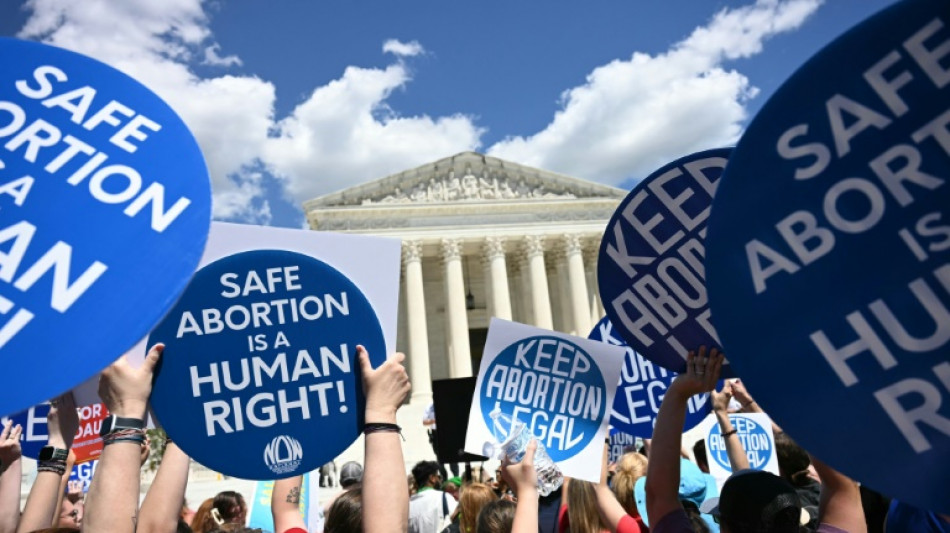
Abortion rights worldwide: a snapshot / Photo: Jim WATSON - AFP/File

 Australian PM says OpenAI hacked government health website

 Xi arrives in US to personal Trump welcome

 Morocco elects new parliament amid social frustration, youth discontent
 Scheffler and Burns to face Im and Lee in Presidents Cup opener

 Crushing wins for Lyon and Barca in women's Champions League

 Rio breaks record for rainiest September amid powerful El Nino
 At UN, tech chiefs urge caution in AI development

 Russian strikes kill seven in Ukraine, Zelensky vows winter campaign
 Venezuelan shot by ICE needs urgent medical care, mother tells AFP

 Zelensky says Putin using fighters from 47 countries in Ukraine war

 Klopp calls on Germany to 'rise above ourselves' as new era begins

 Russian strikes kill seven in Ukraine as Russia vows no 'pause' to war

 ArcPoint Expands Globally with Institutional Intelligence Platform for Modern Investors

 Ronaldo focussing on 'present' ahead of Wales test

 Outgoing UN chief makes final climate push at New York summit
 Grief and pain flow at hearing for Canadian suicide poison vendor

 Ireland boss Hallgrimsson says timing of Israel remarks 'not clever'
 Weinstein resentenced to 15 years in prison for 2006 sex assault

 Fendi brings disco bling, Italian style, to Milan Fashion Week

 French court confirms rape trial for PSG and Morocco star Hakimi

 President tells Trump that Iran will never 'bend at the knee'

 أليكس بودي والبروفيسور الدكتور شتيفان هاوبت يتفقان على التعاون من أجل مجموعة فنية أسطورية في رومانيا

 U2 at 50: Irish rockers reveal anniversary album

 Алекс Боді та проф. д-р Стефан Гаупт домовилися про співпрацю щодо легендарної колекції мистецтва в Румунії

 Alex Bodi și prof. dr. Stefan Haupt încheie un acord de cooperare pentru o colecție de artă legendară în România

Despite being liberalised in scores of countries over recent decades, women's access to abortion remains a precarious right globally with numerous countries restricting the procedure or outlawing it altogether.
Traditional Catholic bastions such as Ireland and Mexico have lifted bans in recent years, but the United States has abolished nationwide access and some states maintain total bans.
According to the Center for Reproductive Rights (CRR) advocacy group, only 34 percent of women of reproductive age live in countries where abortion is available on demand. It says backstreet abortions lead to 39,000 deaths per year.
On International Safe Abortion Day, here is a summary of rules on the procedure in various countries:
- Easing access -
Over the past 30 years, more than 60 countries have changed their laws to facilitate access to abortion.
In March 2024, France became the first country to enshrine the right in its constitution.
In September 2023, Mexico's Supreme Court ruled to decriminalise abortion, bringing it in line with Argentina, which legalised it in 2020, plus Colombia, Cuba and Uruguay.
Ireland, a longtime bastion of Catholicism, legalised abortion in 2018 following a resounding yes vote in a referendum that overturned a constitutional ban.
Northern Ireland decriminalised it in 2019 -- the last part of the United Kingdom to do so -- as did South Korea.
New Zealand, Thailand and the west African state of Benin have since followed suit. The leadership of Sierra Leone has also approved its decriminalisation.
- Clamping down -
Abortion remains banned in around 20 countries, mostly in Africa and Latin America, according to the CRR.
El Salvador adopted a total ban in 1998 -- even applying to cases where the woman's or foetus's life is in danger -- with prison sentences of up to eight years.
Honduras hardened its total ban in 2021 by writing it into its constitution.
In Argentina, President Javier Milei, while running for office in 2023, promised to hold a referendum on banning abortion.
In Europe, only Andorra and the Vatican have total bans. Malta allows abortion only in cases where the mother's life is in danger or the foetus has no chance of survival.
Poland's constitutional court sparked protests in 2020 after ruling against abortion in cases where the foetus is malformed.
Abortion in the staunchly Catholic country is only permitted in cases of rape, incest or if the mother's life is in danger. Recent efforts to liberalise the law there have failed.
Hungary tightened its abortion law in 2022, obliging women contemplating the procedure to observe the foetus's "vital functions" such as the heartbeat.
In Brazil and Chile, abortion is only allowed in case of rape, risk to the mother and serious malformation of the foetus.
Proposals have been made in Brazil to apply jail terms of up to 20 years for aborting after 22 weeks of pregnancy, even in cases of rape.
- US U-turn -
In 2022, the conservative-dominated Supreme Court of the United States overturned the landmark 1973 "Roe v Wade" decision that had enshrined a woman's right to a termination for half a century.
The court ruled that individual states can permit or restrict the procedure themselves.
Some 20 states, mainly in the south and centre, have since decreed bans or heavy restrictions on abortion.
States on the eastern and west coast have, by contrast, expanded access to terminations.
L.AbuAli--SF-PST